


ASTM D3124 Vinylidene Unsaturation Testing in Polyethylene by IR
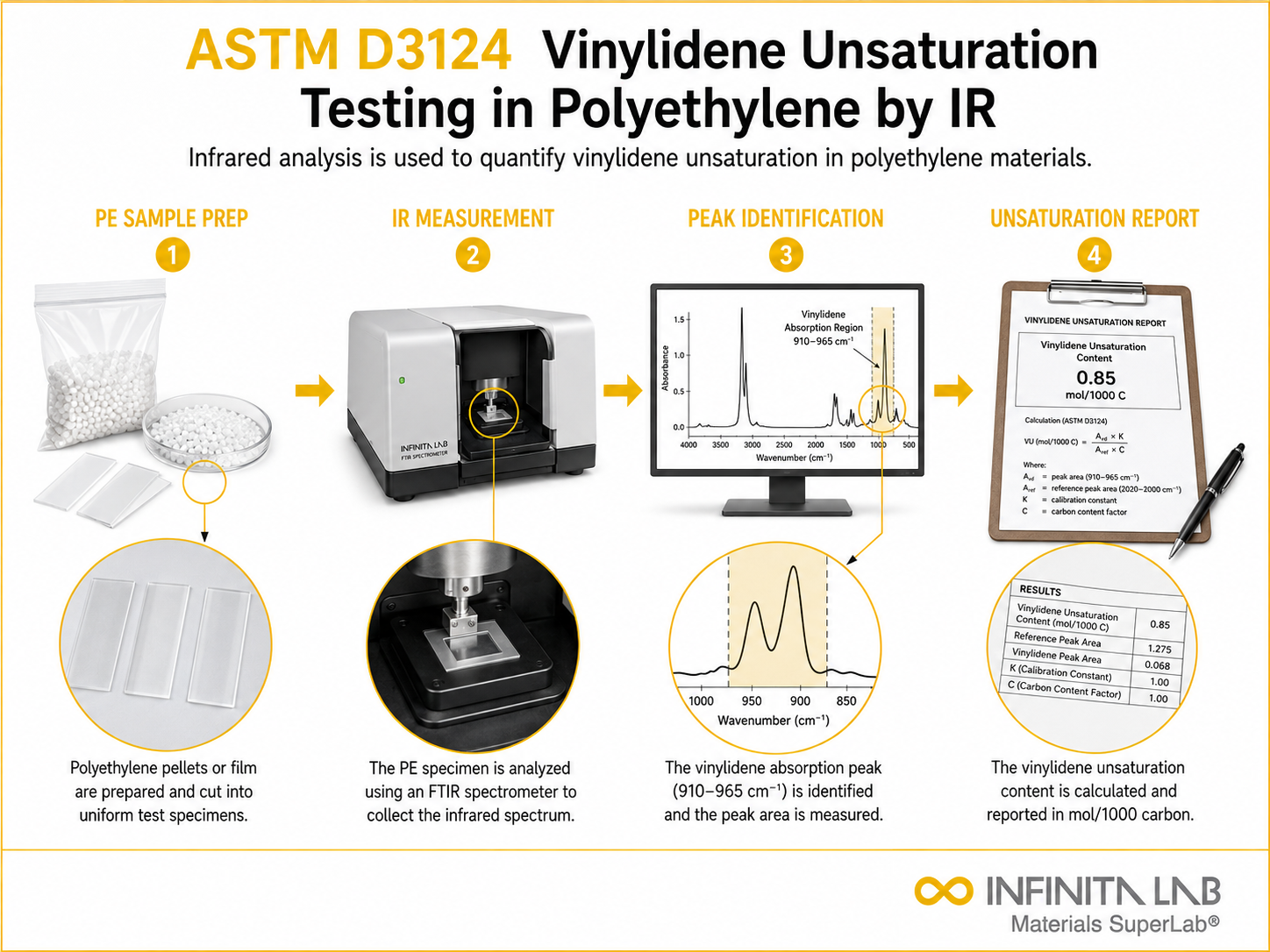
ASTM D3124 test method covers every sort of polyethylene such as ethylene plastics, α-olefin copolymers that are longer than propylene, and the mixture of these in any ratio. It determines the effect of unsaturation of vinylidene by using reagents like bromine, carbon disulfide, and 2, 3-dimethyl-1,3-butadiene. The final results of the test method are expressed in SI units.
TRUSTED BY


Precision-driven testing for dimensional accuracy and compliance
- Overview
- Scope, Applications, and Benefits
- Test Process
- Specifications
- Instrumentation
- Results and Deliverables
Overview
ASTM D3124 defines a standardised infrared spectrophotometric method for determining the concentration of vinylidene unsaturation (=CH₂ end groups) in polyethylene. Vinylidene groups are a type of unsaturation that arises during polymerisation and thermal processing, and their concentration is an indicator of branching structure, molecular weight distribution, and thermal history of the polyethylene resin.
The test uses infrared spectroscopy to measure the absorption band characteristic of vinylidene groups, typically at approximately 888 cm⁻¹. The absorbance is compared to a calibration standard, and the vinylidene content is expressed as the number of vinylidene groups per 1,000 carbon atoms. This data is used in quality control of polyethylene resin production and in the characterisation of resin grades for specific processing applications.

Scope, Applications, and Benefits
Scope
ASTM D3124 evaluates:
- Vinylidene unsaturation concentration in polyethylene
- Number of vinylidene groups per 1,000 carbon atoms
- Infrared absorption at the characteristic vinylidene band
- Effect of polymerization conditions on vinylidene content
- Thermal processing effects on unsaturation level
- Batch-to-batch consistency of PE resin production
Applications
- Polyethylene resin quality control
- HDPE, LDPE, and LLDPE characterisation
- Resin grade differentiation
- Catalyst and process development for PE production
- Recycled polyethylene characterization
- Research and development in polyolefin chemistry
- Regulatory compliance in food contact PE materials
Benefits
- Provides a sensitive measure of PE molecular structure
- Enables resin grade verification and quality control
- Detects processing-induced degradation
- Supports polymerisation process optimisation
- Provides data for structure-property relationship studies
- Enables monitoring of resin aging and oxidation
Test Process
Film Preparation
Polyethylene is pressed into a thin film of controlled thickness for infrared transmission measurement.
1Baseline Correction
Infrared spectrum is acquired and baseline-corrected at the vinylidene absorption band (~888 cm⁻¹).
2Absorbance Measurement
Peak absorbance at the vinylidene band is measured and normalized to film thickness.
3Calculation
Vinylidene content is calculated using the calibration factor and reported per 1,000 carbons.
4Technical Specifications
| Parameter | Details |
|---|---|
| Applicable Materials | Polyethylene (PE), PE copolymers, and blends |
| Specimen Types | Polymer film, sheet, or molded sample for IR analysis |
| Analytical Group | Pendent methylene (RR′C = CH₂) |
| Output Units | Unsaturation content (per 1000 carbon atoms or absorbance ratio) |
| Test Environment | Controlled laboratory ambient conditions |


- FTIR spectrometer or dispersive infrared spectrophotometer
- Hydraulic hot press for film preparation
- Film thickness gauge/micrometre
- Calibration standards
- Data processing and peak integration software
- Desiccator for specimen storage
Instrumentation Used for Testing
Results and Deliverables
- Vinylidene content (groups per 1,000 carbons)
- Infrared spectrum with identified absorption bands
- Calibration curve and factor
- Batch comparison data
- Quality assurance reports
Frequently Asked Question
It measures the vinylidene unsaturation present in polyethylene using infrared spectrophotometry.
It helps assess polymer structure, branching characteristics, and resin quality, especially in low-density polyethylene.
The method is suitable for all types of polyethylene, copolymers, and blends.
A Fourier Transform Infrared (FTIR) or standard IR spectrophotometer is typically used.
It is widely used in polymer manufacturing, quality control, and material characterization laboratories.
Why Choose Infinita Lab for Advanced Materials Testing and Characterization?
At the core of this breadth is our network of 2,000+ accredited laboratories across the USA, offering access to over 10,000 testing methods and analytical services. From advanced materials characterization (SEM, TEM, RBS, XPS) to mechanical, chemical, environmental, biological, and standardized ASTM/ISO-compliant testing, we deliver unmatched flexibility, specialization, and scale. You are never limited by geography, facility, or methodology — Infinita Lab connects you to the right expertise and testing solution, every time.

Looking for a Trusted Partner for Accurate and Reliable Testing Services?
Send query us at hello@infinitalab.com or call us at (888) 878-3090 to learn more about our services and how we can support you.



Request a Quote
Submit your material details and receive testing procedures, pricing, and turnaround time within 24 hours.
 Quick Turnaround and Hasslefree process
 Confidentiality Guarantee
 Free, No-obligation Consultation
 100% Customer Satisfaction
