


ASTM D2238: Polyethylene Absorbance IR Testing Services
The 1378.4-cm-1 (7.255-m) infrared absorption band associated with the methyl groups in the material is specifically targeted for measurement by ASTM D 2238 Standard Test Methods T, which is intended for the quantitative analysis of polyethene. To properly measure the presence and concentration of methyl groups in polyethene samples, this analytical method uses infrared spectrophotometry.
TRUSTED BY


Get ASTM D2238 compliant results — request your polyethylene absorbance IR testing quote
- Overview
- Scope, Applications, and Benefits
- Test Process
- Specifications
- Instrumentation
- Results and Deliverables
What Is ASTM D2238 Polyethylene Absorbance IR?
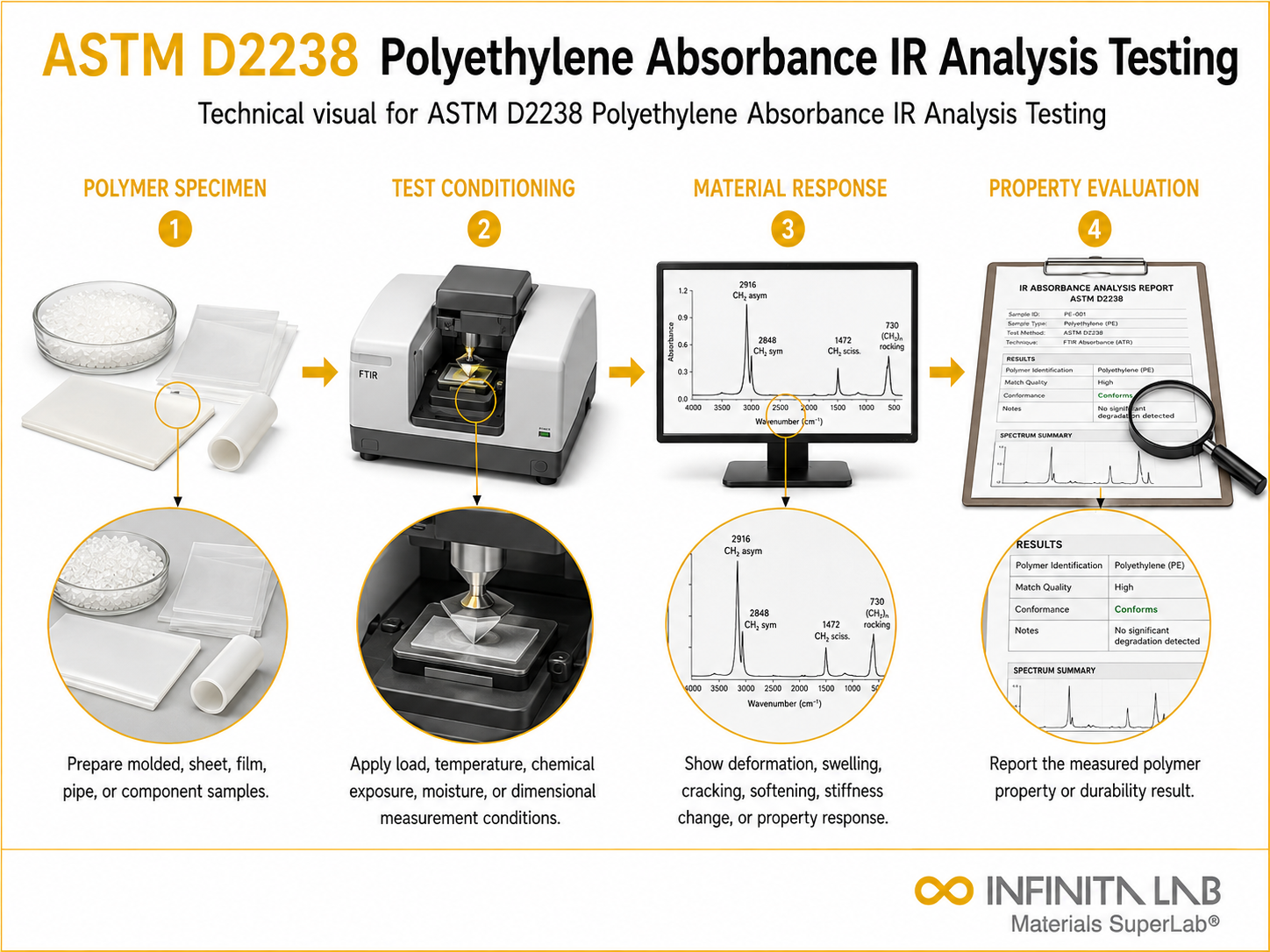
ASTM D2238 determines the absorbance characteristics of polyethylene materials using infrared spectroscopy. The test evaluates molecular structure, oxidation level, and the presence of functional groups that influence material performance.
This method is widely used in polymer manufacturing and quality control. It helps assess material composition, degradation, and consistency for applications in packaging, cables, and industrial products.

Applications and Benefits of ASTM D2238 Polyethylene Absorbance IR Testing
Scope
ASTM D2238 evaluates polyethylene by measuring infrared absorbance at specific wavelengths. The test provides insight into chemical structure and oxidation behavior.
The test evaluates:
- Infrared absorbance characteristics of polyethylene
- Presence of oxidation or degradation products
- Molecular structure and functional groups
- Material consistency and uniformity
- Suitability for processing and applications
Applications
- Polyethylene films and sheets
- Wire and cable insulation materials
- Packaging and industrial plastics
- Polymer research and development
- Quality control in PE production
- Material degradation studies
Benefits
- Provides detailed chemical characterization
- Detects oxidation and material degradation
- Supports material quality and consistency
- Assists in formulation and process control
- Enables comparison of polyethylene grades
Our ASTM D2238 Testing Procedure
Sample Preparation
Polyethylene samples are prepared as thin films or pellets.
1Instrument Setup
Samples are placed in an infrared spectrometer.
2Spectral Measurement
IR radiation is passed through the sample to measure absorbance.
3Data Recording & Evaluation
Absorbance peaks are analyzed to determine material properties.
4ASTM D2238 Test Parameters and Requirements
| Parameter | Details |
|---|---|
| Applicable Materials | Polyethylene (PE) |
| Measurement Method | FTIR spectroscopy |
| Wavelength Range | ~4000 cm⁻¹ to 400 cm⁻¹ |
| Sample Thickness | ~0.01 mm to 1 mm |
| Measurement Accuracy | ±1% |
| Measured Outputs | Absorbance spectrum, oxidation indices |


- FTIR spectrometer
- Sample holder or film preparation tools
- Calibration standards
- Optical measurement system
- Data acquisition software
- Sample preparation equipment
Equipment and Instrumentation Used for ASTM D2238 Testing
What You Receive: Test Report, Data, and Certification
- Infrared absorbance spectrum
- Oxidation and degradation analysis
- Chemical structure evaluation
- Comparative material assessment
- Test condition summary
- ASTM compliance report
ASTM D2238 Polyethylene Absorbance IR FAQs
ASTM D2238 measures infrared absorbance of polyethylene materials. It evaluates chemical structure and presence of functional groups, helping assess material composition, oxidation levels, and quality consistency in polyethylene products.
Key parameters include wavelength range, sample thickness, instrument calibration, and baseline correction. Proper sample preparation ensures accurate infrared absorbance measurement and reliable analysis.
The test measures absorbance peaks corresponding to specific chemical bonds. Results indicate presence of oxidation, additives, or structural variations in polyethylene materials.
ASTM D2238 applies to polyethylene materials such as films, sheets, and molded products used in packaging, construction, and industrial applications.
ASTM D2238 depends on proper sample preparation and instrument calibration. Overlapping peaks or impurities may affect interpretation, and additional analytical methods may be required for detailed chemical characterization.
Why Choose Infinita Lab for Polyethylene Absorbance IR Testing?
At the core of this breadth is our network of 2,000+ accredited laboratories across the USA, offering access to over 10,000 testing methods and analytical services. From advanced materials characterization (SEM, TEM, RBS, XPS) to mechanical, chemical, environmental, biological, and standardized ASTM/ISO-compliant testing, we deliver unmatched flexibility, specialization, and scale. You are never limited by geography, facility, or methodology — Infinita Lab connects you to the right expertise and testing solution, every time.

Looking for an Accredited Partner for ASTM D2238 Polyethylene Absorbance IR Testing?
Send query us at hello@infinitalab.com or call us at (888) 878-3090 to learn more about our services and how we can support you.



Request a Quote
Submit your material details and receive testing procedures, pricing, and turnaround time within 24 hours.
 Quick Turnaround and Hasslefree process
 Confidentiality Guarantee
 Free, No-obligation Consultation
 100% Customer Satisfaction
