


ASTM D2007: Petroleum Oil Clay Gel Chromatography Testing Services
ASTM D2007 test method specifies a protocol for classifying oil samples with an initial boiling point of at least 260 °C into the hydrocarbon types polar compounds, aromatics, and saturates, as well as recovering representative fractions of these types. This classification is used to specify rubber extenders and processing oils.
TRUSTED BY


Get ASTM D2007 compliant results — request your petroleum oil clay gel chromatography testing quote
- Overview
- Scope, Applications, and Benefits
- Test Process
- Specifications
- Instrumentation
- Results and Deliverables
What Is ASTM D2007 Petroleum Oil Clay Gel Chromatography?
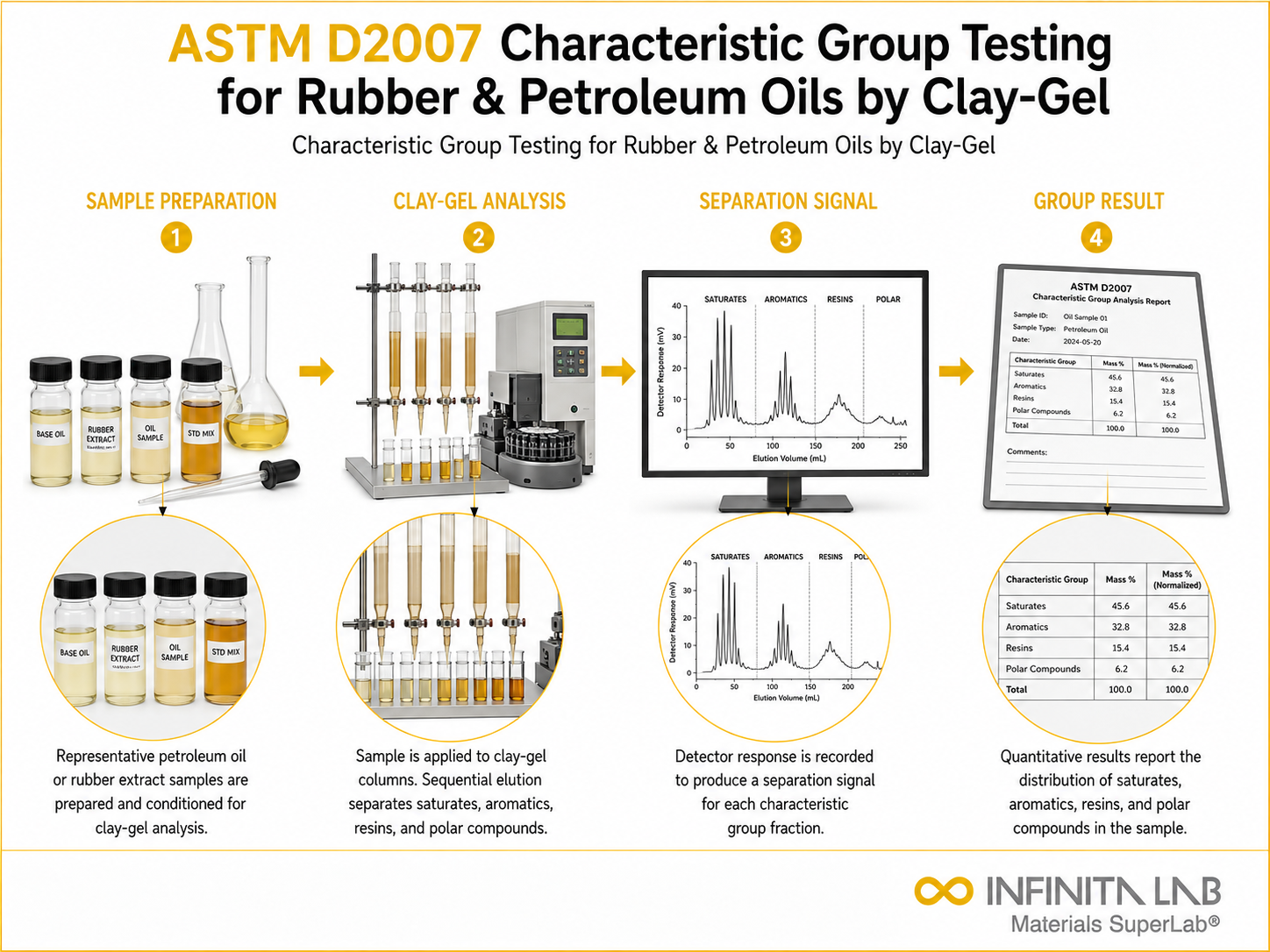
ASTM D2007 describes a standardised method for identifying and quantifying characteristic chemical groups in rubber extender and processing oils, as well as other petroleum-derived oils. The method uses adsorption chromatography on clay and silica gel to separate the oil into three fractions: saturates, aromatics, and polar compounds (resins).
The relative proportions of these fractions directly influence the compatibility of the oil with rubber compounds, its plasticising efficiency, and its effect on the aging behaviour of the final rubber product. ASTM D2007 is an essential tool for rubber compounders who need to verify oil type and quality before use in production.

Applications and Benefits of ASTM D2007 Petroleum Oil Clay Gel Chromatography Testing
Scope
ASTM D2007 is a standard test method used to classify rubber extender oils, processing oils, and other petroleum-derived oils into three major hydrocarbon groups:
- Saturates
- Aromatics
- Polar compounds
The test is performed using the clay-gel absorption chromatographic method and is widely used for quality control, product specification, and research in rubber compounding applications. It applies to oils with an initial boiling point of at least 260°C (500°F).
Applications
- Rubber compounding and formulation
- Tire manufacturing
- Industrial rubber products
- Petroleum refinery quality control
- Oil blending operations
- Raw material incoming inspection
- Research and development in polymer science
Benefits
- Verifies oil composition for rubber compatibility
- Predicts plasticizing performance in compounds
- Supports formulation optimization
- Detects oil adulteration or substitution
- Ensures compliance with compound specifications
- Enables informed supplier qualification
Our ASTM D2007 Testing Procedure
Sample Preparation
Oil sample is weighed and prepared for chromatographic separation.
1Adsorption Chromatography
Sample is passed through clay and silica gel columns to separate fractions.
2Fraction Recovery
Each fraction (saturates, aromatics, polars) is eluted, collected, and weighed.
3Calculation
Weight percentages of each group are calculated relative to total sample weight.
4ASTM D2007 Test Parameters and Requirements
| Parameter | Details |
|---|---|
| Test Principle | Adsorption chromatography separation |
| Measured Groups | Saturates, Aromatics, Polar Compounds |
| Sample Type | Processing / Extender Oils |
| Boiling Point | ≥ 260°C |
| Reporting Unit | wt.% |


- Adsorption chromatography columns
- Silica gel and activated clay adsorbents
- Analytical balance
- Rotary evaporator or solvent recovery system
- Appropriate solvents (pentane, toluene, methanol)
- Data recording equipment
Equipment and Instrumentation Used for ASTM D2007 Testing
What You Receive: Test Report, Data, and Certification
- Saturate, aromatic, and polar fraction percentages
- Total mass balance and recovery data
- Oil composition classification
- Compliance documentation
- Quality assurance reports
- Comparative analysis against reference oil specifications
ASTM D2007 Petroleum Oil Clay Gel Chromatography FAQs
It measures the percentage of saturates, aromatics, and polar compounds present in rubber processing and extender oils.
The chemical composition of processing oil significantly affects rubber hardness, flexibility, compatibility, aging, and performance.
It is commonly used in the rubber, tire, automotive, polymer, and petrochemical industries.
The method is suitable for petroleum-derived oils with an initial boiling point above 260°C.
It is not directly applicable to oils containing more than 0.1% pentane insoluble unless those materials are removed first.
Why Choose Infinita Lab for Petroleum Oil Clay Gel Chromatography Testing
At the core of this breadth is our network of 2,000+ accredited laboratories across the USA, offering access to over 10,000 testing methods and analytical services. From advanced materials characterization (SEM, TEM, RBS, XPS) to mechanical, chemical, environmental, biological, and standardized ASTM/ISO-compliant testing, we deliver unmatched flexibility, specialization, and scale. You are never limited by geography, facility, or methodology — Infinita Lab connects you to the right expertise and testing solution, every time.

Need ASTM D2007 Petroleum Oil Clay Gel Chromatography Testing You Can Rely On?
Send query us at hello@infinitalab.com or call us at (888) 878-3090 to learn more about our services and how we can support you.



Request a Quote
Submit your material details and receive testing procedures, pricing, and turnaround time within 24 hours.
 Quick Turnaround and Hasslefree process
 Confidentiality Guarantee
 Free, No-obligation Consultation
 100% Customer Satisfaction
