


ASTM C912 Cleaning Process Design & Validation for Technical Glasses
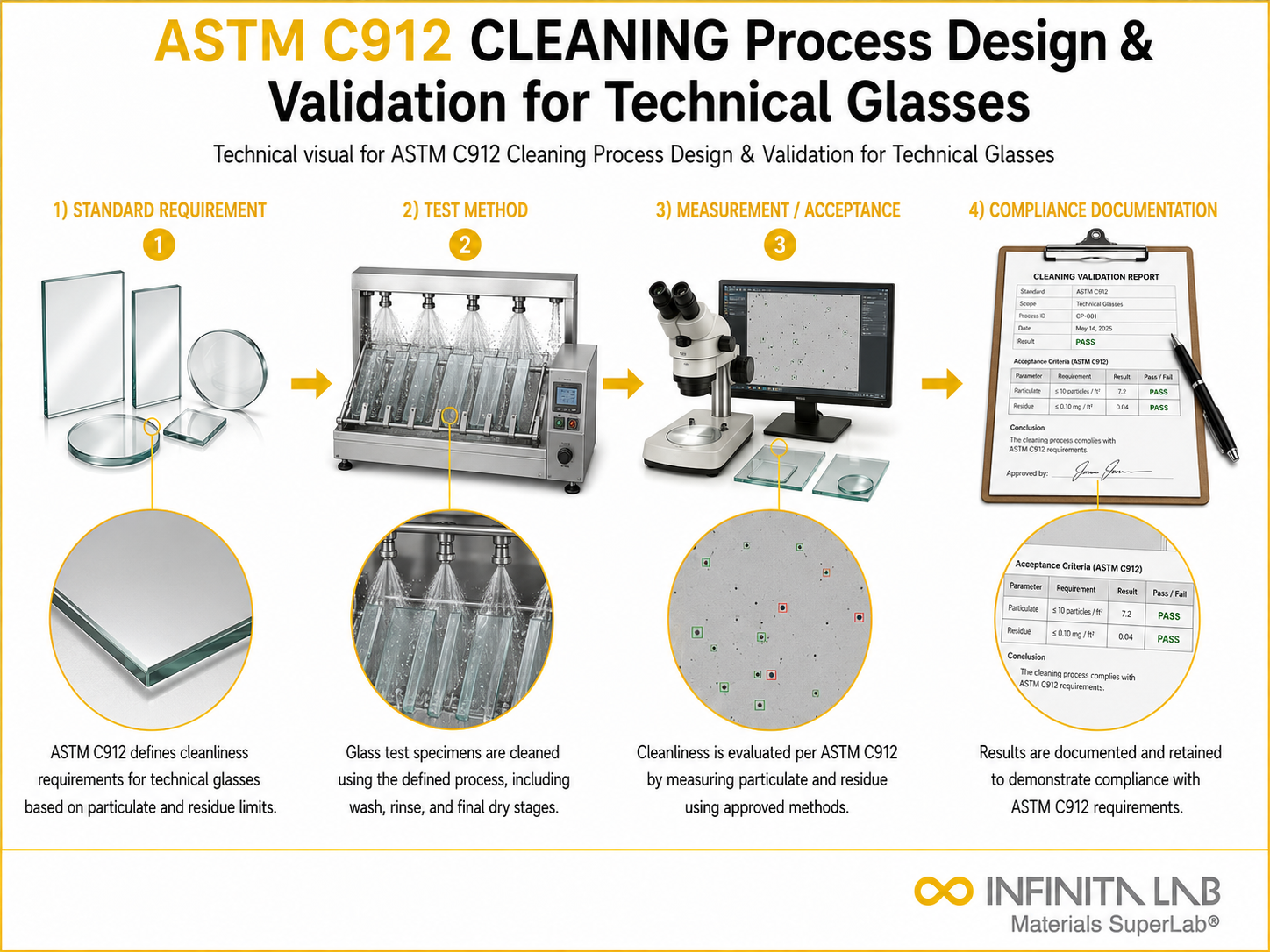
ASTM C912 is used to design rational cleaning procedures for technical glasses, glasses that are used in optical ware, glass-to-metal seals, glass fibers, infrared transmitting products, and products resistant to metallic vapors. This practice is for technical glass that contains high concentrations of oxides that react with certain aqueous chemicals.
TRUSTED BY


Precision-driven testing for dimensional accuracy and compliance
- Overview
- Scope, Applications, and Benefits
- Test Process
- Specifications
- Instrumentation
- Results and Deliverables
Overview
ASTM C912 provides guidance for designing an effective and controlled process for cleaning technical glasses used in high-performance applications. Cleanliness is critical because even microscopic contaminants can affect optical clarity, adhesion, and overall functionality of glass components.
This standard helps establish systematic cleaning procedures tailored to specific glass types and contamination levels. It ensures repeatability, reliability, and compatibility with downstream processes such as coating, bonding, or assembly, making it essential for precision-driven industries.

Scope, Applications, and Benefits
Scope
ASTM C912 outlines practices for developing and validating cleaning processes for technical glass surfaces, ensuring removal of contaminants without damaging the material.
- Covers process design for cleaning technical glass surfaces
- Addresses removal of organic, inorganic, and particulate contaminants
- Includes selection of cleaning agents and methods
- Focuses on maintaining surface integrity and performance
- Applicable to laboratory and industrial environments
Applications
- Cleaning of optical glass components
- Preparation of glass for coating or bonding
- Semiconductor and electronics glass processing
- Laboratory and analytical glass cleaning
- Precision glass manufacturing processes
Benefits
- Ensures high surface cleanliness and quality
- Improves adhesion for coatings and films
- Reduces contamination-related defects
- Enhances consistency and repeatability
- Supports optimized process design and control
Test Process
Contamination Assessment
Identify type and level of contaminants present on the glass surface before cleaning.
1Method Selection
Choose appropriate cleaning techniques and agents based on glass type and contamination characteristics.
2Cleaning Execution
Apply selected cleaning process under controlled conditions to remove contaminants effectively.
3Verification and Validation
Evaluate cleanliness and validate process effectiveness using inspection or analytical methods.
4Technical Specifications
| Parameter | Details |
|---|---|
| Material Type | Technical and optical glass |
| Objective | Removal of contaminants without surface damage |
| Contaminant Types | Organic, inorganic, and particulates |
| Process Type | Chemical, mechanical, or combined cleaning |
| Evaluation Method | Visual or analytical inspection |
| Environment | Controlled laboratory or production setting |
| Compatibility | Suitable for pre-coating or bonding preparation |
| Repeatability | Designed for consistent process outcomes |


- Ultrasonic cleaner
- Analytical balance
- Optical microscope
- Surface inspection tools
- Cleanroom equipment
- Chemical handling setup
- Drying oven
Instrumentation Used for Testing
Results and Deliverables
- Documented cleaning process design
- Cleanliness verification report
- Observations on surface condition
- Validation of cleaning effectiveness
- Recommendations for process optimization
Frequently Asked Question
ASTM C912 provides guidelines for designing effective cleaning processes for technical glasses. It helps ensure removal of contaminants while maintaining surface integrity, supporting high-quality performance in applications such as optics, electronics, and advanced manufacturing processes.
Cleaning is critical because contaminants can affect optical clarity, adhesion, and performance. Proper cleaning ensures that glass surfaces meet required specifications, especially in applications involving coatings, bonding, or precision optical functions.
Parameters such as temperature, cleaning time, chemical concentration, and mechanical action are critical for achieving effective and consistent cleaning results.
Drying removes moisture after cleaning and rinsing, preventing water spots or residue formation that could compromise surface quality and performance.
Cleaning processes should be validated during initial setup and periodically reviewed to ensure consistent performance, especially when materials, contaminants, or process conditions change.
Why Choose Infinita Lab for Advanced Materials Testing and Characterization?
At the core of this breadth is our network of 2,000+ accredited laboratories across the USA, offering access to over 10,000 testing methods and analytical services. From advanced materials characterization (SEM, TEM, RBS, XPS) to mechanical, chemical, environmental, biological, and standardized ASTM/ISO-compliant testing, we deliver unmatched flexibility, specialization, and scale. You are never limited by geography, facility, or methodology — Infinita Lab connects you to the right expertise and testing solution, every time.

Looking for a Trusted Partner for Accurate and Reliable Testing Services?
Send query us at hello@infinitalab.com or call us at (888) 878-3090 to learn more about our services and how we can support you.



Request a Quote
Submit your material details and receive testing procedures, pricing, and turnaround time within 24 hours.
 Quick Turnaround and Hasslefree process
 Confidentiality Guarantee
 Free, No-obligation Consultation
 100% Customer Satisfaction
