


Microstructural Metallographic Analysis Metals Testing Services
Metallography and microstructure analysis are techniques to study the microstructural characteristics of metallic materials. Sample preparation and microscopy allow observation of features like grain structure, phases, and defects, providing valuable insights into material properties, manufacturing processes, and failure analysis in diverse industries such as manufacturing, automotive, and aerospace.
TRUSTED BY


Get compliant results — request your microstructural metallographic analysis metals testing quote
- Overview
- Scope, Applications, and Benefits
- Test Process
- Specifications
- Instrumentation
- Results and Deliverables
What Is Microstructural Metallographic Analysis Metals?
Microstructural and metallographic analysis is used to examine the internal structure of metallic materials by preparing and observing polished and etched specimens under microscopes. It reveals grain size, phase distribution, inclusions, and defects that directly influence mechanical properties and material performance.
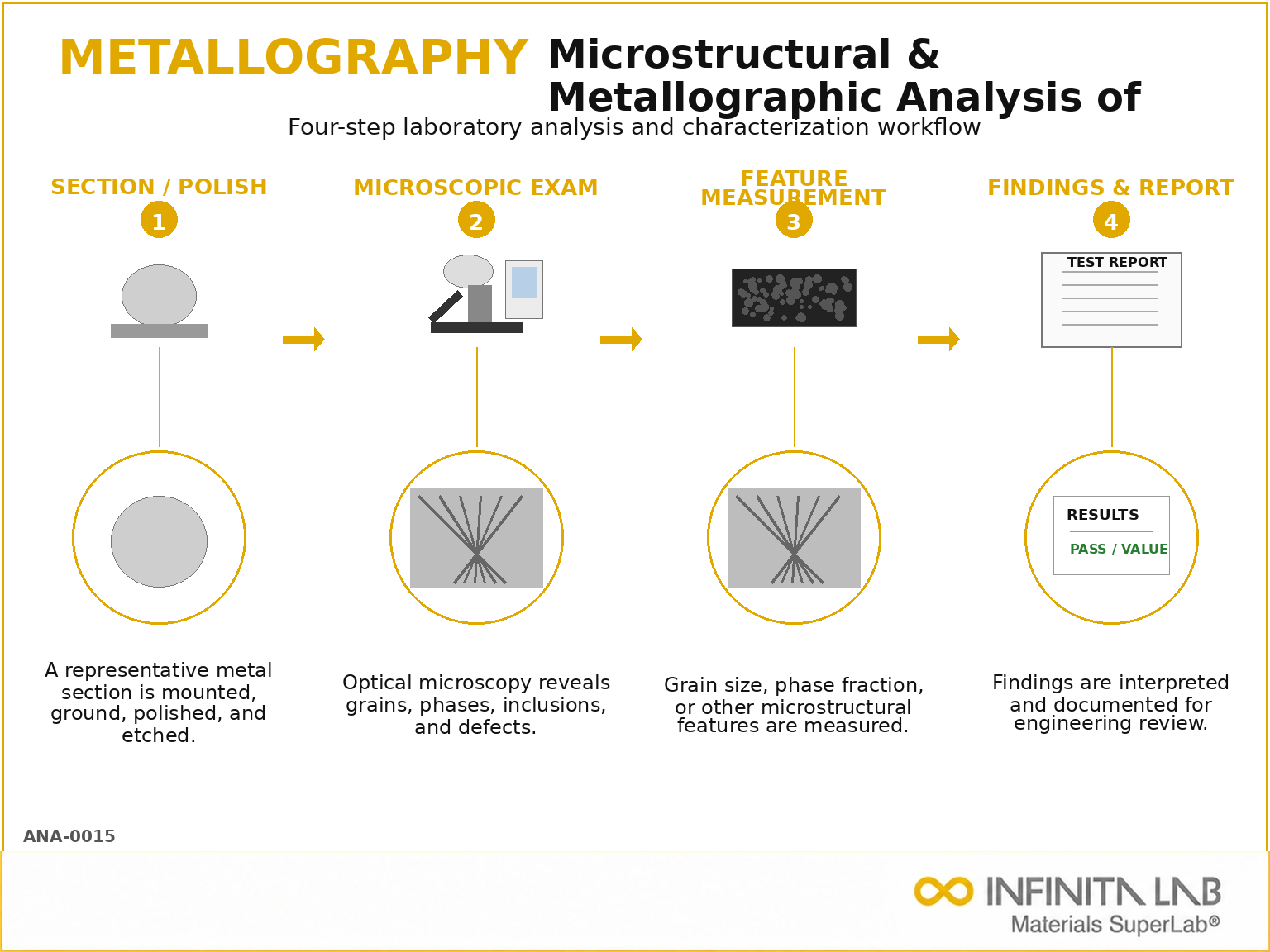
This analysis involves sectioning, mounting, polishing, and chemical etching to make microstructural features visible. Advanced optical and electron microscopy techniques provide high-resolution imaging, enabling detailed evaluation of processing effects, heat treatment outcomes, and failure mechanisms in metallic materials.

Applications and Benefits of Microstructural Metallographic Analysis Metals Testing
Scope
Microstructural and metallographic analysis focuses on characterizing the internal structure of metals to evaluate quality, processing effects, and material integrity under controlled preparation and observation conditions.
- Examination of grain structure and size
- Identification of phases and microconstituents
- Detection of inclusions and micro-defects
- Evaluation of heat treatment effects
- Analysis of deformation and failure features
Applications
- Quality control of metallic materials
- Failure analysis and root cause investigation
- Heat treatment verification
- Welding and joint evaluation
- Research and development of alloys
- Process optimization and validation
Benefits
- Provides detailed insight into material structure
- Helps correlate microstructure with mechanical properties
- Detects defects not visible externally
- Supports failure analysis and prevention
- Improves process control and material performance
- Enables informed material selection decisions
Our Testing Procedure
Sample Sectioning & Mounting
The material is carefully cut and mounted to preserve structure and enable controlled handling.
1Grinding & Polishing
The sample surface is progressively ground and polished to achieve a smooth, scratch-free mirror finish.
2Etching Treatment
Chemical etchants are applied to reveal grain boundaries and microstructural features clearly.
3Microscopic Examination
The prepared sample is analyzed using optical or electron microscopy for detailed structural evaluation.
4Test parameters and requirements
| Parameter | Details |
|---|---|
| Sample Type | Metallic specimens including alloys, welds, and heat-treated components |
| Preparation Method | Sectioning, mounting, grinding, polishing, and chemical etching |
| Magnification Range | Typically 50× to 1000× (optical), higher for electron microscopy |
| Imaging Technique | Optical microscopy and scanning electron microscopy (SEM) |
| Resolution | Micron to sub-micron level depending on instrument used |
| Sample Size | Small cross-sections or representative material segments |


- Metallurgical microscope
- Scanning electron microscope (SEM)
- Sample cutting machine
- Mounting press
- Grinding and polishing machine
- Etching chemicals and kits
- Image analysis software
Equipment and Instrumentation Used for Testing
What You Receive: Test Report, Data, and Certification
- Microstructure images with magnification details
- Grain size measurement and phase identification
- Detection of inclusions and defects
- Metallographic evaluation report
- Interpretation of processing and material condition
- Recommendations for quality improvement
Microstructural Metallographic Analysis Metals FAQs
It examines the internal structure of metals to understand grain size, phases, and defects. This is essential because microstructure directly controls mechanical properties, performance, and failure behavior, making it critical for quality assurance and material evaluation.
Grain size, phase distribution, and defects affect strength, toughness, and ductility. Fine grains generally improve strength, while certain phases may enhance hardness or reduce toughness, depending on material composition and processing.
SEM provides higher magnification and resolution than optical microscopy, enabling detailed examination of fine features, fracture surfaces, and microstructural details not visible at lower magnifications.
It links material structure to performance, enabling engineers to predict behavior, prevent failures, and design materials with desired mechanical properties and reliability.
It identifies structural anomalies, crack origins, and degradation patterns, enabling determination of failure causes and supporting corrective actions.
Why Choose Infinita Lab for Microstructural Metallographic Analysis Metals Testing
At the core of this breadth is our network of 2,000+ accredited laboratories across the USA, offering access to over 10,000 testing methods and analytical services. From advanced materials characterization (SEM, TEM, RBS, XPS) to mechanical, chemical, environmental, biological, and standardized ASTM/ISO-compliant testing, we deliver unmatched flexibility, specialization, and scale. You are never limited by geography, facility, or methodology — Infinita Lab connects you to the right expertise and testing solution, every time.

Looking for an Accredited Partner for Microstructural Metallographic Analysis Metals Testing?
Send query us at hello@infinitalab.com or call us at (888) 878-3090 to learn more about our services and how we can support you.



Request a Quote
Submit your material details and receive testing procedures, pricing, and turnaround time within 24 hours.
 Quick Turnaround and Hasslefree process
 Confidentiality Guarantee
 Free, No-obligation Consultation
 100% Customer Satisfaction
