


ASTM C738: Glazed Ceramic Lead Cadmium Extraction Testing Services
Accredited ASTM C738 glazed ceramic lead cadmium extraction testing from Infinita Lab, performed to the exact standard requirements - accurate, reproducible results with full documentation for compliance, R&D, and quality control programs.
TRUSTED BY


Get ASTM C738 compliant results - request your glazed ceramic lead cadmium extraction testing quote
- Overview
- Scope, Applications, and Benefits
- Test Process
- Specifications
- Instrumentation
- Results and Deliverables
What Is ASTM C738 Glazed Ceramic Lead Cadmium Extraction?
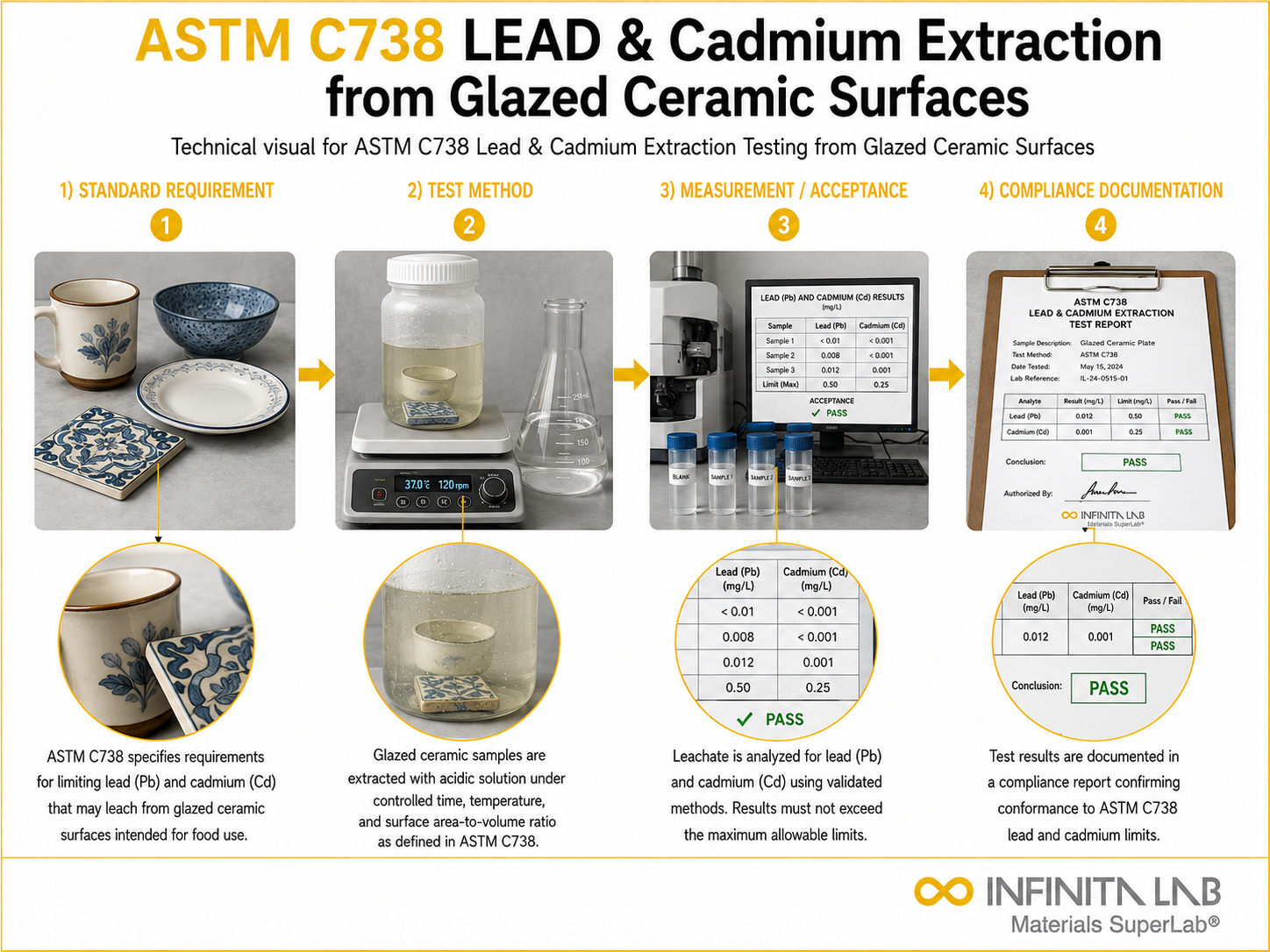
ASTM C738, Standard Test Method for Lead and Cadmium Extracted from Glazed Ceramic Surfaces, covers the precise determination of lead and cadmium extracted by acetic acid from glazed ceramic surfaces. Subcommittee C21.03 developed the method, and it’s published in Volume 15.02 of the Book of ASTM Standards. It’s currently active as ASTM C738-94(2025), the latest reapproval of the original 1994 edition. The standard is deliberately framed as a severe test. Acetic acid extraction is intended to accelerate the release of metals from the glaze, producing results unlikely to be matched under the actual conditions of use. In practice, a glazed article (or the food-contact surface of one) sits in an acetic acid leaching solution for a fixed period under ambient conditions, and the resulting extract is analyzed for dissolved lead and cadmium. Quantitation is by atomic absorption spectrometry using lead and cadmium lamps. The method also calls for chemically resistant borosilicate glassware, so the vessels neither contribute nor retain metals. The method also addresses measurement procedures, precision, and bias; SI units are standard, and safety and health practices are left to the user. Extraction happens on the glazed surface rather than on the bulk ceramic body. So the result describes what the glaze itself can release, reported as a concentration in the leachate. ASTM C738 does not set pass/fail limits. Those come from regulators and related frameworks. The FDA Compliance Policy Guide Sec. 545.450 cites ASTM C738 as an examination method. It sets lead action levels by product category, while ISO 6486 and its permissible-limits companion take a comparable acid-extraction approach with their own criteria. The method is the analytical engine behind compliance decisions, not the decision rule.

Applications and Benefits of ASTM C738 Glazed Ceramic Lead Cadmium Extraction Testing
Scope
ASTM C738 evaluates the leaching behavior of lead and cadmium from glazed ceramic surfaces by exposing them to an acidic solution. The test measures the concentration of extracted metals.
The test evaluates:
- ASTM C738 covers the precise determination of lead and cadmium extracted by acetic acid from glazed ceramic surfaces.
- Intentionally a severe test: the extraction is designed to accelerate metal release from the glaze beyond what normal use would produce.
- Because the method is written for glazed ware, what gets measured is what the glaze surface releases into the leaching solution.
- Atomic absorption spectrometry fitted with lead and cadmium lamps handles quantitation.
- Chemically resistant borosilicate glassware is specified to prevent contamination or loss of the target metals.
- The document addresses measurement procedures, precision, and bias.
- SI units are the standard. The user is responsible for establishing appropriate safety, health, and environmental practices.
- ASTM C738-94(2025) is the current active designation; earlier reapprovals such as 2011, 2016, and 2020 are now historical revisions.
- It reports extracted metal and doesn’t itself define acceptance limits, which are set by regulations and customer specifications.
- For the examination of ceramicware for lead leaching, FDA Compliance Policy Guide Sec. 545.450 references ASTM C738.
Applications
- Screening glazed tableware, such as plates, bowls, cups, and mugs, for lead and cadmium release.
- Hollowware like pitchers, teapots, and serving vessels can be evaluated against regulatory lead action levels.
- FDA import and domestic compliance programs for pottery and ceramic foodware.
- Qualifying new glaze formulations, plus firing schedules and decorative overglaze or enamel treatments.
- Supplier qualification and incoming-lot verification for importers and retailers.
- Data to support California Proposition 65 and other jurisdictional compliance reviews.
- Investigating complaints or recalls that involve suspected metal leaching from glazed ware.
Benefits
- A severe, accelerated measurement that provides a conservative view of glaze stability.
- It’s a recognized, citable method, and regulators such as the FDA reference it by name.
- Well-established atomic absorption instrumentation, which qualified laboratories already operate.
- Quantitative lead and cadmium results that can be compared against any applicable limit.
- It helps manufacturers catch glaze or firing problems before products reach the market.
- Supply chains and regulatory submissions both get support from documented due diligence.
Our ASTM C738 Testing Procedure
Sample Preparation
Glazed ceramic specimens are cleaned and prepared.
1Acid Extraction
Samples are exposed to a controlled acidic solution (e.g., acetic acid).
2Exposure Period
Specimens are maintained under specified time and temperature conditions.
3Data Recording & Evaluation
Extracted solution is analyzed for lead and cadmium content.
4ASTM C738 Test Parameters and Requirements
| Parameter | Details |
|---|---|
| Applicable Materials | Glazed ceramic surfaces |
| Extraction Solution | ~4% acetic acid |
| Test Temperature | ~20°C to 25°C |
| Exposure Time | ~24 hours |
| Detection Limit | ~0.1 mg/L |
| Measured Outputs | Lead and cadmium concentration (mg/L) |


- Atomic Absorption Spectrometer – quantifies lead and cadmium in the acetic acid leachate.
- Lead and Cadmium Hollow Cathode Lamps – the element-specific light source for each analyte.
- Borosilicate Glassware – chemically resistant vessels and containers that hold the leaching solution without adding or retaining metals.
- Analytical Balance and Volumetric Equipment – for accurate preparation of reagents, standards, and dilutions.
- Calibration Standards and Reagent Blanks – these establish the calibration curve and confirm that reagents and labware are free of contamination.
- Graphite Furnace Accessory (where the lab’s validated method uses it) – extends sensitivity for low-level leachate measurements.
Equipment and Instrumentation Used for ASTM C738 Testing
What You Receive: Test Report, Data, and Certification
- Lead and cadmium concentrations in the leachate for each tested specimen.
- Identification of the standard and edition used, including ASTM C738-94(2025), where applicable.
- A sample description covering product type, glaze or decoration, and the surface tested.
- Method blank and calibration results that support the validity of the run.
- On request, a comparison to the regulatory or customer limit, such as FDA lead action levels by product category.
- A formal laboratory report suitable for compliance files, audits, and supplier records.
ASTM C738 Glazed Ceramic Lead Cadmium Extraction FAQs
ASTM C738 measures the amount of lead and cadmium extracted from glazed ceramic surfaces. It evaluates potential leaching into food or liquids, ensuring safety of ceramic products used in food contact applications.
Key parameters include extraction solution type, exposure time, temperature, and surface area of the specimen. Controlled conditions ensure accurate measurement of metal release from glazed surfaces.
The test determines concentrations of lead and cadmium released, typically reported in mg/L. Results indicate compliance with safety regulations and suitability for food-contact use.
ASTM C738 is used for glazed ceramic products such as tableware, cookware, and decorative items that may come into contact with food or beverages.
ASTM C738 uses controlled extraction conditions and may not fully represent real usage scenarios with varying food types, temperatures, or repeated use affecting metal leaching behavior.
The sample is treated with a specified leaching solution under controlled conditions, and the resulting extract is analyzed for lead and cadmium using techniques such as ICP-MS or ICP-OES. The measured concentrations determine the amount of these metals that can leach from the material.
Why Choose Infinita Lab for Glazed Ceramic Lead Cadmium Extraction Testing
When your Glazed Ceramic Lead Cadmium Extraction results have to hold up - for compliance, a customer audit, or an engineering decision - ASTM C738 accuracy and an unbiased third-party report matter more than price. Infinita Lab routes your ASTM C738 glazed ceramic lead cadmium extraction testing to ISO/IEC 17025-accredited U.S. partner labs with hands-on method experience, so you get defensible data, transparent reporting, and turnaround times built around your project deadline - not ours.

Looking for a Trusted Partner for Accurate and Reliable Testing Services?
Send query us at hello@infinitalab.com or call us at (888) 878-3090 to learn more about our services and how we can support you.



Request a Quote
Submit your material details and receive testing procedures, pricing, and turnaround time within 24 hours.
 Quick Turnaround and Hasslefree process
 Confidentiality Guarantee
 Free, No-obligation Consultation
 100% Customer Satisfaction
