


ASTM A604: VAR ESR Steel Macroetch Testing Services
Accredited ASTM A604 VAR ESR steel macro etch testing from Infinita Lab, performed to the exact standard requirements - accurate, reproducible results with full documentation for compliance, R&D, and quality control programs.
TRUSTED BY


Get ASTM A604 compliant results - request your VAR ESR steel macro etch testing quote
- Overview
- Scope, Applications, and Benefits
- Test Process
- Specifications
- Instrumentation
- Results and Deliverables
What Is ASTM A604 VAR ESR Steel Macroetch?
When a steel producer runs a heat through vacuum arc remelting (VAR) or electroslag remelting (ESR), the goal is a cleaner, more homogeneous bar or billet than conventional ingot casting could ever deliver. But remelting isn’t a guarantee, and the conditions that can still go wrong – freckling, white spots, radial segregation, banded ring patterns – sit below the surface, invisible to the naked eye until someone cuts and etches a cross-section. That’s precisely the job ASTM A604/A604M was written to do. Officially titled the Standard Practice for Macroetch Testing of Consumable Electrode Remelted Steel Bars and Billets, it gives producers, purchasers, and independent labs a common language for evaluating the internal macrostructure of carbon, alloy, and stainless steel that’s gone through a consumable electrode remelting process.
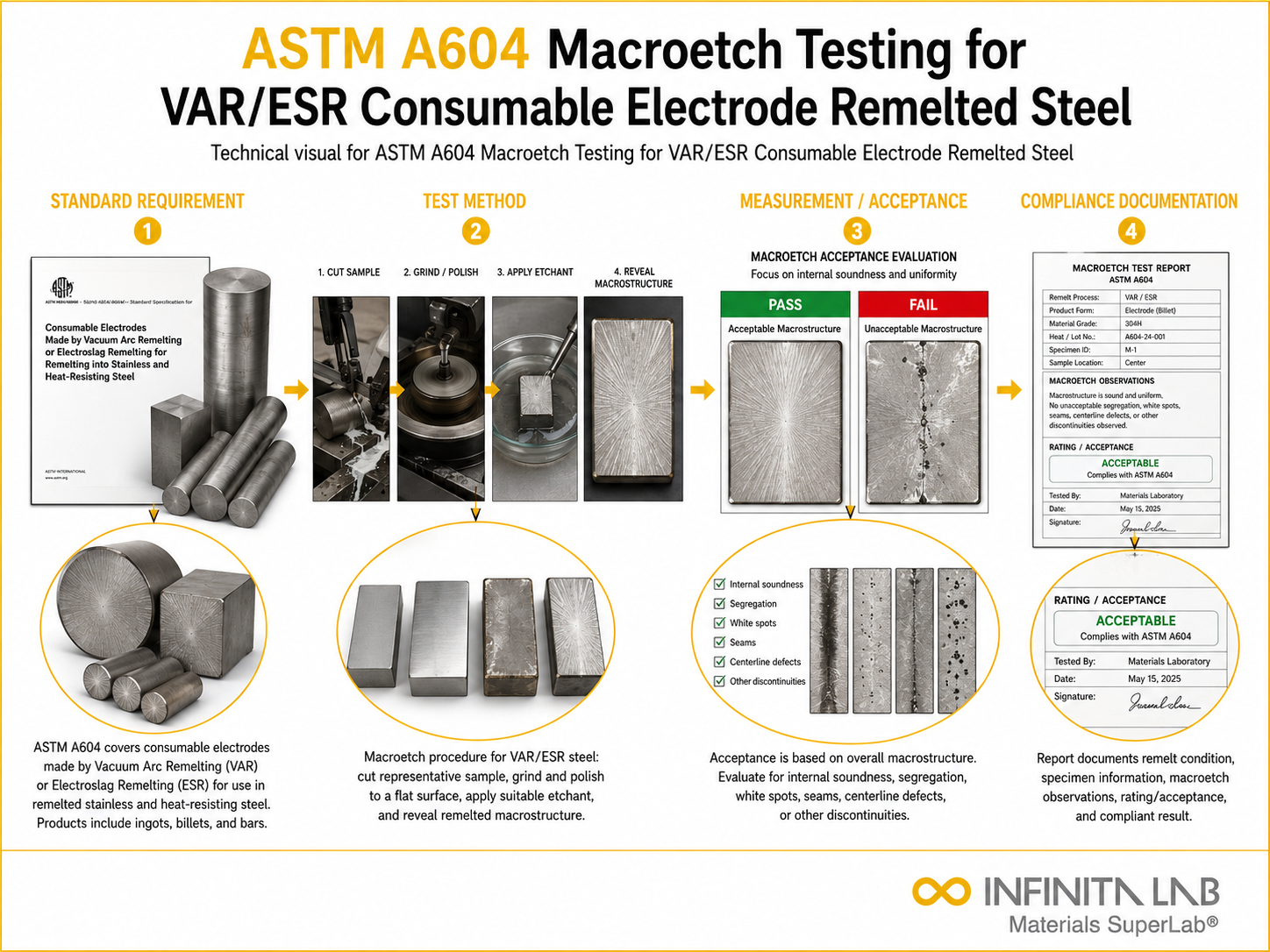
The method itself is straightforward in concept, even if it takes a trained eye to interpret correctly. A representative disc is sliced from the bar or billet, ground flat, and then etched in a hot acid solution that attacks grain boundaries and segregated regions at a different rate than the surrounding matrix. What emerges is a macrograph – a visible map of how the metal solidified, where alloying elements pooled unevenly, and whether any of the classic remelting-related conditions are present. That macrograph is then compared against reference standards and assigned a severity rating, giving both sides of a transaction an objective basis for acceptance.
This matters because A604/A604M product rarely ends up in forgiving service. VAR and ESR steels typically end up in aircraft engine rotors, landing gear, and bearing races, where a hidden segregation defect could seed a fatigue crack years into service. Macro etch testing catches that risk early, well before the material is machined, forged, or certified onward.

Applications and Benefits of ASTM A604 VAR ESR Steel Macroetch Testing
Scope
ASTM A604/A604M evaluates the internal macrostructure of remelted steel products using chemical etching techniques. The test ensures homogeneity and identifies internal defects that may affect performance.
The test evaluates:
- ASTM A604/A604M covers macro etch testing procedures for bars, billets, and blooms of carbon, alloy, and stainless steel produced by a consumable electrode remelting process, meaning vacuum arc remelting or electroslag remelting.
- It applies to remelted product with a transverse cross-sectional area up to roughly 225 square inches (1450 cm²), which covers everything from smaller diameter bar stock to large remelted ingots processed into billet form.
- Testing happens on a transverse section, generally a disc cut perpendicular to the long axis of the bar or billet so that the examiner can view the full cross-section in one plane.
- Within its pages, the standard describes the macro segregation conditions most characteristic of consumable electrode remelted material, including freckles, white spots, radial (or ray) segregation, and ring patterns.
- A severity rating framework is built in, too, using reference macrographs and letter-based classifications so that an etched sample can be scored consistently rather than judged subjectively.
- Think of A604/A604M as a companion document to broader macro etch standards such as ASTM E340 and E381; it draws on similar etching and evaluation principles but is tailored specifically to remelted product.
- That said, the practice doesn’t attempt to characterize every possible internal flaw – it stays focused on the segregation-related conditions tied to the remelting process itself, not general porosity or inclusion rating, which fall under separate standards.
- Specimen preparation and etching directly affect what the macrostructure reveals, which is exactly why the standard places real emphasis on consistent sectioning location, surface finish, and etchant handling.
- Acceptance criteria, meaning which severity classes are permitted, are typically agreed upon between the producer and purchaser or specified in the governing material specification, rather than fixed universally within A604/A604M itself.
- Ultimately, the standard is written for use both as an acceptance test between supplier and buyer and as an internal process-control check during remelted steel production.
Applications
- Qualifying VAR and ESR heats of aircraft-quality (AQ) alloy steel before release for forging or machining.
- Confirming the internal soundness of bearing-quality steel bars destined for aerospace and high-performance bearing races.
- Backing up acceptance testing on premium billet purchased for jet engine discs, shafts, and rotating components.
- Serving as incoming-material verification for forge shops working with critical rotating or structural parts.
- Helping metallurgical labs and producers maintain in-process quality control across a remelting campaign.
- Documenting material pedigree for defense, energy, and other sectors where remelted steel traceability is required.
- Getting called on to investigate suspected macro segregation issues after a downstream quality escape or customer complaint.
Benefits
- It reveals internal segregation conditions that are impossible to detect through surface inspection or dimensional checks alone.
- Producers and purchasers get a shared, standardized rating language instead of having to rely on subjective visual judgment.
- Remelting process problems get caught early, before costly forging, machining, or heat-treating operations are performed on flawed material.
- It supports the traceability and documentation requirements common in aerospace and defense procurement.
- Compared to the cost of downstream rework or an in-service failure, the test itself is relatively fast and economical.
- Over time, tracking severity trends across multiple heats builds real confidence in VAR/ESR process control.
Our ASTM A604 Testing Procedure
Sample Preparation
Steel specimens are sectioned, ground, and polished to expose the surface.
1Etching
Prepared surfaces are treated with chemical etchants to reveal macrostructure.
2Visual Examination
Macroetched surfaces are examined for patterns, defects, and segregation.
3Data Recording & Evaluation
Observations are recorded and compared with acceptance criteria.
4ASTM A604 Test Parameters and Requirements
| Parameter | Details |
|---|---|
| Applicable Materials | VAR/ESR remelted steel bars and billets |
| Specimen Size | ~25 mm to 150 mm cross-section |
| Etching Solution | Acid-based (e.g., HCl or HNO₃ mixtures) |
| Etching Time | ~5 to 30 minutes |
| Surface Finish | Ground to ~120–320 grit before etching |
| Measured Outputs | Macrostructure patterns, segregation, defects |


- Precision Sectioning Saw – Cuts the transverse disc from the bar or billet cleanly, minimizing heat input that could distort the macrostructure.
- Surface Grinder / Machining Equipment – Produces a flat, smooth specimen face, so the etch reveals true internal structure rather than preparation artifacts.
- Acid-Resistant Etching Tanks – Hold the heated acid reagent safely during the controlled immersion step.
- Temperature-Controlled Heating Bath – Keeps the etchant at the consistent temperature needed for repeatable, comparable results.
- Fume Extraction and Ventilation System – Protects lab personnel throughout the acid etching of the specimen.
- Reference Macrograph Rating Charts – Supply the comparison standards used to classify severity of freckles, white spots, radial segregation, and ring patterns.
- Macrophotography and Digital Imaging Equipment – Captures high-resolution images of the etched surface for the test report and customer record.
Equipment and Instrumentation Used for ASTM A604 Testing
What You Receive: Test Report, Data, and Certification
- High-resolution macrographs of the etched transverse specimen, documenting the as-tested macrostructure.
- A severity rating for each relevant condition observed, referenced against the standard’s comparison charts.
- Where applicable, a pass/fail or conformance assessment once the results are evaluated against a purchaser’s or specification’s acceptance criteria.
- A complete, signed test report referencing ASTM A604/A604M, including specimen identification, location, and etching parameters used.
- Retained specimens or archived images, kept available for future reference, audits, or dispute resolution.
- Practical guidance on the findings, useful for engineering or quality teams deciding whether material can proceed to the next production step.
ASTM A604 VAR ESR Steel Macroetch FAQs
ASTM A604/A604M includes specimen preparation, etchant type, etching time, surface condition, and visual examination, evaluating macrostructure of consumable electrode remelted steel bars and billets to identify segregation, inclusions, and defects.
ASTM A604/A604M identifies defects such as segregation, porosity, inclusions, cracks, and structural irregularities visible in macroetched steel surfaces.
ASTM A604/A604M is applied to consumable electrode remelted steel bars and billets used in critical applications requiring high-quality material structure.
ASTM A604/A604M uses chemical etching followed by visual inspection to reveal macrostructural features and assess material quality.
ASTM A604/A604M relies on visual inspection and may not detect microscopic defects, requiring additional analytical methods for comprehensive evaluation of material quality.
Why Choose Infinita Lab for VAR ESR Steel Macroetch Testing
When your VAR ESR Steel Macro etch results have to hold up - for compliance, a customer audit, or an engineering decision - ASTM A604 accuracy and an unbiased third-party report matter more than price. Infinita Lab routes your ASTM A604 VAR ESR steel macroetch testing to ISO/IEC 17025-accredited U.S. partner labs with hands-on method experience, so you get defensible data, transparent reporting, and turnaround times built around your project deadline - not ours.

Need ASTM A604 VAR ESR Steel Macroetch Testing You Can Rely On?
Send query us at hello@infinitalab.com or call us at (888) 878-3090 to learn more about our services and how we can support you.


Request a Quote
Submit your material details and receive testing procedures, pricing, and turnaround time within 24 hours.
 Quick Turnaround and Hasslefree process
 Confidentiality Guarantee
 Free, No-obligation Consultation
 100% Customer Satisfaction
