


Short Beam Shear Test
Short Beam Shear Testing determines the shear strength of materials. A small beam-shaped sample is cut and subjected to a three-point bending load until it fails. The maximum load is recorded, and the shear strength is calculated using the dimensions of the sample and the maximum load.
TRUSTED BY


Precision-driven testing for dimensional accuracy and compliance
- Overview
- Scope, Applications, and Benefits
- Test Process
- Specifications
- Instrumentation
- Results and Deliverables
ASTM D2344 Short-Beam Shear Test Overview
The short-beam shear test, standardized as ASTM D2344, determines the short-beam strength of polymer-matrix composite materials and is widely used as a measure of interlaminar shear strength (ILSS). Interlaminar shear is the shear stress that acts between the layers (plies) of a laminated composite – and because composites are typically much weaker between their plies than within them, interlaminar shear is one of the most common and important failure modes for laminated composite structures.
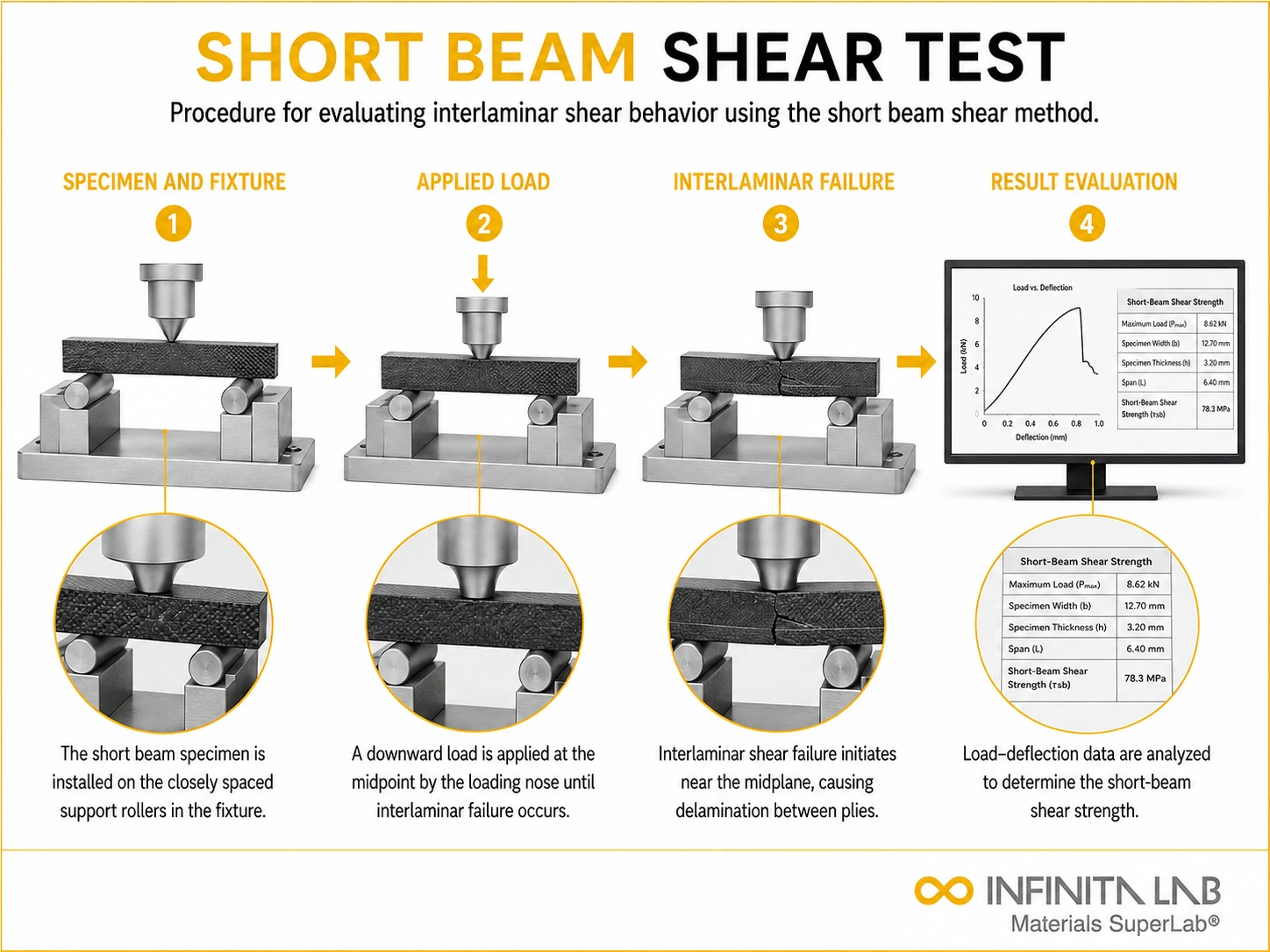
The test is deceptively simple in setup but specific in geometry. A short, beam-shaped specimen is supported on two points and loaded at the center by a third point – a three-point bend configuration. The defining feature is the deliberately short span relative to the specimen thickness. By keeping the support span short, the test maximizes the interlaminar shear stress at the mid-plane relative to the bending stress, encouraging the specimen to fail in shear between the plies rather than in tension or compression on the outer surfaces. The short-beam strength is then calculated from the maximum load and the specimen cross-section.
ASTM D2344 is valued because it is quick, uses small specimens, and requires only simple fixturing, making it ideal for material screening, quality control, and process monitoring of composites. It is widely used in aerospace, automotive, and other industries that rely on fiber-reinforced composites, where it provides a fast, repeatable comparative measure of interlaminar quality – though the standard notes the result is a short-beam strength used for comparison rather than a pure material shear property suitable for design allowables.

ASTM D2344 Short-Beam Shear Test Scope, Applications, and Benefits
Scope
ASTM D2344 covers the determination of the short-beam strength of high-modulus fiber-reinforced polymer-matrix composites using a short-span three-point bend configuration, commonly reported as interlaminar shear strength (ILSS).
Key aspects of the test scope include:
- Test configuration – three-point bend (short beam) with a deliberately short support span-to-thickness ratio to promote interlaminar shear failure at the mid-plane
- Measured property – short-beam strength, calculated from the maximum load and the specimen width and thickness; reported as a measure of interlaminar shear strength
- Specimen – a small flat coupon with dimensions proportioned to the laminate thickness per the standard
- Applicable materials – high-modulus, fiber-reinforced polymer-matrix composites (carbon, glass, and other fiber reinforcements)
- Failure mode dependence – the result is valid as an interlaminar shear measure only when the specimen fails in interlaminar shear; the standard requires the failure mode to be identified, since flexural or mixed failures invalidate the shear interpretation
- Use of the result – primarily a comparative/quality measure rather than a design-allowable shear property
Applications
- Composite quality control – fast, routine verification of interlaminar quality of laminates batch to batch, one of the most common QC tests for composites
- Process monitoring – detecting processing problems (poor consolidation, voids, incomplete cure, contamination) that reduce interlaminar strength
- Material screening and development – comparing resin systems, fiber-matrix combinations, and processing routes during composite development
- Cure and consolidation verification – confirming that a laminate was properly cured and consolidated, since interlaminar strength is sensitive to both
- Aerospace composite verification – routine interlaminar strength checks on aerospace laminates, where interlaminar failure is a key concern
- Incoming material and prepreg verification – confirming that laminates made from incoming prepreg meet the expected interlaminar strength
- Environmental conditioning studies – comparing interlaminar strength after exposure to moisture, temperature, or fluids to assess environmental effects
Benefits
- Fast, simple, and economical – the test uses small specimens, simple three-point fixturing, and a quick procedure, making it ideal for routine QC and screening where many specimens are run
- Sensitive to interlaminar quality and processing – because interlaminar strength depends strongly on consolidation, cure, and void content, the test is an effective indicator of laminate processing quality
- Targets a critical composite failure mode – interlaminar shear is a common cause of composite failure, so the property the test measures is directly relevant to composite performance
- Small specimen requirement – minimal material is needed per test, which is valuable when material is limited or expensive
- Repeatable comparative measure – the standardized geometry gives a consistent basis for comparing materials, processes, and conditions
- Failure-mode discipline built in – the standard’s requirement to identify the failure mode ensures the result is interpreted correctly and invalid (non-shear) failures are recognized
ASTM D2344 Short-Beam Shear Test Process
Prepare the Specimen
Cut short-beam samples to the required dimensions and measure width and thickness accurately.
1Set Up the Fixture
Place the specimen in a three-point bend fixture with the specified support span.
2Apply the Load
Load the specimen at the required rate until failure and record the maximum force.
3Calculate and Report
Determine short-beam strength and report the result with the observed failure mode.
4ASTM D2344 Short-Beam Shear Test Technical Specifications
| Parameter | Details |
|---|---|
| Configuration | Three-point bend, short support span-to-thickness ratio |
| Measured Property | Short-beam strength (reported as interlaminar shear strength, ILSS) |
| Applicable Materials | High-modulus fiber-reinforced polymer-matrix composites |
| Specimen | Small flat coupon, dimensions proportioned to laminate thickness |
| Equipment | Universal testing machine with short-beam three-point fixture |
| Failure Mode | Must be identified; valid as ILSS only for interlaminar-shear failure |


Instrumentation Used for ASTM D2344 Short-Beam Shear Test
- Universal Testing Machine (UTM) with calibrated load cell
- Short-beam shear three-point bend fixture (support and loading noses per standard)
- Precision measuring instruments (micrometers/calipers) for specimen dimensions
- Specimen cutting equipment for composite coupons
- Conditioning chamber (for environmental conditioning where required)
- Data acquisition system for load recording
ASTM D2344 Short-Beam Shear Test Results and Deliverables
- Short-beam shear report – short-beam strength (ILSS) for each specimen, with the identified failure mode and the test configuration documented
- Per-specimen results – individual and average short-beam strength values with the relevant statistics
- Failure mode identification – the observed failure mode for each specimen (interlaminar shear, flexural, or mixed), confirming validity of the ILSS interpretation
- Specimen dimensions – measured width and thickness used in the calculation, with the span-to-thickness ratio used
- Test conditions – loading rate, span, fixture, and any environmental conditioning applied
- Comparison against specification (where provided) – measured short-beam strength against the requirement or baseline
- Sample records – laminate/material identification, layup, and lot information
Frequently Asked Questions
The test primarily evaluates resin-dominated and interlaminar behaviour under three-point bending. It is commonly used to compare laminate quality, bonding between layers and manufacturing consistency.
The method applies to continuous- or discontinuous-fibre-reinforced polymer composites with balanced, symmetric elastic properties. Flat or curved laminates up to 6 mm thick may be tested.
A short rectangular specimen is supported on two rollers and loaded at its centre using a third loading nose. Force is applied until interlaminar failure, significant load reduction or another specified endpoint occurs.
Short-beam strength is calculated from the maximum recorded load, specimen width and specimen thickness. The result is generally reported in megapascals or pounds per square inch.
Common failure modes include interlaminar shear cracking, delamination, fibre crushing, tensile fracture and compressive failure beneath the loading nose. The failure mode must be examined to determine whether the result is valid.
Why Choose Infinita Lab for Advanced Materials Testing and Characterization?
At the core of this breadth is our network of 2,000+ accredited laboratories across the USA, offering access to over 10,000 testing methods and analytical services. From advanced materials characterization (SEM, TEM, RBS, XPS) to mechanical, chemical, environmental, biological, and standardized ASTM/ISO-compliant testing, we deliver unmatched flexibility, specialization, and scale. You are never limited by geography, facility, or methodology — Infinita Lab connects you to the right expertise and testing solution, every time.

Looking for a Trusted Partner for Accurate and Reliable Testing Services?
Send query us at hello@infinitlab.com or call us at (888) 878-3090 to learn more about our services and how we can support you.



Request a Quote
Submit your material details and receive testing procedures, pricing, and turnaround time within 24 hours.
 Quick Turnaround and Hasslefree process
 Confidentiality Guarantee
 Free, No-obligation Consultation
 100% Customer Satisfaction
