


ASTM D1995: Methods For Multi Modal Strength Of Autohesives Testing Services
ASTM D1995 covers a set of standard test methods for multi-modal strength testing of autohesives (contact adhesives). Multi-modal strength tests include compression shear, cleavage, climbing drum peel, and T-peel. Results are reported in inch-pound units.
TRUSTED BY


Get ASTM D1995 compliant results — request your methods for multi modal strength of autohesives testing quote
- Overview
- Scope, Applications, and Benefits
- Test Process
- Specifications
- Instrumentation
- Results and Deliverables
What Is ASTM D1995 Methods For Multi Modal Strength Of Autohesives?
ASTM D1995 is a set of standard test methods for measuring the strength of autohesives – contact adhesives that bond to themselves on contact, without needing a separate curing step or external pressure to form an initial bond. Because these adhesives are used in joints that can be loaded in very different ways in service, a single strength number is not enough to characterize them. ASTM D1995 instead provides several test modes so the adhesive can be evaluated under the type of loading that matters for the intended application.
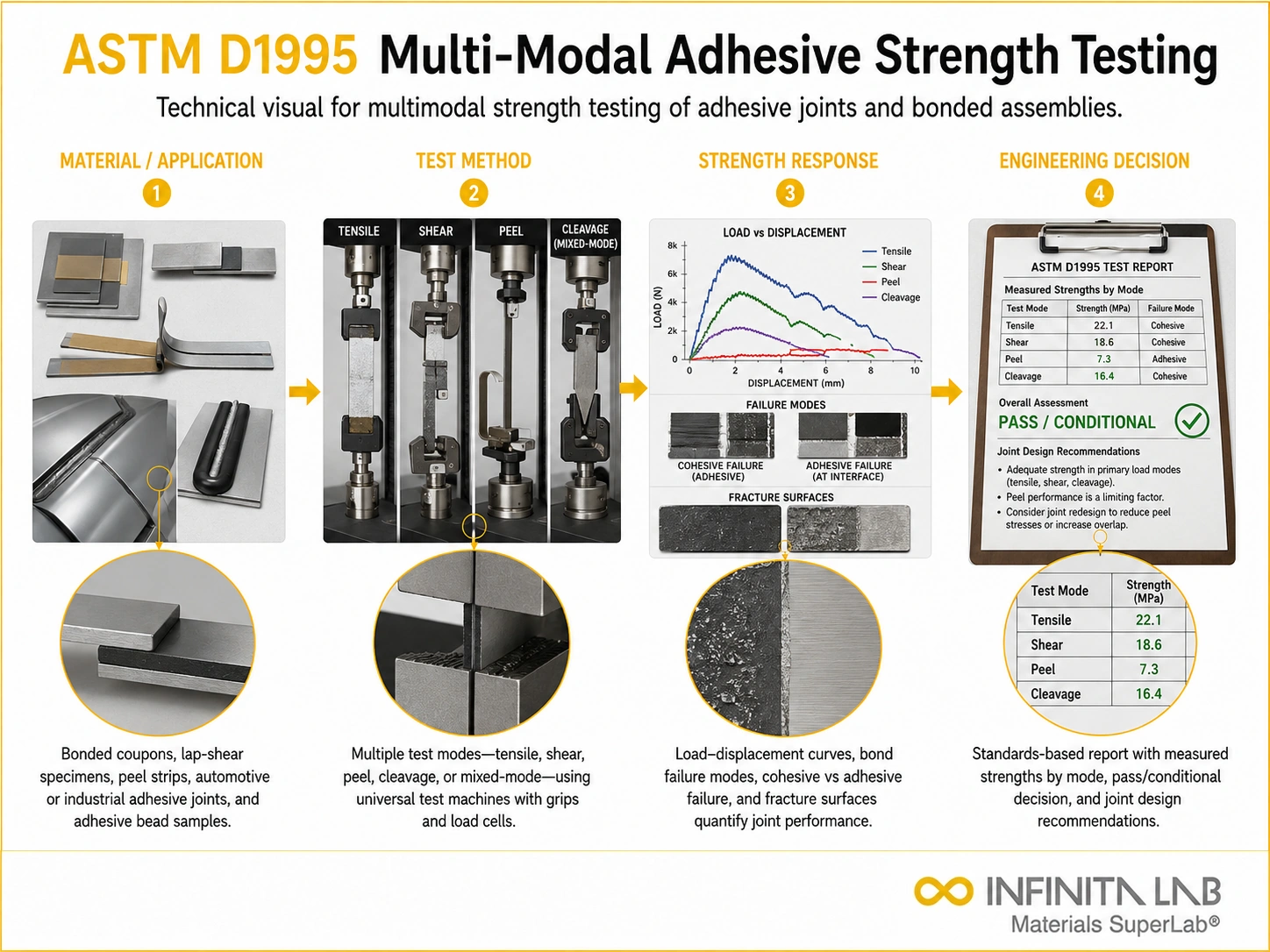
The standard covers multi-modal strength testing across four loading geometries: compression shear, cleavage, climbing drum peel, and T-peel. Each mode stresses the autohesive bond in a different way – shear loads the bond in-plane, cleavage and peel load it by progressively separating the bonded surfaces, and the climbing drum method applies a controlled peel to flexible-to-rigid assemblies. Testing in more than one mode gives a fuller picture of how the adhesive will perform under real, mixed loading conditions. Results are reported in inch-pound units.
ASTM D1995 is used to characterize and compare autohesive (contact adhesive) products, support formulation development, and verify that a contact adhesive provides adequate strength in each of the loading modes relevant to its end use.

Applications and Benefits of ASTM D1995 Methods For Multi Modal Strength Of Autohesives Testing
Scope
ASTM D1995 covers the determination of the strength of autohesive (contact adhesive) bonds under multiple loading modes. The applicable mode or modes are selected based on the loading the bond will experience in service, and results are reported in inch-pound units.
The test modes within the standard are:
- Compression shear – loads the bonded joint in shear under compression, measuring the autohesive’s shear strength
- Cleavage – applies a separating force at one edge of the bond, measuring resistance to cleavage
- Climbing drum peel – uses a drum fixture to apply a controlled peel to an assembly (typically a flexible facing bonded to a more rigid substrate), measuring peel resistance
- T-peel – peels two flexible bonded members apart in a T-configuration, measuring T-peel strength
- Autohesive focus – the methods are specific to autohesives/contact adhesives, which bond to themselves on contact
- Multi-modal approach – more than one mode can be run to characterize the adhesive across the relevant loading types
Applications
- Contact adhesive characterization – measuring the strength of contact/autohesive adhesives across the loading modes relevant to their use
- Adhesive formulation development – evaluating how formulation changes affect shear, cleavage, and peel strength during development of contact adhesives
- Product comparison – comparing competing contact adhesive products on a consistent, multi-modal basis
- Quality control – verifying that production batches of contact adhesive deliver consistent strength in the relevant modes
- Application qualification – confirming a contact adhesive provides adequate strength in the specific loading mode(s) its joint will see in service
- Bonded assembly design – generating strength data in multiple modes to support the design of joints made with contact adhesives
Benefits
- Characterizes the adhesive under multiple loading types – testing in shear, cleavage, and peel modes reflects the different ways a bond is actually loaded, giving a fuller picture than a single strength value
- Matches the test to the application – the ability to select the relevant mode(s) means the adhesive is evaluated under the loading that matters for its intended joint
- Supports formulation and product decisions – multi-modal data shows how formulation or product changes affect each type of strength, informing development and selection
- Specific to contact adhesives – the methods are tailored to autohesives, so the results are directly relevant to this class of self-bonding adhesives
- Standardized and comparable – as a defined ASTM method, the results provide a consistent basis for comparing products and verifying batches
Our ASTM D1995 Testing Procedure
Prepare the Specimens
Bond and condition the test samples according to the selected test method.
1Set Up the Fixture
Install the required shear, cleavage, climbing drum, or T-peel fixture.
2Perform the Test
Load the specimen at the specified rate until bond failure and record the force.
3Calculate and Report
Report the strength, failure mode, test conditions, and results for each test mode.
4ASTM D1995 Test Parameters and Requirements
| Parameter | Details |
|---|---|
| Adhesive Type | Autohesives / contact adhesives (self-bonding on contact) |
| Test Modes | Compression shear, cleavage, climbing drum peel, T-peel |
| Measured Properties | Shear strength, cleavage strength, peel force/strength (by mode) |
| Equipment | Universal testing machine with mode-specific fixtures |
| Conditioning | Standard atmosphere per the method |
| Failure Mode Recorded | Adhesive, cohesive, or substrate failure |
| Replicates | Per method requirements |


- Universal Testing Machine (UTM) with load cell
- Compression shear test fixture
- Cleavage test fixture
- Climbing drum peel apparatus
- T-peel grips
- Specimen preparation and bonding equipment
- Conditioning chamber for specimen preconditioning
Equipment and Instrumentation Used for ASTM D1995 Testing
What You Receive: Test Report, Data, and Certification
- Multi-modal strength report – the strength results for each mode tested (compression shear, cleavage, climbing drum peel, T-peel) in inch-pound units
- Per-mode results – individual and average strength values for each loading mode run, with replicate data
- Failure mode – classification of the failure (adhesive, cohesive, or substrate) for each specimen
- Test conditions – bonding conditions, conditioning atmosphere, test rate, and fixtures used
- Specimen records – adhesive and substrate identification, specimen preparation, and bond formation details
- Comparison against specification (where provided) – measured strengths against the relevant requirements for each mode
ASTM D1995 Methods For Multi Modal Strength Of Autohesives FAQs
The standard covers four principal stressing modes: compression shear, cleavage, climbing drum peel and T-peel. These modes evaluate how contact-adhesive bonds respond to different loading conditions.
ASTM D1995 allows rigid-to-rigid, flexible-to-rigid and flexible-to-flexible bonding arrangements. Example adherends include wood, aluminium, steel, flakeboard and plastic laminates.
The standard provides static, roller and impact pressure methods. The selected pressure magnitude, duration and application method should represent the adhesive’s intended service conditions.
Results can be affected by adhesive-film thickness, applied pressure, pressure duration, temperature, humidity, open time and bond-conditioning time. These conditions must be carefully controlled and reported.
After testing, the specimens are examined to determine whether failure occurred within the adhesive, at the adhesive–adherend interface or within the adherend. Failure-mode observations help explain differences in measured strength.
Why Choose Infinita Lab for Methods For Multi Modal Strength Of Autohesives Testing?
At the core of this breadth is our network of 2,000+ accredited laboratories across the USA, offering access to over 10,000 testing methods and analytical services. From advanced materials characterization (SEM, TEM, RBS, XPS) to mechanical, chemical, environmental, biological, and standardized ASTM/ISO-compliant testing, we deliver unmatched flexibility, specialization, and scale. You are never limited by geography, facility, or methodology — Infinita Lab connects you to the right expertise and testing solution, every time.

Looking for an Accredited Partner for ASTM D1995 Methods For Multi Modal Strength Of Autohesives Testing?
Send query us at hello@infinitalab.com or call us at (888) 878-3090 to learn more about our services and how we can support you.



Request a Quote
Submit your material details and receive testing procedures, pricing, and turnaround time within 24 hours.
 Quick Turnaround and Hasslefree process
 Confidentiality Guarantee
 Free, No-obligation Consultation
 100% Customer Satisfaction
