


ASTM D1002 Lap Shear Strength of Adhesives
The ASTM D1002 test method covers the determination of the apparent shear strengths of adhesives for bonding metals when tested on a standard single-lap-joint specimen and under specified conditions of preparation and test. The performance of specimens assessed by this method is quantified in terms of the SI units.
TRUSTED BY


ASTM D1002 Lap Shear Strength of Adhesives
- Overview
- Scope, Applications, and Benefits
- Test Process
- Specifications
- Instrumentation
- Results and Deliverables
ASTM D1002 Lap Shear Strength of Adhesives Overview
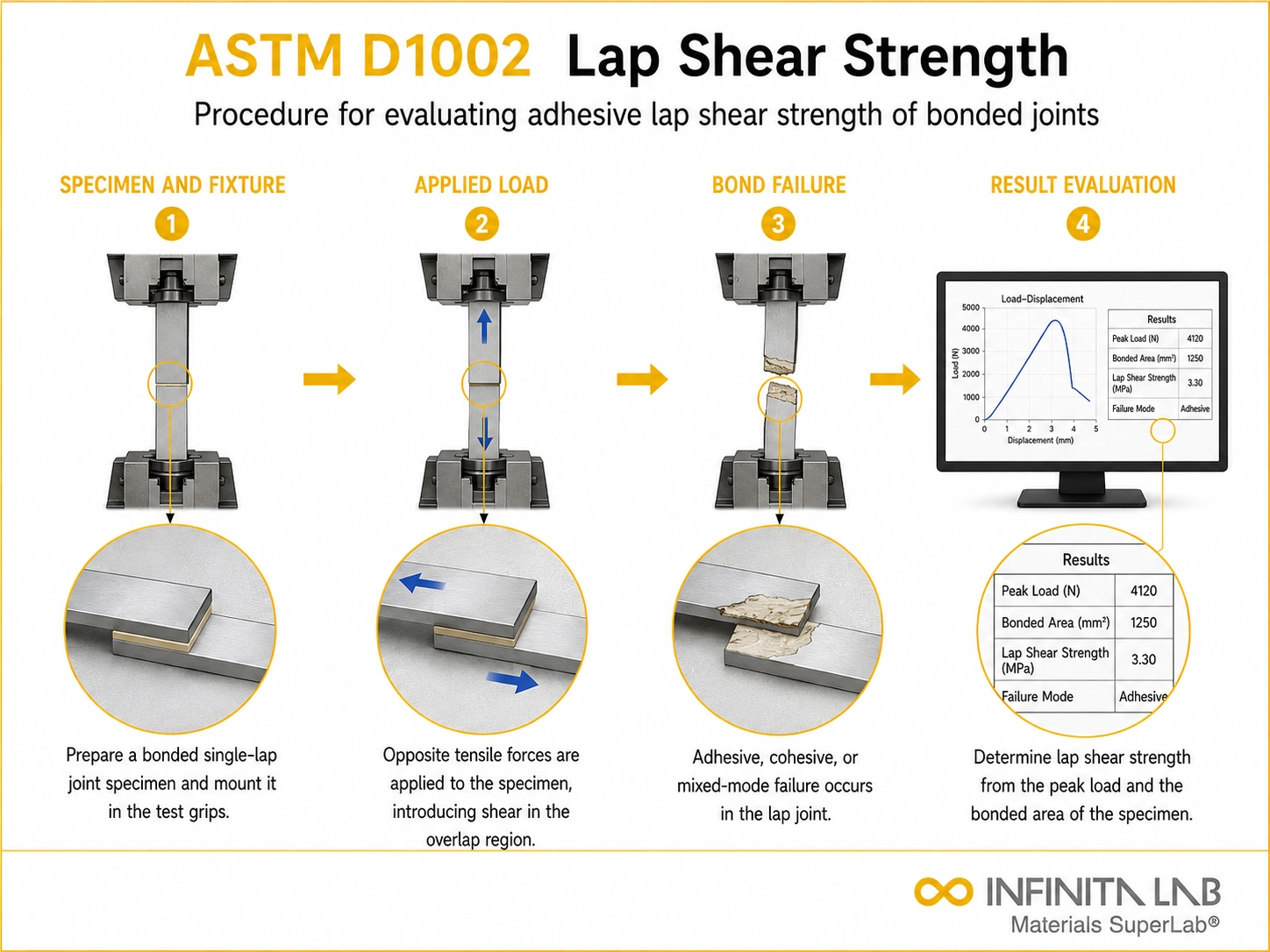
ASTM D1002 defines the method for measuring the apparent shear strength of adhesive bonds using single-lap metal specimens. Two metal strips are bonded at a defined overlap and tested in tension until the bond fails. The ratio of failure load to bonded area gives the lap shear strength, expressed in force per unit area. It is one of the most widely used adhesive tests in industry because the specimen geometry is simple, the test is fast, and the result gives a comparative number that can be used to rank adhesive systems or process conditions.
The standard specifies aluminum alloy adherends (2024-T3 or 7075-T6 are most common) at defined thickness and overlap dimensions. This standardization is important because lap shear results are sensitive to adherend stiffness and thickness – a stiffer, thicker adherend reduces the peel component of loading at the bond termination, resulting in a higher measured strength. ASTM D1002 controls these variables so that results are comparable across laboratories.
It is worth noting that ASTM D1002 measures apparent shear strength, not true shear strength. Because the two adherends are offset, the load path through the specimen introduces a bending moment at the overlap ends, generating a peel stress component in addition to the shear stress. The contribution of this peel component varies with bond line thickness, overlap length, and adherend stiffness. For design purposes, ASTM D1002 results are best used for comparative evaluation rather than as direct design allowable shear stresses.

ASTM D1002 Lap Shear Strength of Adhesives Scope, Applications, and Benefits
Scope
ASTM D1002 applies to structural adhesives bonded between metal adherends under the defined specimen geometry. While the standard specifies aluminum adherends, the test is widely adapted for steel, titanium, and other metal substrates when noted in the test report. The test evaluates:
- Apparent lap shear strength of adhesive bonds to metal substrates
- Comparative performance of adhesive systems under identical substrate and geometry conditions
- Effect of surface preparation method on bond strength
- Influence of bond line thickness on lap shear performance
- Bond strength retention after environmental conditioning
- Production lot-to-lot consistency of adhesive performance
Applications
- Structural adhesive selection and qualification for metal bonding
- Surface preparation optimization for adhesively bonded metal assemblies
- Aerospace and automotive adhesive joint qualification
- Adhesive primer and surface treatment evaluation
- Environmental durability testing of metal adhesive bonds
- Production quality control for adhesive bonded assemblies
Benefits
- Simple, well-standardized specimen geometry with traceable reference data
- Widely accepted across aerospace, automotive, and industrial specifications
- Sensitive to surface preparation quality and bond line variability
- Failure mode examination reveals whether failure is adhesive, cohesive, or substrate
- Low cost per specimen compared to structural joint configurations
- Results directly comparable to a large existing database of published adhesive performance data
ASTM D1002 Lap Shear Strength of Adhesives Process
Adherend Preparation
Metal adherends are cut to specified dimensions and surface-treated by the designated method
1Bond Assembly
Adhesive is applied to one or both adherend surfaces.
2Cure
Specimens are cured under specified temperature, pressure, and time conditions
3Load Application and Failure
Specimens are gripped in a tensile testing machine and loaded at 1.3 mm/min crosshead speed until bond failure
4ASTM D1002 Lap Shear Strength of Adhesives Technical Specifications
| Parameter | Details |
|---|---|
| Standard | ASTM D1002 |
| Specimen Type | Single lap shear, metal adherends |
| Standard Adherend Material | Aluminum alloy 2024-T3 or 7075-T6 |
| Adherend Thickness | 1.6 mm (0.063 inch) |
| Overlap Length | 12.7 mm (0.5 inch) |
| Crosshead Speed | 1.3 mm/min (0.05 in/min) |


Instrumentation Used for ASTM D1002 Lap Shear Strength of Adhesives
- Universal tensile testing machine with appropriate load cell
- Lap shear alignment grips and specimen fixtures
- Bonding fixtures for overlap length and alignment control
- Shim stock or calibration beads for bond line thickness control
- Environmental conditioning chamber for humidity or thermal exposure
- Photographic system for pre-test surface and post-test failure documentation
ASTM D1002 Lap Shear Strength of Adhesives Results and Deliverables
- Apparent lap shear strength in MPa or psi
- Failure mode classification (adhesive failure, cohesive failure, or substrate failure)
- Photographic documentation of failure surfaces
- Statistical summary for the specimen set (mean, standard deviation, range)
- Surface preparation method and cure conditions used
- Quality assurance documentation
Frequently Asked Questions
ASTM D1002 measures the lap shear strength of adhesive-bonded metal specimens under tensile loading. It is used to assess how well an adhesive resists shear forces between overlapping metal surfaces.
Lap shear strength indicates the structural reliability of an adhesive joint under service loads. It helps predict joint performance in real applications like automotive, aerospace, and structural bonding.
Failures may occur cohesively within the adhesive, adhesively at the interface, or through substrate yielding. The failure mode provides insight into bond quality and surface preparation effectiveness.
Results are influenced by surface preparation, adhesive type, cure conditions, bondline thickness, and substrate material. Even small variations in alignment or curing can significantly affect shear strength values. 5. What materials are commonly tested using ASTM D1002?
Why Choose Infinita Lab for Advanced Materials Testing and Characterization?
At the core of this breadth is our network of 2,000+ accredited laboratories across the USA, offering access to over 10,000 testing methods and analytical services. From advanced materials characterization (SEM, TEM, RBS, XPS) to mechanical, chemical, environmental, biological, and standardized ASTM/ISO-compliant testing, we deliver unmatched flexibility, specialization, and scale. You are never limited by geography, facility, or methodology — Infinita Lab connects you to the right expertise and testing solution, every time.

Looking for a Trusted Partner for Accurate and Reliable Testing Services?
Send query us at hello@infinitlab.com or call us at (888) 878-3090 to learn more about our services and how we can support you.



Request a Quote
Submit your material details and receive testing procedures, pricing, and turnaround time within 24 hours.
 Quick Turnaround and Hasslefree process
 Confidentiality Guarantee
 Free, No-obligation Consultation
 100% Customer Satisfaction
