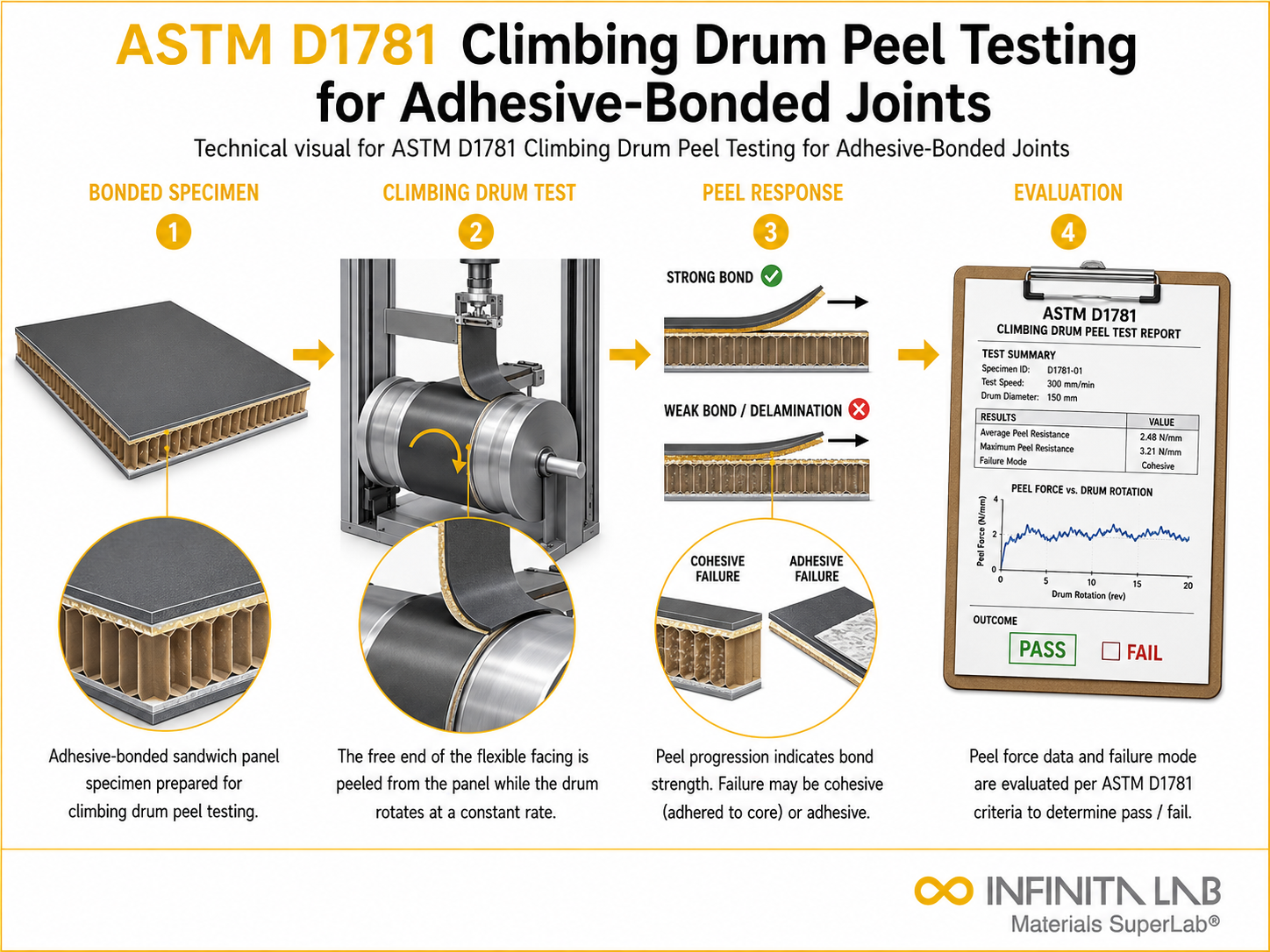


What Is ASTM D1781 Climbing Drum Peel Adhesive?
ASTM D1781 determines the peel resistance of adhesive bonds using the climbing drum method, measuring the force required to separate a flexible adherend from a rigid substrate. The test simulates real-life peeling conditions and evaluates bond strength under controlled mechanical loading.
This method is widely used for structural adhesives, especially in sandwich panels and laminated constructions. It provides reliable data on adhesive performance, bonding quality, and resistance to delamination, supporting product development, quality control, and durability assessment.

Applications and Benefits of ASTM D1781 Climbing Drum Peel Adhesive Testing
Scope
ASTM D1781 defines a procedure to evaluate adhesive bond strength by measuring peel resistance using a rotating drum mechanism. It is particularly suitable for bonded assemblies involving flexible and rigid materials.
- Applicable to adhesive-bonded sandwich structures and laminates
- Measures peel strength under controlled mechanical conditions
- Uses climbing drum apparatus for consistent peel action
- Suitable for flexible-to-rigid bonded specimens
- Supports evaluation of bond integrity and durability
- Used for quality control and comparative analysis
- Helps identify failure modes such as adhesive or cohesive failure
Applications
- Sandwich panel bonding evaluation
- Aerospace and automotive bonded structures
- Composite material assemblies
- Laminated panel testing
- Adhesive formulation development
Benefits
- Provides accurate peel resistance measurement
- Simulates realistic peeling conditions
- Identifies bond strength and failure modes
- Supports material and adhesive selection
- Enhances product reliability and durability
Our ASTM D1781 Testing Procedure
Specimen Preparation
Bonded specimen with flexible and rigid adherends is prepared with defined dimensions.
1Mounting on Drum
Specimen is attached to the climbing drum apparatus securely.
2Peel Execution
Drum rotates to peel the flexible adherend at a constant rate.
3Force Measurement
Peel force is recorded continuously to determine peel strength.
4ASTM D1781 Test Parameters and Requirements
| Parameter | Details |
|---|---|
| Material Type | Adhesive-bonded assemblies |
| Specimen | Flexible adherend bonded to rigid substrate |
| Measurement | Peel force per unit width |
| Output Unit | N/mm or N/m |
| Test Speed | Constant peel rate |
| Failure Mode | Adhesive, cohesive, or substrate failure |
| Equipment | Rotating drum mechanism |


- Climbing drum peel tester
- Load cell and force measurement system
- Specimen holding fixtures
- Data acquisition system
- Cutting and preparation tools
Equipment and Instrumentation Used for ASTM D1781 Testing
What You Receive: Test Report, Data, and Certification
- Peel strength value (N/mm or N/m)
- Force vs displacement data
- Failure mode identification
- Sample and bonding details
- Compliance statement with ASTM D1781
ASTM D1781 Climbing Drum Peel Adhesive FAQs
ASTM D1781 is used to measure the peel resistance of adhesive bonds, particularly in sandwich structures. It helps determine how well an adhesive can withstand peeling forces under controlled conditions, ensuring reliable bond performance.
The climbing drum method provides a consistent and controlled peeling action. It ensures uniform force application and accurate measurement of peel strength, making results more reliable and repeatable.
Peel strength indicates the force required to separate bonded materials. Higher peel strength reflects better adhesion and stronger bonding performance under peeling conditions.
Failure mode analysis helps identify whether the bond failure is due to poor adhesion, weak adhesive material, or substrate issues, guiding improvements in design and materials.
It ensures adhesives can withstand real-world peeling forces, improving durability, safety, and reliability of bonded structures in demanding applications.
A drum peel test measures the resistance of an adhesive bond to peeling. The bonded specimen is secured in a testing machine, and a rotating drum progressively separates the flexible facing from the rigid substrate or sandwich core. The machine records the peeling force, which is analyzed to evaluate bond strength and adhesive performance.
ASTM D1781 specifies the climbing drum peel test for measuring the peel resistance of adhesive bonds between flexible and rigid materials or between a sandwich panel’s facing and core. The specimen is mounted in a climbing drum fixture and pulled at a controlled rate. The average peeling load, maximum and minimum loads, and failure mode are evaluated to compare adhesive bonding performance.
Why Choose Infinita Lab for Climbing Drum Peel Adhesive Testing
When your Climbing Drum Peel Adhesive results have to hold up - for compliance, a customer audit, or an engineering decision - ASTM D1781 accuracy and an unbiased third-party report matter more than price. Infinita Lab routes your ASTM D1781 climbing drum peel adhesive testing to ISO/IEC 17025-accredited U.S. partner labs with hands-on method experience, so you get defensible data, transparent reporting, and turnaround times built around your project deadline - not ours.

Need ASTM D1781 Climbing Drum Peel Adhesive Testing You Can Rely On?
Send query us at hello@infinitalab.com or call us at (888) 878-3090 to learn more about our services and how we can support you.





