


Sand Dust Testing Services
Sand and dust testing are the most critical environmental testing for electronics, equipment, or vehicle components that are to be operated in arid and semi-arid regions where exposure to these elements could significantly impact your product’s performance.
TRUSTED BY


Get compliant results — request your sand dust testing quote
- Overview
- Scope, Applications, and Benefits
- Test Process
- Specifications
- Instrumentation
- Results and Deliverables
What Is Sand Dust?
Sand and dust testing evaluates the resistance of products, enclosures, and materials to the ingress and abrasive effects of particulate matter encountered in arid, desert, and dusty industrial environments. The test exposes the specimen to controlled concentrations of standardized sand or fine dust particles under defined airflow conditions and assesses whether the product maintains functional integrity and acceptable appearance after exposure.
Sand testing and dust testing address different particle sizes and different failure modes. Sand tests use particles in the 150 to 850 micron range at higher velocities and are designed to assess abrasion of surfaces, seals, and optical elements. Dust tests use fine particles below 150 microns at lower velocities and are designed to assess ingress into enclosures, clogging of filters and vents, and the accumulation of conductive or abrasive particles in sensitive internal components.
The applicable test standards depend on the product type and intended market. Military and defense equipment follows MIL-STD-810, which includes Method 510 for sand and dust. Commercial and industrial electronics follow IEC 60529 for ingress protection (IP ratings), where IP5X and IP6X define dust resistance levels. Automotive and aerospace components may reference their own OEM or system specifications that invoke specific particle size, concentration, and duration requirements.

Applications and Benefits of Sand Dust Testing
Scope
Sand and dust testing applies to electronic equipment, mechanical assemblies, connectors, filters, optical systems, and enclosures intended for use in dusty or desert environments. Testing addresses both surface abrasion effects and internal ingress. Evaluation areas include:
- Dust ingress resistance of sealed enclosures and housings
- Abrasive wear of seals, gaskets, and external surfaces
- Clogging of ventilation openings, filters, and heat sinks
- Contamination of connectors, optical elements, and display surfaces
- Functional performance of mechanical and electrical systems after exposure
- Effectiveness of protective coatings against particulate abrasion
Applications
- Military and defense electronics qualification per MIL-STD-810
- Commercial electronics IP rating verification per IEC 60529
- Automotive HVAC, sensor, and connector environmental qualification
- Industrial control and instrumentation enclosure testing
- Aerospace avionics and ground support equipment qualification
- Consumer electronics ingress protection verification for outdoor use
Benefits
- Verifies product suitability for desert and dusty industrial environments
- Identifies seal, gasket, or enclosure design weaknesses before field deployment
- Supports IP rating documentation for product marketing and specification
- Meets procurement requirements for military and aerospace programs
- Detects particle ingress paths that compromise electrical or mechanical function
- Provides documented evidence of environmental robustness for product qualification
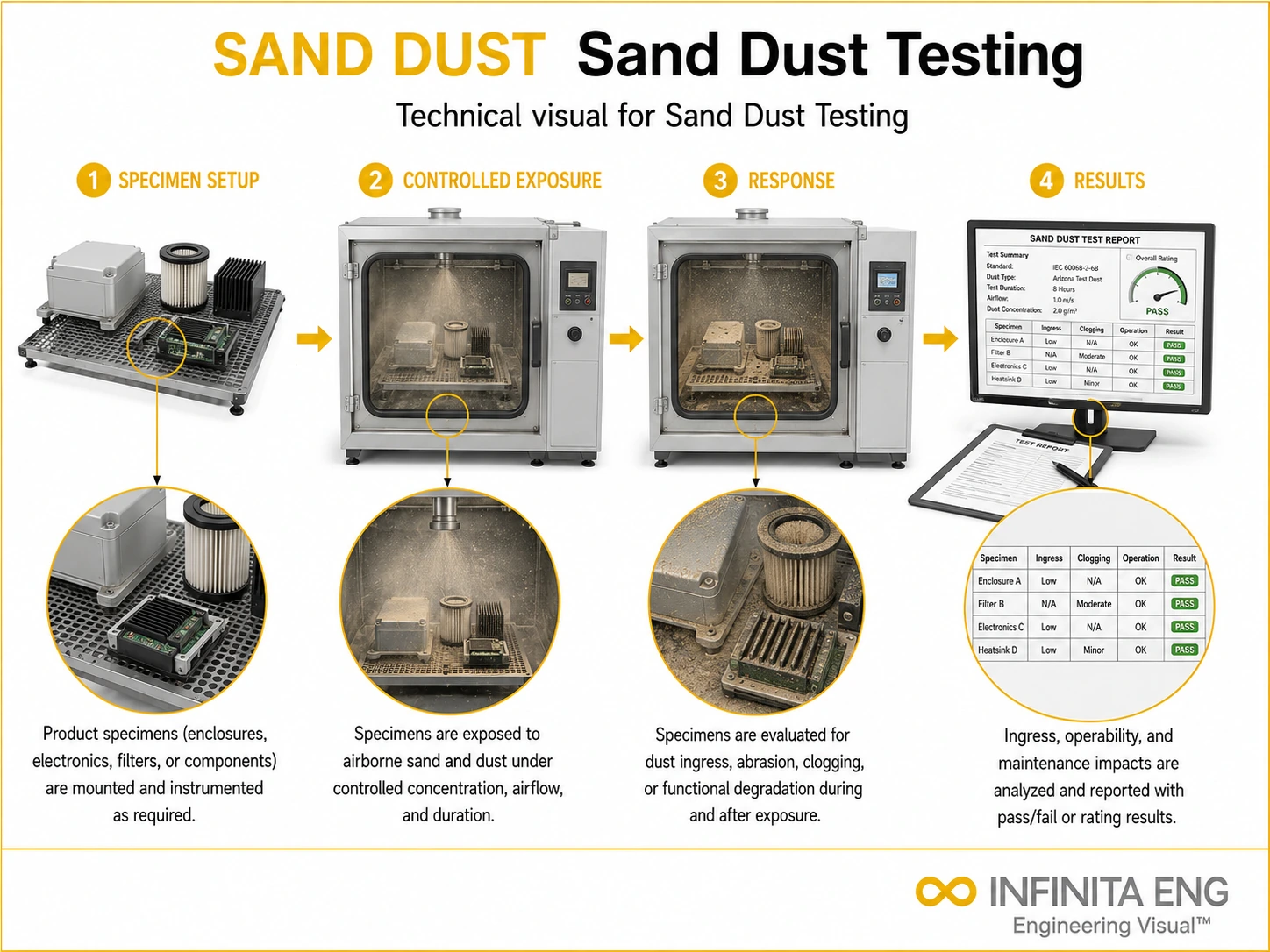
Our Testing Procedure
Specimen Preparation
The product is prepared in its representative operating or stored configuration.
1Test Chamber Setup
The sand or dust test chamber is configured with the specified particle type, concentration, airflow velocity, and temperature
2Exposure
The specimen is subjected to continuous particulate exposure for the specified duration.
3Post-Exposure Evaluation
The specimen is removed, inspected for ingress and surface damage, and subjected to post-test functional checks
4Test parameters and requirements
| Parameter | Details |
|---|---|
| Applicable Standards | MIL-STD-810 Method 510, IEC 60529 (IP5X/IP6X), ISO 20653 |
| Sand Particle Size | 150 to 850 microns |
| Dust Particle Size | Less than 150 microns (fine dust) |
| Airflow Velocity | 1.5 to 10 m/s depending on test type and standard |
| Dust Concentration | Up to 10.6 g/m3 per MIL-STD-810 |
| Test Duration | 1.5 to 6 hours typical (standard dependent) |


- Sand and dust test chamber with programmable airflow and concentration control
- Particle size verification equipment and sieves
- Airflow velocity measurement instrumentation
- Temperature and humidity monitoring within the chamber
- Functional test equipment specific to the product under test
- Photographic and visual inspection equipment for post-test evaluation
Equipment and Instrumentation Used for Testing
What You Receive: Test Report, Data, and Certification
- Pre- and post-test functional performance comparison
- Documentation of any particulate ingress observed
- Photographic record of specimen condition before and after exposure
- Abrasion or surface damage assessment where applicable
- Pass/fail determination against applicable standard requirements
- Quality assurance documentation
Sand Dust FAQs
Sand and dust testing evaluates a product's ability to resist the ingress of airborne particles and continue functioning when exposed to dusty or sandy environments.
The test is frequently performed on electronics, automotive components, military equipment, enclosures, outdoor devices, and industrial products intended for use in harsh environments.
Dust testing focuses on fine particles that may penetrate seals and affect performance, while sand testing uses larger, abrasive particles to assess resistance to erosion, clogging, and mechanical damage.
Testing can identify issues such as seal failures, reduced mechanical performance, electrical malfunctions, overheating, blocked ventilation systems, and excessive wear caused by particle intrusion.
Why Choose Infinita Lab for Sand Dust Testing?
At the core of this breadth is our network of 2,000+ accredited laboratories across the USA, offering access to over 10,000 testing methods and analytical services. From advanced materials characterization (SEM, TEM, RBS, XPS) to mechanical, chemical, environmental, biological, and standardized ASTM/ISO-compliant testing, we deliver unmatched flexibility, specialization, and scale. You are never limited by geography, facility, or methodology — Infinita Lab connects you to the right expertise and testing solution, every time.

Looking for an Accredited Partner for Sand Dust Testing?
Send query us at hello@infinitalab.com or call us at (888) 878-3090 to learn more about our services and how we can support you.



Request a Quote
Submit your material details and receive testing procedures, pricing, and turnaround time within 24 hours.
 Quick Turnaround and Hasslefree process
 Confidentiality Guarantee
 Free, No-obligation Consultation
 100% Customer Satisfaction
