


Altitude Testing Services
Altitude package testing is conducted to assess pressure differentials encountered during the transportation cycle. ASTM D3078, ASTM D4991, ASTM D6653, and ASTM D5094 are popular test methods used to detect pressure leaks in packages. The process for altitude integrity testing requires the selection of specimens and their adjustment to the laboratory environment. Test reports are written detailing the testing conditions, product information, number of samples, and number of failures (if any).
TRUSTED BY


Get compliant results — request your altitude testing quote
- Overview
- Scope, Applications, and Benefits
- Test Process
- Specifications
- Instrumentation
- Results and Deliverables
What Is Altitude?
Altitude testing, also called low-pressure or hypobaric testing, evaluates how products and packages perform when exposed to the reduced atmospheric pressure encountered at high elevations and during air transport. As altitude increases, air pressure drops, and that pressure differential can damage equipment, force air or fluid out of seals, rupture or deform sealed packages, and cause electronics to overheat (because thin air carries away less heat) or arc. Testing reproduces these reduced-pressure conditions in a controlled chamber so that problems are found before a product ships or is deployed.
The testing divides broadly into two related applications. Equipment/product altitude testing – typically per MIL-STD-810 Method 500 – qualifies devices and equipment for storage, transport, and operation at high altitude, confirming they survive and function at reduced pressure. Package altitude testing – using methods such as ASTM D6653, D3078, D4991, and D5094 – checks sealed packages for leaks and integrity under the pressure differential of air transport, which is especially important for sterile barrier packaging, liquids, and anything with a sealed or pressurized component.
By replicating the low-pressure environment, altitude testing verifies that a product will not fail, leak, deform, or malfunction when it reaches altitude – whether carried in an unpressurized cargo hold, shipped by air, used at high elevation, or deployed in aerospace and military service.

Applications and Benefits of Altitude Testing
Scope
Altitude testing covers the controlled exposure of products and packages to reduced atmospheric pressure in an altitude (hypobaric) chamber, to assess survival, function, and seal/package integrity. The pressure level (equivalent altitude), duration, and whether the item is operating are set by the applicable standard or specification.
Key aspects of the test scope include:
- Equipment altitude testing (MIL-STD-810 Method 500) – storage, transport, and operational low-pressure exposure for equipment, covering survival at altitude and correct operation at reduced pressure
- Package altitude/leak testing – ASTM D6653 (effects of high altitude on packages), ASTM D3078 (bubble-emission leak detection), ASTM D4991 (leakage of empty rigid containers by vacuum), and ASTM D5094 (leakage of liquid-filled containers)
- Equivalent altitude – chamber pressure is reduced to simulate a target altitude (e.g., typical air-cargo, high-elevation, or specified operational altitude)
- Operating and non-operating modes – equipment can be tested powered (operational) or unpowered (storage/transport survival)
- Evaluation – for equipment, function and physical condition; for packages, seal integrity, leakage, and deformation
- Combined conditions – altitude can be combined with temperature where the standard or application requires it
Applications
- Air transport qualification – confirming that products and packages survive the reduced pressure of air cargo holds during shipping
- Sterile and medical packaging – verifying that sterile barrier packaging maintains its seal integrity through the pressure differential of air transport (commonly via ASTM D6653)
- Liquid and filled containers – checking that liquid-filled packaging does not leak under reduced pressure (ASTM D5094)
- Aerospace and defense equipment – qualifying equipment per MIL-STD-810 Method 500 for high-altitude operation, storage, and rapid decompression scenarios
- Electronics at altitude – confirming electronic equipment operates without overheating or electrical arcing at reduced pressure, where reduced air density affects cooling and insulation
- High-elevation product use – verifying products intended for use at high-altitude locations function and survive as intended
- Pressure leak detection – finding leaks in sealed packages and containers using vacuum and bubble-emission methods
Benefits
- Reproduces real transport and operational pressure conditions – the chamber replicates the reduced pressure of air transport and high altitude, revealing failures that would otherwise only appear in the field
- Protects sealed packages and their contents – package altitude testing catches seal failures and leaks before products ship, protecting sterile barriers, liquids, and sensitive contents
- Qualifies equipment for altitude service – MIL-STD-810 Method 500 testing confirms equipment will survive and operate at altitude, essential for aerospace and military deployment
- Identifies pressure-related electronic failures – testing reveals overheating and arcing problems caused by reduced air density before products reach altitude
- Covers both products and packaging – the same low-pressure chamber capability supports equipment qualification and package integrity testing across many industries
- Reduces field failures and returns – finding pressure-related problems in the lab avoids damaged goods, failed deployments, and the associated costs
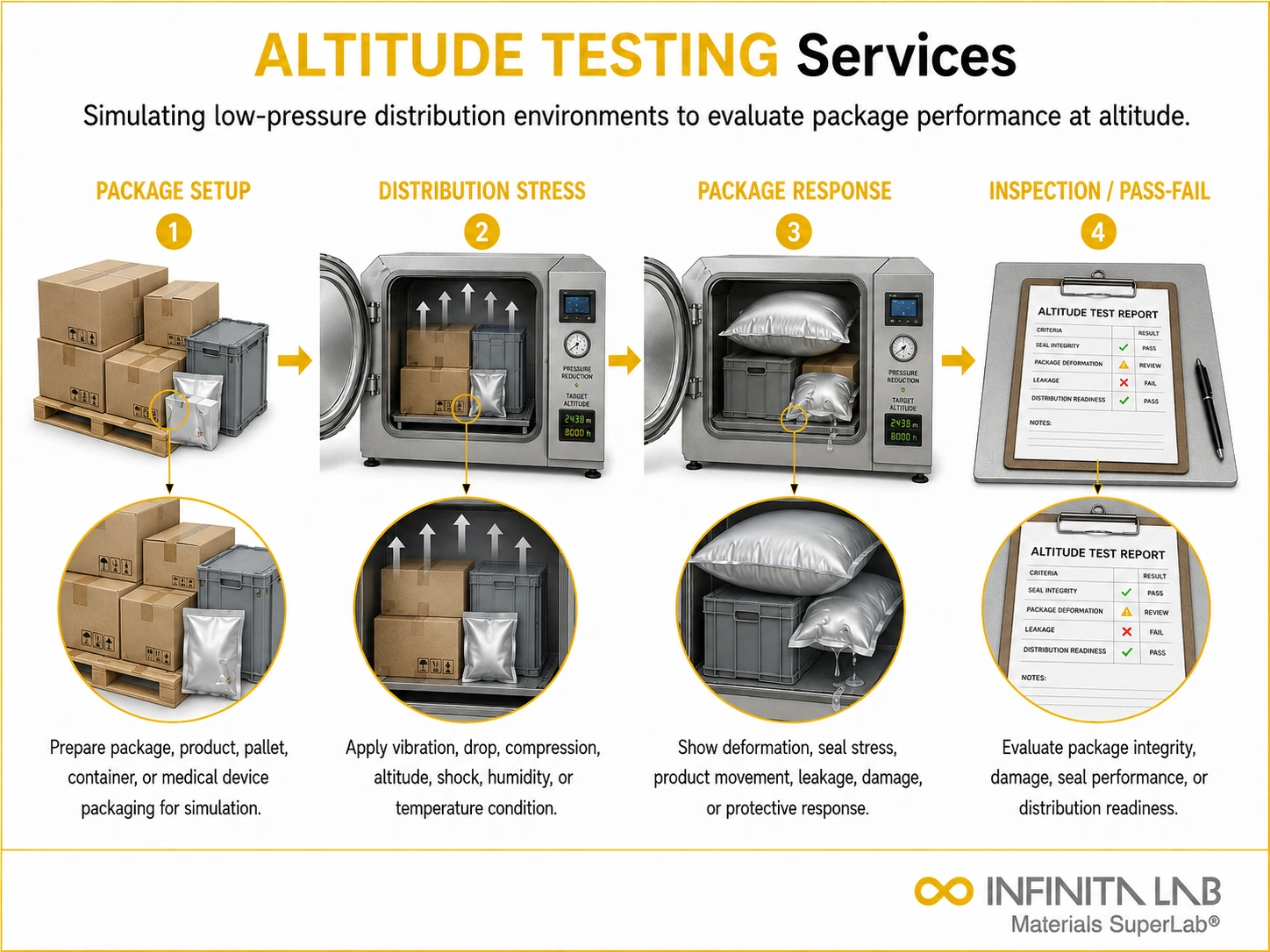
Our Testing Procedure
Define the Test
Set the target altitude, pressure, duration, temperature, and operating condition.
1Establish the Baseline
Document the initial condition and confirm equipment function or package integrity.
2Apply Low Pressure
Reduce the chamber pressure to the specified level and monitor the equipment or package.
3Inspect and Report
Check for functional failure, leakage, seal damage, or deformation and report the pass/fail outcome.
4Altitude Testing Technical Specifications
| Parameter | Details |
|---|---|
| Equipment Standard | MIL-STD-810 Method 500 (low pressure/altitude) |
| Package Standards | ASTM D6653, ASTM D3078, ASTM D4991, ASTM D5094 |
| Controlled Variable | Reduced chamber pressure (simulated equivalent altitude) |
| Modes | Operating and non-operating (equipment); sealed-integrity (packages) |
| Combined Conditions | Temperature combined with altitude where specified |
| Evaluation (equipment) | Function and physical condition at/after altitude |
| Evaluation (packages) | Seal integrity, leakage, deformation |


- Altitude (hypobaric / low-pressure) test chamber with vacuum system
- Pressure control and measurement instrumentation
- Temperature control (for combined altitude-temperature testing)
- Vacuum leak-test apparatus (for ASTM D4991/D5094 package leak methods)
- Bubble-emission leak-detection setup (ASTM D3078)
- Functional monitoring equipment for powered equipment testing
- Data acquisition and recording system
Equipment and Instrumentation Used for Testing
What You Receive: Test Report, Data, and Certification
- Altitude test report – the simulated altitude (chamber pressure), exposure duration, temperature (if combined), product information, and number of samples tested
- Equipment results – function and physical condition during and after low-pressure exposure against the acceptance criteria
- Package results – seal integrity, leakage, and deformation findings, including the leak-detection method used and any leaks observed
- Pass/fail determination – outcome against the applicable standard, with the number of failures (if any)
- Test conditions record – pressure profile, rate of change, dwell time, and operating mode
- Sample identification – product or package description, condition on receipt, and specimen details
Altitude FAQs
Lower air pressure can affect cooling, insulation, sealing and product operation. Testing helps identify failures such as overheating, leakage, swelling, arcing or loss of functionality.
Altitude testing is commonly performed on aerospace equipment, electronics, batteries, medical devices, packaging and automotive components. Products transported by aircraft may also require reduced-pressure evaluation.
The specimen is placed inside a vacuum or altitude chamber where pressure is reduced to simulate a specified elevation. Temperature, operating condition and exposure duration are controlled according to the test plan.
Pressure differences can cause sealed containers, batteries or housings to expand, leak or deform. Testing verifies whether seals and structural components can tolerate these pressure changes.
Yes. Temperature and altitude are often combined because high-elevation environments may also involve extreme heat or cold. Combined testing provides a more realistic assessment of product performance.
Why Choose Infinita Lab for Altitude Testing?
At the core of this breadth is our network of 2,000+ accredited laboratories across the USA, offering access to over 10,000 testing methods and analytical services. From advanced materials characterization (SEM, TEM, RBS, XPS) to mechanical, chemical, environmental, biological, and standardized ASTM/ISO-compliant testing, we deliver unmatched flexibility, specialization, and scale. You are never limited by geography, facility, or methodology — Infinita Lab connects you to the right expertise and testing solution, every time.

Looking for an Accredited Partner for Altitude Testing?
Send query us at hello@infinitalab.com or call us at (888) 878-3090 to learn more about our services and how we can support you.



Request a Quote
Submit your material details and receive testing procedures, pricing, and turnaround time within 24 hours.
 Quick Turnaround and Hasslefree process
 Confidentiality Guarantee
 Free, No-obligation Consultation
 100% Customer Satisfaction
