


Ingress Protection (IP) Testing
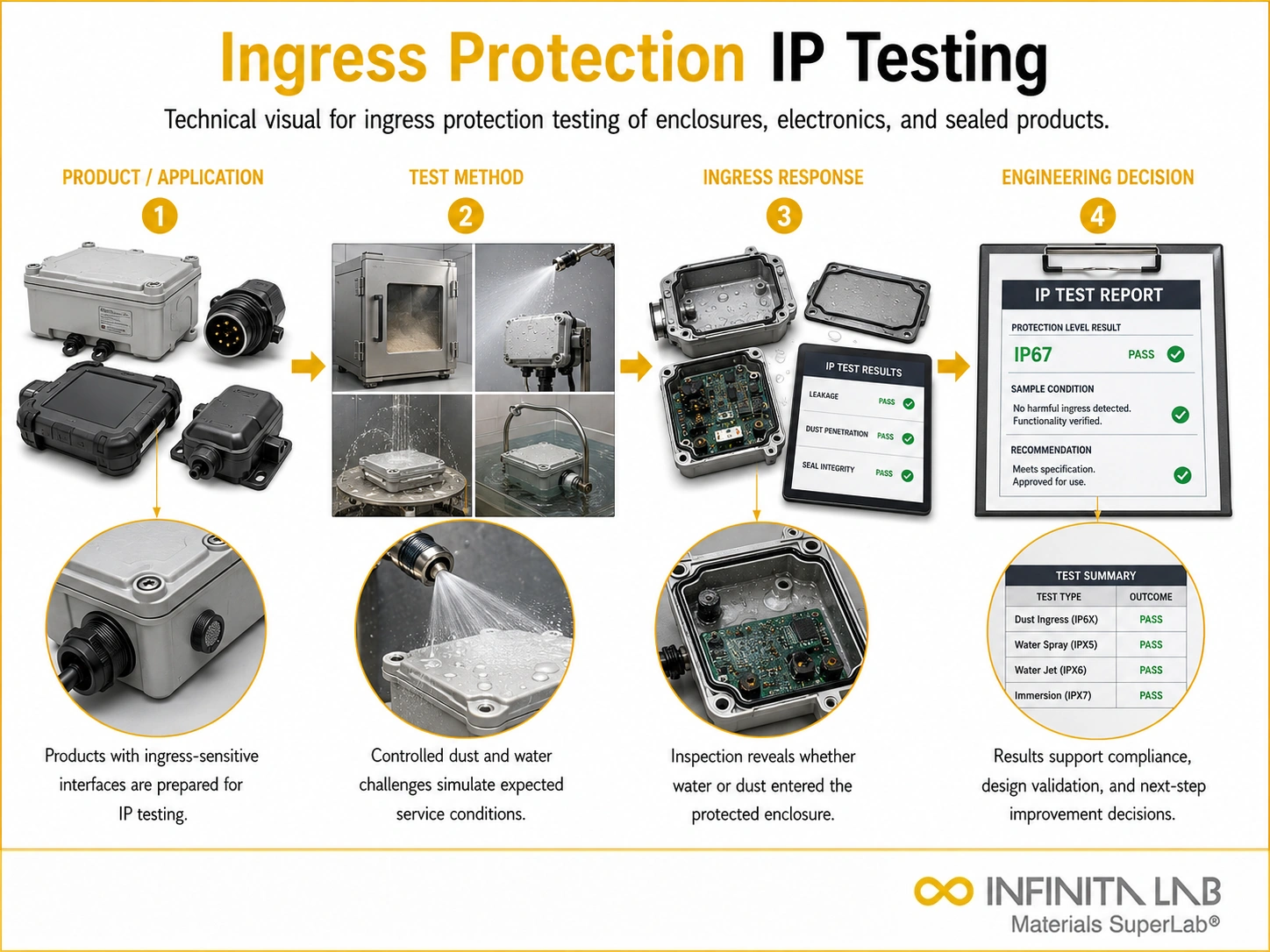
Ingress protection testing is performed to check for a product’s ability to resist the infiltration of water, dust, and other foreign solids to ensure functionality, safety, and product compliance.
TRUSTED BY


Ingress Protection (IP) Testing
- Overview
- Scope, Applications, and Benefits
- Test Process
- Specifications
- Instrumentation
- Results and Deliverables
Ingress Protection (IP) Testing Overview
Ingress Protection (IP) testing, governed by IEC 60529, is the internationally standardized method for evaluating and classifying how well an enclosure or housing protects its contents from the intrusion of solid objects, dust, and water. The IP code consists of two digits: the first describes protection against solid particle intrusion from large objects down to dust, and the second describes protection against water from light drip through high-pressure immersion. An optional third letter can indicate protection against mechanical impact or access by persons.
Every electronic product, electrical enclosure, luminaire, sensor, connector, or device that will be used in anything other than a clean, dry, indoor environment needs to have its IP rating tested and verified. Marking a product with an IP rating without testing to back it up is both misleading and a liability. IP testing confirms that the enclosure design, seals, gaskets, and cable entries actually perform as intended under the defined test conditions.
The tests are sequential and additive -a product claiming IP67 must pass both the IP6X dust test and the IPX7 immersion test. The tests are not interchangeable with NEMA ratings: while there is approximate overlap at certain levels, the test protocols and additional NEMA criteria for corrosion and icing mean the two systems are not directly equivalent and should not be substituted for each other without verification.

Ingress Protection (IP) Testing Scope, Applications, and Benefits
Scope
IEC 60529 IP testing covers solid particle and dust ingress (IP1X through IP6X) and water ingress (IPX1 through IPX9K) for enclosures of electrical equipment. Solid particle tests use standardized contact probes ranging from 50 mm diameter spheres for IP1X through 1 mm probes for IP4X, and dust chamber exposure at reduced pressure for IP5X (dust protected) and IP6X (dust tight). Water tests range from vertical drip (IPX1, IPX2) through angled rain (IPX3), splash from any direction (IPX4), low-pressure water jets (IPX5), strong water jets (IPX6), temporary immersion to 1 m for 30 minutes (IPX7), continuous immersion beyond 1 m (IPX8), and high-pressure hot water jets from any direction (IPX9K). Combined ratings are tested by applying both tests to the same enclosure. The standard applies to enclosures for electrical equipment with rated voltages up to 72.5 kV.
Applications
- Consumer electronics -smartphones, tablets, wearables, and cameras rated IP67 or IP68
- Industrial sensors, transmitters, and instruments for process environments rated IP65 or IP67
- Outdoor electrical enclosures, junction boxes, and distribution panels rated IP54 to IP66
- LED luminaires and outdoor lighting rated IP65 or IP66 for weatherproof service
- Automotive electrical connectors and control modules requiring IP67 or IP69K
- Medical devices and equipment requiring IP21 through IP68 depending on the use environment
- Marine and offshore electrical equipment for salt spray and water immersion exposure
- Food processing and washdown equipment requiring IP69K for high-pressure hot water cleaning
Benefits
- Internationally recognized rating system accepted by regulators, buyers, and specifiers worldwide
- Clear two-digit code directly communicates the level of protection without ambiguity
- Tests are standardized and reproducible -results from accredited labs are comparable globally
- Sequential testing confirms combined ratings are met by the same enclosure
- Identifies sealing weaknesses before products reach the market or field
- Required for CE marking and many regional market access requirements
- Applicable to any product size or construction from small connectors to large switchgear enclosures
Ingress Protection (IP) Testing Process
Pre-Test Inspection and Setup
The enclosure is inspected for assembly completeness. All gaskets, seals, cable glands, and fasteners are verified.
1Solid Particle and Dust Ingress Testing
For IP1X through IP4X, standardized probes are applied to all openings to confirm no access to hazardous internal parts.
2Water Ingress Testing
The applicable water test is performed per the second IP digit. IPX1/X2: drip apparatus at defined flow rate. IPX3/X4: oscillating tube or spray nozzle at defined angles.
3Post-Test Evaluation and Reporting
After each test, the enclosure is examined for evidence of ingress that would be harmful to the equipment.
4Ingress Protection (IP) Testing Technical Specifications
| Parameter | Details |
|---|---|
| Standard | IEC 60529 (Edition 2.2, 2013) |
| First Digit Range | IP0X (no protection) through IP6X (dust tight) |
| Second Digit Range | IPX0 (no protection) through IPX9K (high-pressure hot water) |
| Dust Chamber Conditions | Talcum powder, 8-hour exposure, reduced pressure per IEC 60529 |
| IPX5 Conditions | 12.5 L/min at 3 m distance, 6.3 mm nozzle, all practicable directions |
| IPX6 Conditions | 100 L/min at 3 m distance, 12.5 mm nozzle, all practicable directions |


Instrumentation Used for Ingress Protection (IP) Testing
- IEC 60529 standardized test probes (50 mm sphere, 12.5 mm sphere, 2.5 mm probe, 1 mm probe, articulated finger)
- Dust test chamber with talcum powder and negative pressure control
- Drip test apparatus for IPX1 and IPX2
- Oscillating tube and spray nozzle apparatus for IPX3 and IPX4
- Standard water jet nozzle (6.3 mm) for IPX5
- Large water jet nozzle (12.5 mm) for IPX6
- Immersion tank with depth control for IPX7 and IPX8
- High-pressure hot water test apparatus for IPX9K
Ingress Protection (IP) Testing Results and Deliverables
- Pass/fail result for each IP digit tested
- Achieved IP code based on test results
- Dust ingress observations -quantity and location of any dust found inside the enclosure
- Water ingress observations -volume, location, and whether it would be harmful to internal components
- Test conditions applied for each digit including duration, pressure, flow rate, and distance
- Pre- and post-test photographs of enclosure interior
- Enclosure description including material, gasket type, and all penetrations sealed during test
- Full test report formatted for product documentation, certification body submission, or customer review
Frequently Asked Questions
Laboratories typically require the product's dimensions, intended IP rating, operating configuration, enclosure details, and any special conditions, such as whether the device should be powered during testing.
Yes. Prototype testing is commonly conducted during product development to identify enclosure weaknesses, validate design improvements, and reduce the risk of failure during final certification testing.
An IP (Ingress Protection) rating defines a product's level of protection against the ingress of solid particles and water. The first digit represents protection against solids, while the second digit indicates resistance to water.
Yes. Testing can be performed for a specific target rating, such as IP54, IP65, IP67, or IP68, depending on your product requirements and intended application.
Not necessarily. While IP testing verifies resistance to dust and water ingress, additional environmental tests—such as UV exposure, corrosion, temperature cycling, or impact testing- may be required depending on the product's operating conditions.
Why Choose Infinita Lab for Advanced Materials Testing and Characterization?
At the core of this breadth is our network of 2,000+ accredited laboratories across the USA, offering access to over 10,000 testing methods and analytical services. From advanced materials characterization (SEM, TEM, RBS, XPS) to mechanical, chemical, environmental, biological, and standardized ASTM/ISO-compliant testing, we deliver unmatched flexibility, specialization, and scale. You are never limited by geography, facility, or methodology — Infinita Lab connects you to the right expertise and testing solution, every time.

Looking for a Trusted Partner for Accurate and Reliable Testing Services?
Send query us at hello@infinitalab.com or call us at (888) 878-3090 to learn more about our services and how we can support you.



Request a Quote
Submit your material details and receive testing procedures, pricing, and turnaround time within 24 hours.
 Quick Turnaround and Hasslefree process
 Confidentiality Guarantee
 Free, No-obligation Consultation
 100% Customer Satisfaction
