


IEC Electric Breakdown Strength Testing Services
Accredited IEC electric breakdown strength testing from Infinita Lab, performed to the exact standard requirements - accurate, reproducible results with full documentation for compliance, R&D, and quality control programs.
TRUSTED BY


Get compliant results - request your IEC electric breakdown strength testing quote
- Overview
- Scope, Applications, and Benefits
- Test Process
- Specifications
- Instrumentation
- Results and Deliverables
What Is IEC Electric Breakdown Strength?
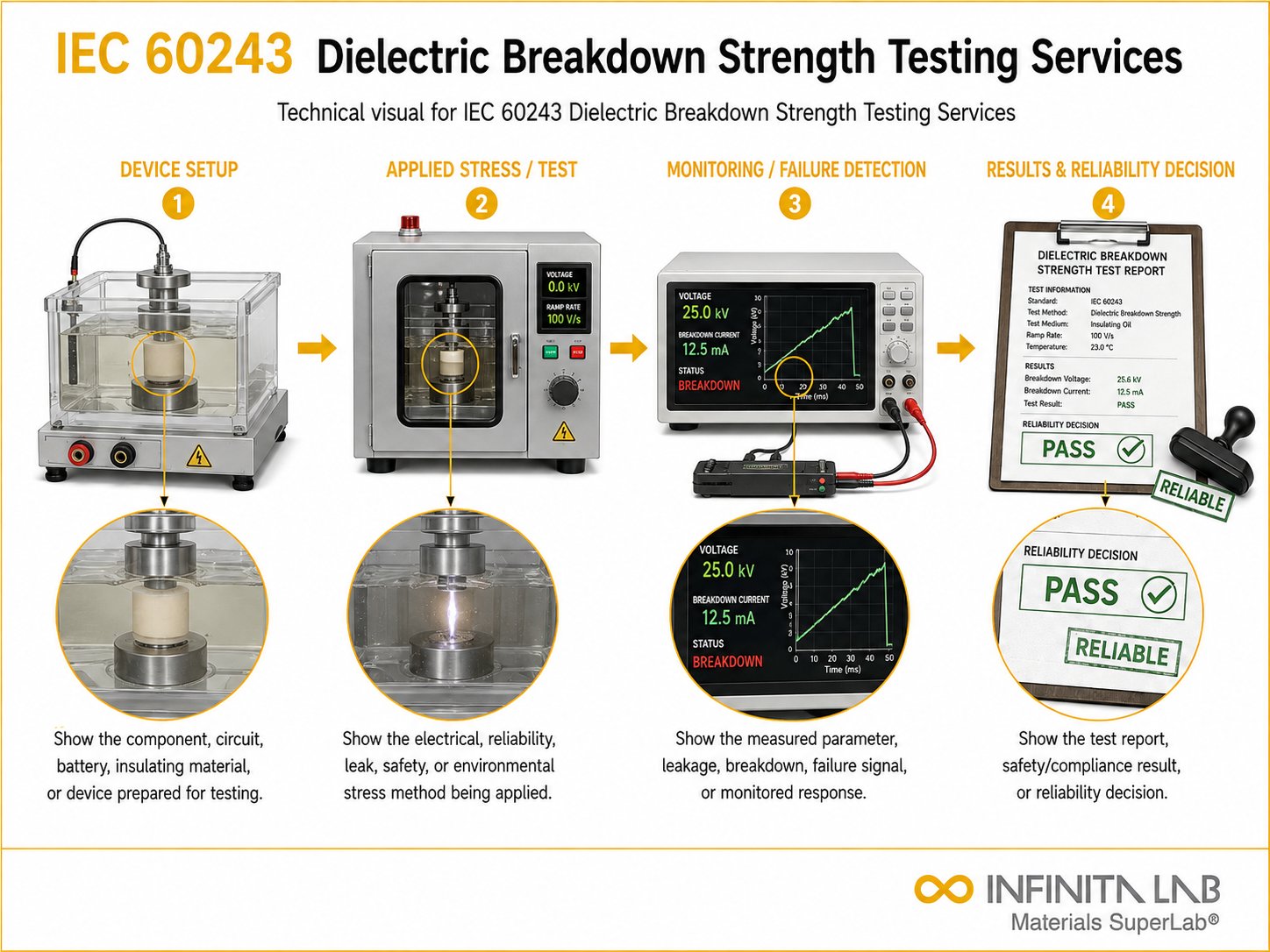
According to the IEC 60243 standard, there is a way to measure the voltage that can be withstood by a solid insulating material without breaking down, under specified test conditions. This is achieved by progressively increasing the voltage applied to the polymers and ceramics, and so forth, to determine the dielectric strength of the material. This is crucial in determining the suitability of the materials, especially when it comes to high-voltage devices and equipment.

Applications and Benefits of IEC Electric Breakdown Strength Testing
Scope
IEC 60243 is an international standard that defines how to rate the electrical strength of solid insulating materials, such as polymers, ceramics, and composites. It defines how to rate these materials to ensure they can withstand high voltage under different environmental conditions and with different electrodes.
The key evaluations of materials are:
- AC breakdown voltage
- DC breakdown voltage
- Dielectric strength in kV/mm
Applications
- Electrical insulation testing for cables and wires
- Transformers, capacitors, and switchgear components
- High-voltage equipment design and qualification
- Quality control of insulating materials
- Research and development of new dielectric materials
- Assessment of polymeric films, laminates, and composites for dielectric performance
Benefits
- Ensures material safety under high-voltage stress
- Detects weak spots and defects in insulating materials
- Supports compliance with international electrical standards
- Provides standardised evaluation of dielectric strength
- Enhances reliability and longevity of electrical components
- Enables material comparison and selection for high-voltage applications
- Reduces risk of insulation failure in critical applications
Our Testing Procedure
Sample Prep & Conditioning
Specimens are cut, measured, and conditioned for temperature and humidity.
1Electrode Setup
Appropriate electrodes are selected based on test type and specimen geometry.
2Voltage Testing
Voltage is applied gradually until breakdown occurs, and data is recorded.
3Verification
Multiple specimens are tested to ensure reliable dielectric strength results.
4Test parameters and requirements
| Parameter | Details |
|---|---|
| Applicable Materials | Solid insulating materials, including polymers, ceramics, laminates, and composites |
| Electrode Types | Spherical, plane, needle |
| Voltage Type | AC or DC, depending on material and requirement |
| Environmental Conditions | Temperature and humidity controlled as specified |
| Output Units | Breakdown voltage (kV), dielectric strength (kV/mm) |


- High-voltage AC/DC test set
- Electrode assemblies (spherical, plane, needle)
- Specimen holders
- Voltage and current measurement devices
- Environmental chamber for temperature/humidity control
- Data acquisition and analysis system
Equipment and Instrumentation Used for Testing
What You Receive: Test Report, Data, and Certification
- Breakdown voltage of tested specimens
- Dielectric strength (kV/mm)
- Statistical analysis of multiple specimens
- Comparative material performance report
- Reports
- Recommendations for material suitability in high-voltage applications
IEC Electric Breakdown Strength FAQs
IEC 60243 evaluates the dielectric strength of solid insulating materials by determining the voltage at which electrical breakdown occurs. It ensures material reliability in high-voltage applications.
Solid insulating materials such as polymers, ceramics, composites, laminates, and high-voltage films can be tested under AC or DC conditions.
Both AC and DC voltages can be applied depending on the material and intended application. The test records the voltage at which breakdown occurs.
The standard uses spherical, plane, or needle electrodes depending on the test method, specimen type, and desired electric field configuration.
Specimen dimensions depend on material type and electrode configuration. Thickness and surface area must be measured accurately to calculate dielectric strength in kV/mm.
IEC 60243-1 determines the short-time electrical strength of solid insulating materials at power frequencies between 48 Hz and 62 Hz. A specimen is placed between electrodes, and the voltage is increased or applied in specified steps until electrical breakdown occurs. The breakdown voltage and specimen thickness are used to calculate dielectric strength, helping evaluate the material’s electrical insulation performance.
The IEC 60243 series evaluates the electrical strength of solid insulating materials under different voltage conditions. Tests apply electrical stress to a specimen until breakdown occurs or the specified voltage withstand requirement is assessed. The results help compare insulation materials and evaluate their resistance to electrical failure. Part 1 covers power-frequency tests, while Parts 2 and 3 address direct-voltage and impulse-voltage tests, respectively.
Why Choose Infinita Lab for IEC Electric Breakdown Strength Testing?
When your IEC Electric Breakdown Strength results have to hold up - for compliance, a customer audit, or an engineering decision - accuracy and an unbiased third-party report matter more than price. Infinita Lab routes your IEC electric breakdown strength testing to ISO/IEC 17025-accredited U.S. partner labs with hands-on method experience, so you get defensible data, transparent reporting, and turnaround times built around your project deadline - not ours.

Looking for an Accredited Partner for IEC Electric Breakdown Strength Testing?
Send query us at hello@infinitalab.com or call us at (888) 878-3090 to learn more about our services and how we can support you.



Request a Quote
Submit your material details and receive testing procedures, pricing, and turnaround time within 24 hours.
 Quick Turnaround and Hasslefree process
 Confidentiality Guarantee
 Free, No-obligation Consultation
 100% Customer Satisfaction
