


ASTM D116: Vitrified Ceramic Electrical Testing Services
Vitrified ceramics have been used in several electrical applications, including producing electrical insulators that are in high demand because of their excellent mechanical properties and durability. ASTM D116 is a set of methods that explain the manufacturing and applications of ceramic insulators.
TRUSTED BY


Get ASTM C598 compliant results — request your glass strain annealing point testing quote
- Overview
- Scope, Applications, and Benefits
- Test Process
- Specifications
- Instrumentation
- Results and Deliverables
What Is ASTM C598 Glass Strain Annealing Point?
ASTM D 116 testing is a standardized specification or test method for vitrified ceramic materials used in electrical applications that tests the physical, mechanical, and electrical properties necessary for classification or verification of vitrified ceramic material performance for insulator, bushing, or electrical component parts. The ASTM D116 specification outlines the property requirements for verifying that vitrified ceramic material meets the performance criteria for material approval, incoming inspection, or validation of electrical components.

Applications and Benefits of ASTM D116 Vitrified Ceramic Electrical Testing
Scope
Vitrified ceramic materials are classified and evaluated according to ASTM D 116, which involves the measurement of a specific number of physical, mechanical, and electrical properties, which are dielectric strength, volume resistivity, flexural strength, water absorption, etc., so that the performance of the ceramics can be checked against the requirements of ASTM D 116.
ASTM D 116 testing evaluates:
- Dielectric strength and electrical insulation performance of vitrified ceramic materials
- Volume resistivity and surface resistivity of ceramic electrical insulation materials
- Flexural strength and mechanical performance of vitrified ceramic specimens
- Water absorption and porosity characteristics of vitrified ceramic material systems
- Compliance with ASTM D 116 minimum electrical and mechanical classification requirements
Applications
- Electrical insulators, bushings, and standoff components for power distribution systems
- High-voltage ceramic insulator materials for transmission and distribution applications
- Ceramic electrical component substrates for industrial and utility power applications
- Vitrified ceramic materials for switchgear, transformer, and electrical enclosure applications
- Ceramic material suppliers requiring ASTM D 116 electrical and mechanical property verification
Benefits
- Supports ASTM D 116 material approval and electrical product specification compliance
- Provides verified electrical and mechanical test data for material supply agreements
- Identifies ceramic material property deficiencies before production processing
- Delivers traceable test records aligned with ASTM D 116 classification requirements
- Reduces production risk by verifying ceramic electrical performance early in the approval cycle
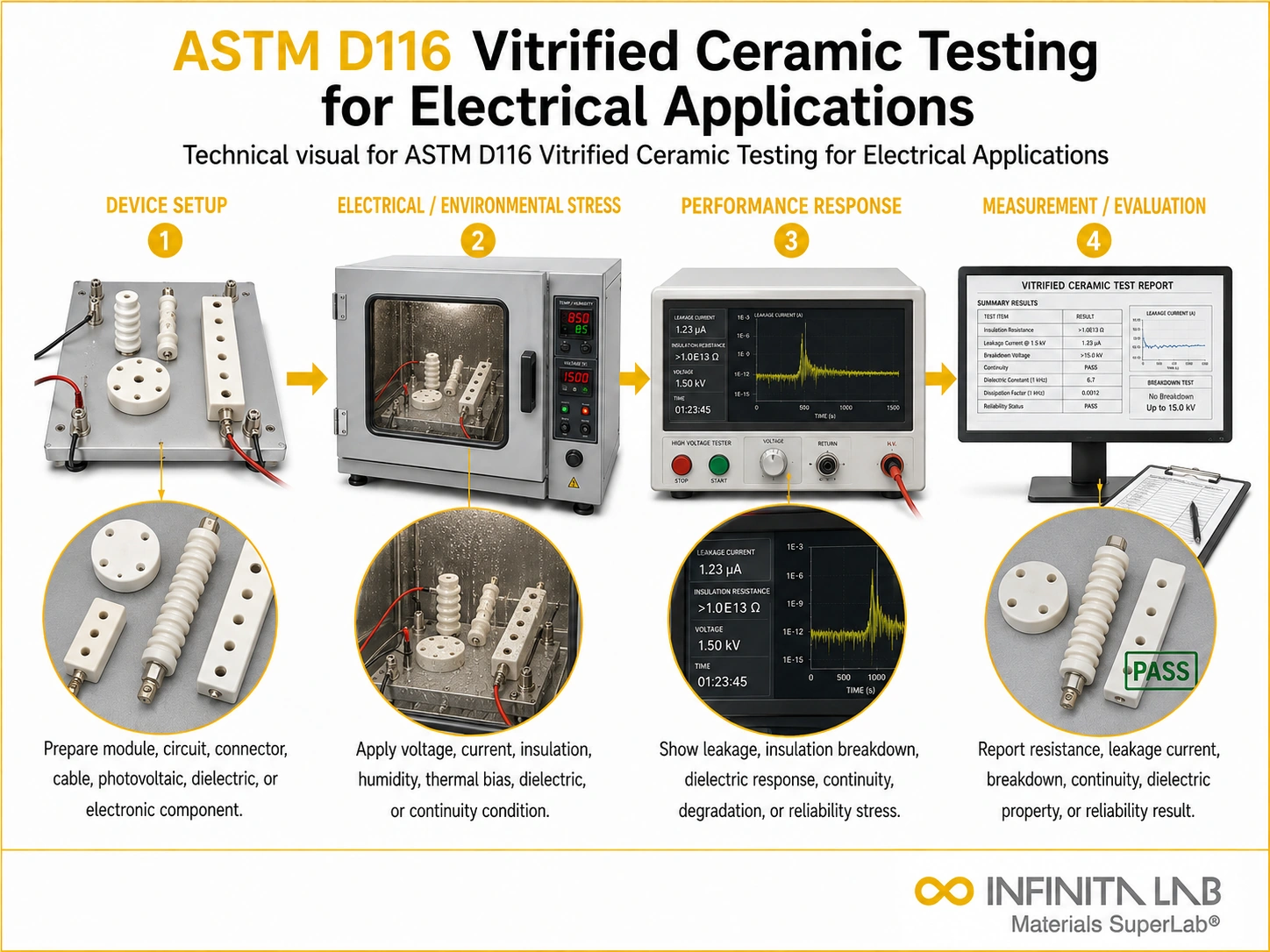
Our ASTM D116 Testing Procedure
Sample Preparation
Vitrified ceramic specimens prepared and conditioned per ASTM D 116 requirements.
1Electrical Property Testing
Specimens tested for dielectric strength, volume resistivity, and surface resistivity.
2Mechanical & Physical Testing
Specimens evaluated for flexural strength, water absorption, and porosity characteristics.
3Data Analysis & Reporting
Measured properties assessed against ASTM D 116 criteria to determine test compliance result.
4ASTM D116 Test Parameters and Requirements
| Parameter | Details |
|---|---|
| Applicable Materials | Vitrified ceramic materials for electrical insulation and component applications |
| Specimen Geometry | Defined specimen dimensions per ASTM D 116 individual test requirements |
| Specimen Conditioning | Pre-test conditioning per ASTM D 116 temperature and humidity requirements |
| Measured Parameters | Dielectric strength, volume resistivity, flexural strength, water absorption, porosity |
| Measured Outputs | Electrical, mechanical, physical property data, and test compliance result |


- High-voltage dielectric strength test apparatus for electrical breakdown measurement
- Volume and surface resistivity measurement system for ceramic insulation assessment
- Universal testing machine for flexural strength property measurement
- Water absorption immersion tank and precision balance for porosity assessment
- Specimen conditioning chamber with temperature and humidity control
- Data acquisition and test reporting system
Equipment and Instrumentation Used for ASTM D116 Testing
What You Receive: Test Report, Data, and Certification
- Electrical property data, including dielectric strength and resistivity, for all tested specimens
- Mechanical property data, including flexural strength per ASTM D 116 conditions
- Physical property data, including water absorption and porosity measurements
- Test compliance result assessed against ASTM D 116 minimum classification requirements
- ASTM D 116 test report
ASTM D116 Vitrified Ceramic Electrical FAQs
ASTM D116 outlines the specifications and test requirements for vitrified ceramic materials used in electrical applications. This standard ensures that these ceramics have the right insulating properties, mechanical strength, and durability for reliable performance in electrical equipment.
Vitrified ceramics offer great electrical insulation, heat resistance, and mechanical strength. These qualities make them ideal for parts like insulators and electrical supports, where dependable performance under electrical stress is crucial.
ASTM D116 includes requirements for electrical insulation performance, mechanical strength, dimensional stability, and resistance to environmental conditions. These standards help ensure that vitrified ceramic materials meet reliability expectations for electrical equipment.
ASTM D116 covers ceramic insulators, electrical bushings, and other vitrified ceramic parts used in power distribution equipment, transformers, and electrical systems that need reliable insulating materials.
ASTM D116 outlines material specifications and testing requirements. However, it may need further evaluation based on operating conditions, electrical load levels, and environmental exposure that components face while in service.
Why Choose Infinita Lab for Vitrified Ceramic Electrical Testing?
At the core of this breadth is our network of 2,000+ accredited laboratories across the USA, offering access to over 10,000 testing methods and analytical services. From advanced materials characterization (SEM, TEM, RBS, XPS) to mechanical, chemical, environmental, biological, and standardized ASTM/ISO-compliant testing, we deliver unmatched flexibility, specialization, and scale. You are never limited by geography, facility, or methodology — Infinita Lab connects you to the right expertise and testing solution, every time.

Looking for an Accredited Partner for ASTM D116 Vitrified Ceramic Electrical Testing?
Send query us at hello@infinitalab.com or call us at (888) 878-3090 to learn more about our services and how we can support you.



Request a Quote
Submit your material details and receive testing procedures, pricing, and turnaround time within 24 hours.
 Quick Turnaround and Hasslefree process
 Confidentiality Guarantee
 Free, No-obligation Consultation
 100% Customer Satisfaction
