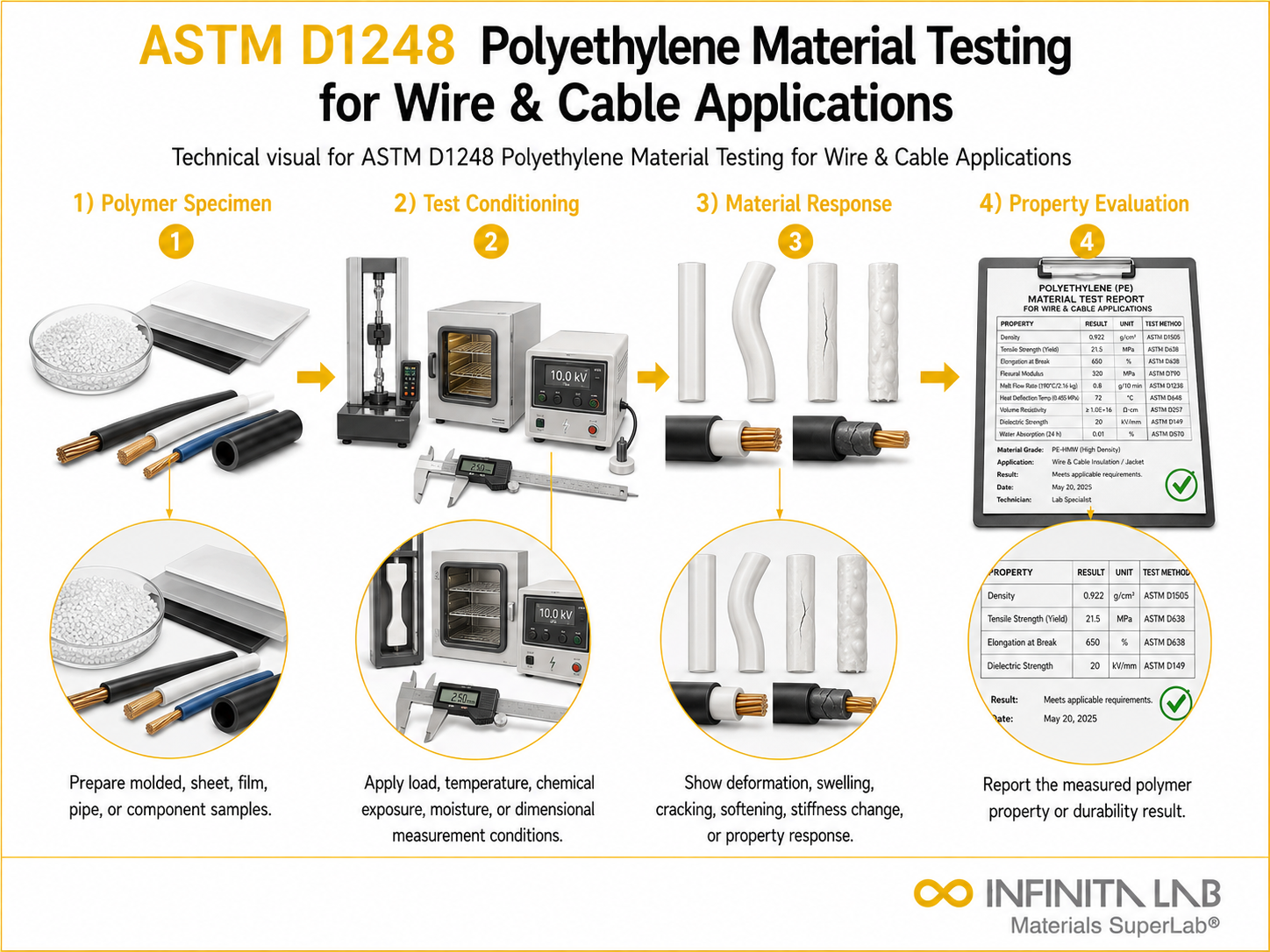


What Is ASTM D1248 Polyethylene Wire Cable?
ASTM D1248 — formerly titled the Standard Specification for Polyethylene Plastics Molding and Extrusion Materials in its earlier editions — is a long-standing ASTM International specification. It classifies polyethylene plastics by Type, Class, Category, and Grade, based on properties such as density and melt flow rate. First issued decades ago to give buyers and sellers of polyethylene resin a shared vocabulary for lot-to-lot material acceptance, it went on to become especially influential in the wire and cable industry, where compounders and cable manufacturers leaned on its Type, Category, Class, and Grade system to identify insulation and jacketing compounds with consistent electrical, mechanical, and environmental performance.
Here’s something worth clearing up: contrary to a fairly common assumption, ASTM D1248 hasn’t been withdrawn. It’s still very much active, most recently reissued as ASTM D1248-25 under ASTM Committee D20.15, and it’s maintained in Volume 08.01 of the Annual Book of ASTM Standards. What did change, though, is its scope. Following a major revision after the 1989 reapproval, the specification narrowed from covering general polyethylene molding and extrusion materials to focusing exclusively on polyethylene extrusion materials used for wire and cable. If you’re after classification of broader polyethylene molding and extrusion resins outside the wire and cable space, that’s now the job of the companion specification, ASTM D4976.
At Infinita Lab, we help resin producers, compounders, and cable manufacturers verify polyethylene material properties against the current ASTM D1248 classification framework — density-based Type designation, flow-rate-based Category, plus Class and Grade — alongside the referenced test methods covering tensile properties, brittleness temperature, environmental and thermal stress-crack resistance, and key electrical characteristics. Whether you need routine lot-acceptance testing or a full classification workup for a new compound formulation, our accredited testing network delivers accurate, standards-traceable results, so you’re not stuck managing multiple lab relationships on your own.

Applications and Benefits of ASTM D1248 Polyethylene Wire Cable Testing
Scope
ASTM D1248 evaluates polyethylene materials used in wire and cable applications by defining key physical, electrical, and thermal properties required for performance and classification.
The test evaluates:
- ASTM D1248 lays out a standardized system for identifying and classifying polyethylene plastics extrusion materials intended for wire and cable applications.
- Each material receives a Type designation (0, I, II, III, IV) based on density, spanning low-density through high-density polyethylene.
- Flow rate, determined through melt index testing, further sorts materials into a Category (1 through 5).
- A Class designation (A through D) captures additional compositional and performance characteristics, including whether carbon black or other additives are present.
- Grade (E1 through E10) adds a further layer of distinction in composition and intended end use.
- Mechanical test methods referenced include ASTM D638 for tensile strength and elongation at break.
- Brittleness temperature is addressed through ASTM D746, while environmental stress-crack resistance falls under ASTM D1693.
- Types III and IV also get evaluated for thermal stress-crack resistance per ASTM D2951.
- Electrical property requirements in the specification cover dissipation factor, dielectric constant, and volume resistivity.
- A prior major revision narrowed the standard’s scope to wire and cable extrusion materials specifically, with general polyethylene molding and extrusion materials now falling under ASTM D4976.
Applications
- Wire and cable manufacturers use it to qualify insulation and jacketing compounds when verifying incoming polyethylene resin lots.
- Quality control and lot-acceptance testing between polyethylene resin suppliers and cable compounders relies on this same framework.
- Compound formulators developing new polyethylene blends for cable applications turn to it for material classification support.
- It’s also useful for comparative benchmarking of polyethylene resins against historical Type, Class, Category, and Grade designations referenced in legacy cable specifications.
- Supplementary characterization alongside industry cable standards such as ICEA and UL specifications, which reference polyethylene material properties, is another common use.
- When polyethylene insulation or jacketing underperforms in service, this testing supports failure investigation and root-cause analysis.
- Research and development teams rely on it too, testing polyethylene compounds intended for electrical, telecommunications, or power distribution cable applications.
Benefits
- Density, melt flow, mechanical, and electrical properties are all confirmed using consistent, repeatable ASTM-referenced test methods.
- Lot-to-lot consistency verification becomes easier, reducing the risk of accepting off-specification polyethylene material.
- Environmental and thermal stress-crack resistance issues can be caught before a compound ever reaches production.
- The documented, standards-traceable data that comes out of testing supports supplier qualification and customer specification compliance.
- Communication between resin producers, compounders, and cable manufacturers gets easier too, since everyone’s working from the same classification vocabulary.
Our ASTM D1248 Testing Procedure
Sample Preparation
Polyethylene material is molded or cut into test specimens.
1Conditioning
Samples are conditioned under controlled environmental conditions.
2Property Evaluation
Electrical, mechanical, and thermal tests are conducted.
3Data Recording & Evaluation
Results are analyzed to classify material performance.
4ASTM D1248 Test Parameters and Requirements
| Parameter | Details |
|---|---|
| Applicable Materials | Polyethylene (PE) for wire and cable |
| Density Range | ~0.91 to 0.96 g/cm³ |
| Tensile Strength | ~10 MPa to 30 MPa |
| Dielectric Strength | ~15 kV/mm to 40 kV/mm |
| Operating Temperature | ~-40°C to 90°C |
| Measured OutputsMeasured Outputs | Electrical, mechanical, thermal properties |


- Density Gradient/Density Testing Equipment — Used to determine material density for Type classification.
- Melt Flow Indexer — Measures flow rate under standardized load and temperature to establish the Category designation.
- Universal Tensile Testing Machine — Captures tensile strength and elongation at break per ASTM D638.
- Brittleness Temperature Testing Apparatus — Pinpoints the low-temperature brittleness point per ASTM D746.
- Environmental Stress-Crack Resistance Chamber — Evaluates resistance to cracking under stress and chemical exposure per ASTM D1693.
- Dielectric and Electrical Property Test Equipment — Handles measurement of dissipation factor, dielectric constant, and volume resistivity.
- Specimen Conditioning and Molding Equipment — Prepares test specimens under controlled, standardized conditions before testing begins.
Equipment and Instrumentation Used for ASTM D1248 Testing
What You Receive: Test Report, Data, and Certification
- A comprehensive test report documenting measured density, flow rate, and mechanical, thermal, and electrical property results.
- Confirmed material classification, covering Type, Category, Class, and Grade designation per ASTM D1248.
- A pass/fail determination against client-specified acceptance criteria or referenced cable industry requirements.
- Supporting raw data and specimen preparation records, kept for audit, traceability, and regulatory documentation purposes.
- Practical guidance on material suitability for intended wire and cable insulation or jacketing applications.
- One consolidated report, even when testing spans multiple accredited laboratories within our partner network.
ASTM D1248 Polyethylene Wire Cable FAQs
ASTM D1248 provides classification and specification for polyethylene plastics used in wire and cable insulation. It defines material types, properties, and performance requirements to ensure reliability in electrical applications.
Key parameters include density, melt index, tensile strength, elongation, environmental stress cracking, and electrical properties. These parameters help classify polyethylene grades for specific cable applications.
The test provides classification based on physical, mechanical, and electrical properties. Results indicate material suitability for insulation, jacketing, and long-term electrical performance.
ASTM D1248 applies to polyethylene materials, including low-density, medium-density, and high-density polyethylene used in wire and cable insulation systems.
ASTM D1248 provides material classification but may not fully represent performance under extreme environmental or operational conditions. Additional testing may be required for specific applications or long-term durability evaluation.
ASTM D1248 is the specification for polyethylene plastics used in molding and extrusion materials. It evaluates polyethylene based on properties such as density, melt index, and environmental stress-crack resistance to classify the material and verify compliance with specified requirements. ASTM D1248-25 covers polyethylene extrusion materials for wire and cable. Testing evaluates density, flow rate, tensile properties, environmental stress-crack resistance, and electrical properties to verify material classification and compliance with specifications.
Why Choose Infinita Lab for Polyethylene Wire Cable Testing
When your Polyethylene Wire Cable results have to hold up - for compliance, a customer audit, or an engineering decision - ASTM D1248 accuracy and an unbiased third-party report matter more than price. Infinita Lab routes your ASTM D1248 polyethylene wire cable testing to ISO/IEC 17025-accredited U.S. partner labs with hands-on method experience, so you get defensible data, transparent reporting, and turnaround times built around your project deadline - not ours.

Need ASTM D1248 Polyethylene Wire Cable Testing You Can Rely On?
Send query us at hello@infinitalab.com or call us at (888) 878-3090 to learn more about our services and how we can support you.





