


Fire Resistance Testing Services for Plastics & Materials
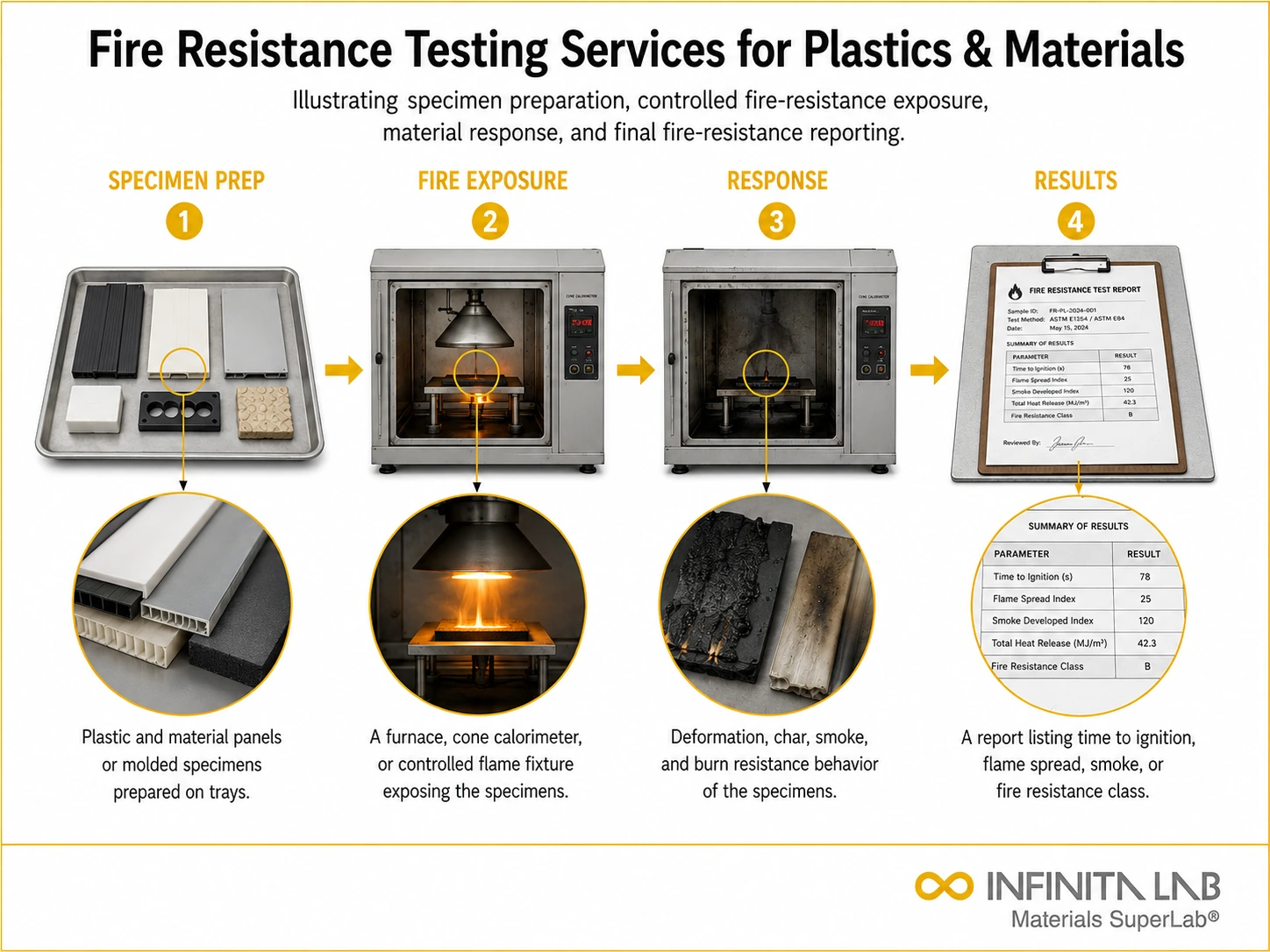
Services for evaluating fire resistance determine how well products and materials can withstand fire and contain it. These tests are essential for assuring the security of structures, transportation networks, and a variety of products, especially in sectors with a high fire risk. The basic goal is to guarantee that components or assemblies can either delay the spread of flames for a predetermined amount of time or resist combustion for that time.
TRUSTED BY


Precision Testing Solutions for Accurate, Reliable, and Standards-Compliant Results
- Overview
- Scope, Applications, and Benefits
- Test Process
- Specifications
- Instrumentation
- Results and Deliverables
Fire Resistance Testing Overview
Fire resistance testing evaluates how plastic materials respond to heat and flame exposure. Infinita Lab’s fire resistance testing services assess ignitability, flame spread rate, smoke generation, and self-extinguishing behavior under controlled, standardized conditions. These tests are critical for product safety compliance in construction, automotive, electronics, and consumer goods industries.

Scope, Applications, and Benefits
Scope
Fire resistance testing covers a broad range of plastic materials and finished products. We evaluate:
- Ignitability and flame propagation behavior
- Heat release rate and smoke density
- Self-extinguishing characteristics
- Flame spread index and critical radiant flux
Applications
- Building and construction materials
- Automotive interior components
- Electrical and electronic enclosures
- Furniture and upholstery materials
- Consumer product safety compliance
Benefits
- Ensures compliance with national and international fire safety regulations
- Reduces product liability risk through standardized testing
- Supports material selection and formulation optimization
- Accelerates approval and market entry
Fire Resistance Testing Test Process
Sample Preparation
Specimens are conditioned to standard temperature and humidity per test method requirements, then cut or molded to specified dimensions.
1Flame Exposure
The specimen is subjected to a defined flame or radiant heat source for a specified duration under controlled laboratory conditions.
2Observation and Measurement
Flame spread, afterflame time, afterglow, dripping behavior, and smoke generation are observed and recorded in real time.
3Reporting
All measured parameters are compiled into a detailed test report with pass/fail classification per the applicable standard.
4Fire Resistance Testing Technical Specifications
| Parameter | Details |
|---|---|
| Applicable Standards | ASTM E84, ISO 11925, UL 94, BS 476 |
| Applicable Materials | Plastics, polymers, composites, insulation materials |
| Specimen Conditioning | 23°C ± 2°C, 50% ± 5% RH for 48 hours |
| Flame Source | Bunsen burner / radiant panel (standard-specific) |
| Measured Outputs | Afterflame time, burn length, flame spread index |


Instrumentation Used for Testing
- Fire resistance test chamber
- Smoke density measurement system
- Heat flux and temperature sensors
- Ignition source apparatus
- Data acquisition and control system
- Environmental conditioning equipment
Results and Deliverables
- Flame spread and ignition characteristics
- Smoke density and emission data
- Heat release rate profiles
- Fire classification and compliance reports
Frequently Asked Questions
Fire resistance testing determines how materials behave under fire exposure, including ignition, flame spread, and smoke production. It helps ensure safety, regulatory compliance, and suitability of materials for applications where fire risk is a critical concern.
Industries such as automotive, aerospace, electronics, and transportation rely heavily on fire resistance testing. These sectors require materials to meet strict safety standards to prevent fire hazards and ensure reliable performance in high-risk environments.
Fire resistance testing is conducted using internationally recognized standards such as ASTM, ISO, and UL. These standards define testing procedures, conditions, and evaluation criteria to ensure consistency, reliability, and regulatory acceptance across industries.
Key parameters include ignition time, flame spread rate, heat release rate, smoke density, and self-extinguishing behavior. These measurements provide a comprehensive understanding of how a material reacts under fire exposure conditions.
Smoke generation is critical because it affects visibility and toxicity during a fire event. High smoke levels can hinder evacuation and pose health risks, making it an essential parameter in evaluating overall fire safety performance.
Why Choose Infinita Lab for Advanced Materials Testing and Characterization?
At the core of this breadth is our network of 2,000+ accredited laboratories across the USA, offering access to over 10,000 testing methods and analytical services. From advanced materials characterization (SEM, TEM, RBS, XPS) to mechanical, chemical, environmental, biological, and standardized ASTM/ISO-compliant testing, we deliver unmatched flexibility, specialization, and scale. You are never limited by geography, facility, or methodology — Infinita Lab connects you to the right expertise and testing solution, every time.

Looking for a Trusted Partner for Accurate and Reliable Testing Services?
Send query us at hello@infinitalab.com or call us at (888) 878-3090 to learn more about our services and how we can support you.



Request a Quote
Submit your material details and receive testing procedures, pricing, and turnaround time within 24 hours.
 Quick Turnaround and Hasslefree process
 Confidentiality Guarantee
 Free, No-obligation Consultation
 100% Customer Satisfaction
