


ASTM D4218: Determination Of Carbon Black Content In Polyethylene Compounds Testing Services
The ASTM D4218 test method uses the Muffle-Furnace technique to determine the presence of channel or furnace black in black polyethylene compounds. This testing process can generate duplicate test data in 20 minutes or less for a simple carbon black content measurement.
TRUSTED BY


Get ASTM D4218 compliant results — request your determination of carbon black content in polyethylene compounds testing quote
- Overview
- Scope, Applications, and Benefits
- Test Process
- Specifications
- Instrumentation
- Results and Deliverables
What Is ASTM D4218 Determination Of Carbon Black Content In Polyethylene Compounds?
ASTM D4218 is the standard test method for determining the carbon black content of polyethylene compounds by muffle furnace ignition. Carbon black is added to polyethylene pipe, fittings, geomembranes, wire and cable jacketing, and other outdoor polyethylene products as a UV stabilizer -it absorbs ultraviolet radiation and prevents photodegradation of the polymer that would otherwise cause surface embrittlement, cracking, and premature failure in outdoor service. The carbon black content, typically specified at 2 to 3 percent by weight for pipe-grade and geomembrane-grade polyethylenes, must be measured and controlled because too little provides inadequate UV protection and too much can negatively affect mechanical properties and processability.
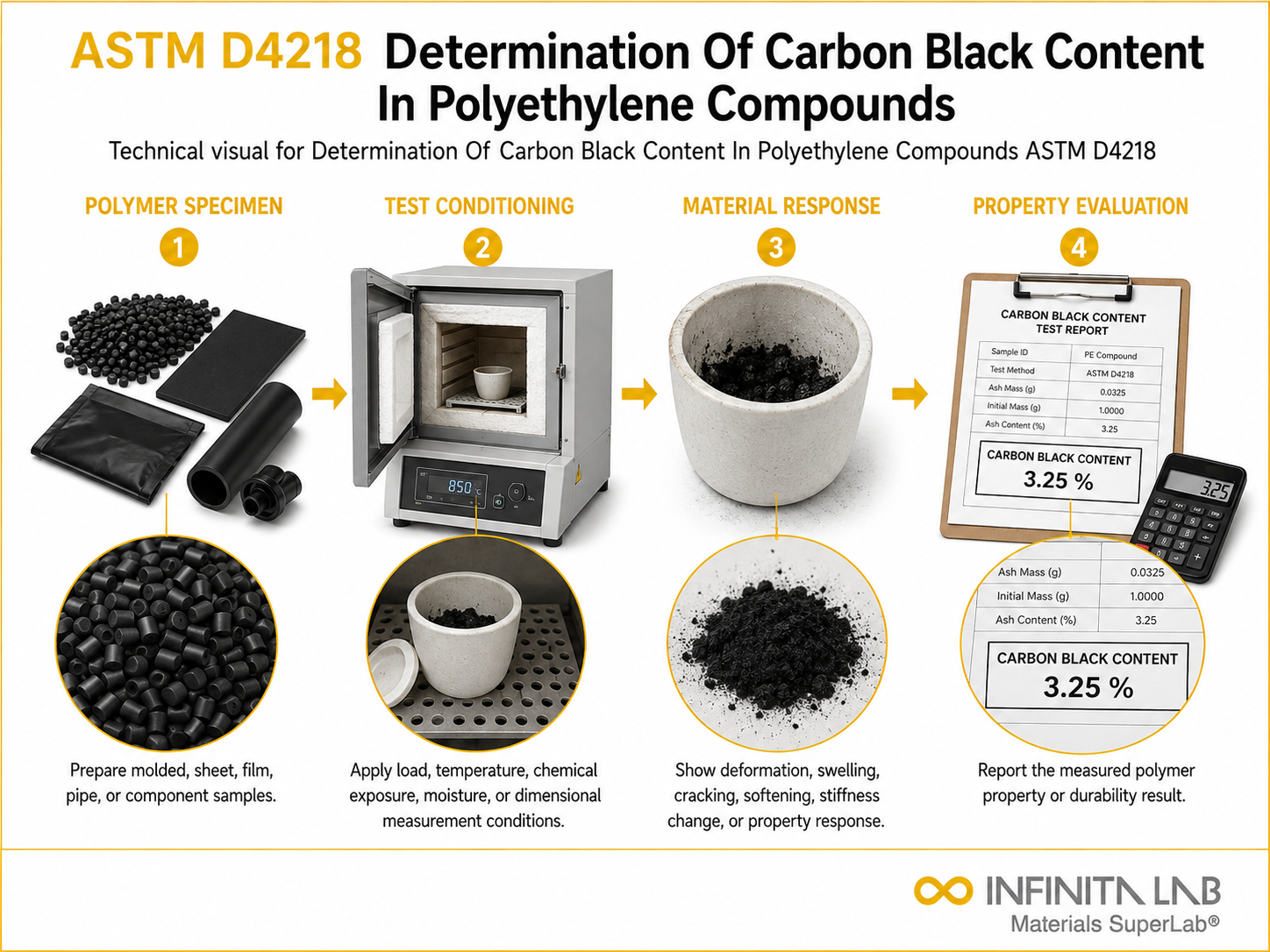
The test works by oxidizing the polymer matrix in a muffle furnace under controlled atmospheric conditions. The polyethylene burns off at elevated temperature, and the carbon black, which has a higher ignition temperature than the polymer, remains as a residue. The weight of the residue relative to the initial sample mass gives the carbon black content by weight percent. The method is specific to polyethylene -it is not applicable to materials that contain other inorganic fillers, since those would also remain as residue and confound the carbon black measurement.
ASTM D4218 is the primary test method cited in ASTM D3350 (PE plastic pipe and fittings), ASTM D1248 (PE for wire and cable), and ASTM F714 (PE pipe) for carbon black content verification. It is a required test in many pipe and geomembrane quality control programs and is referenced by standards for water distribution, gas distribution, industrial piping, and environmental containment applications.

Applications and Benefits of ASTM D4218 Determination Of Carbon Black Content In Polyethylene Compounds Testing
Scope
ASTM D4218 applies to polyethylene compounds containing carbon black as the sole inorganic filler. The test is performed by weighing a specimen of known mass, placing it in a ceramic crucible, and igniting it in a muffle furnace at the specified temperature under conditions that combust the polymer while leaving the carbon black as residue. The carbon black content is calculated from the ratio of residue mass to initial specimen mass, expressed as weight percent. For polyethylene compounds that contain inorganic fillers in addition to carbon black, alternative methods such as thermogravimetric analysis (TGA) or ASTM D1603 (tube furnace method) may be required to separate carbon black from inorganic ash. The standard falls under ASTM Committee D20 on Plastics.
Applications
- PE pipe carbon black content verification per ASTM D3350 and ASTM F714 for water and gas distribution systems
- Geomembrane and geosynthetic PE sheet carbon black content testing for environmental liner quality control
- PE wire and cable jacketing carbon black content verification per ASTM D1248
- Incoming quality control of carbon black masterbatch lots used in PE compounding
- Production quality control of black PE compound lots before extrusion into pipe, film, or profile
- Specification conformance testing for PE compounds where carbon black content is a defined requirement
- Carbon black dispersion evaluation in combination with D4218 content measurement and ASTM D5596 dispersion rating
- Failure investigation for outdoor PE products that have experienced premature UV-related degradation
Benefits
- Simple, fast test requiring only a muffle furnace and analytical balance -no specialized analytical instrumentation
- Directly measures the carbon black content that protects the product in outdoor service
- Referenced by ASTM D3350 and F714 as the acceptance test method for PE pipe and fittings
- Low cost and rapid turnaround make it practical for routine production and incoming inspection
- Results in weight percent directly comparable to specification requirements and supplier certifications
- Identifies under-loaded compound lots that would have insufficient UV protection in service
- Applicable to all grades of PE -HDPE, MDPE, LDPE, and LLDPE -containing carbon black
Our ASTM D4218 Testing Procedure
Sample Preparation and Weighing
A representative sample of the PE compound -pellets, granules, or cut film -is placed in a pre-weighed, pre-ashed ceramic crucible.
1Muffle Furnace Ignition
The crucible containing the sample is placed in a muffle furnace set to the specified ignition temperature.
2Residue Weighing
After ignition and cooling in a desiccator, the crucible and residue are weighed to the nearest 0.1 mg.
3Calculation and Reporting
Carbon black content is calculated as the ratio of residue mass to initial sample mass, expressed as weight percent.
4ASTM D4218 Test Parameters and Requirements
| Parameter | Details |
|---|---|
| Standard | ASTM D4218-20 |
| ASTM Committee | D20 – Plastics |
| Applicable Material | Polyethylene compounds containing carbon black as the sole inorganic component |
| Ignition Method | Muffle furnace at specified temperature and duration |
| Sample Mass | Typically 1 to 3 grams |
| Weighing Precision | 0.1 mg (analytical balance) |


- Muffle furnace capable of the specified ignition temperature with temperature control
- Ceramic crucibles -pre-ashed and tared before use
- Analytical balance accurate to 0.1 mg for specimen and residue weighing
- Desiccator for cooling crucibles before weighing without moisture absorption
- Tongs and heat-resistant handling equipment for hot crucible handling
- Pilot flame or auxiliary burner for pre-ashing where specified by the test method variant
Equipment and Instrumentation Used for ASTM D4218 Testing
What You Receive: Test Report, Data, and Certification
- Carbon black content in weight percent for each specimen tested
- Average carbon black content and range across replicate specimens
- Initial specimen mass, residue mass, and calculated percent for each replicate
- Muffle furnace temperature and ignition duration
- Comparison to specification requirement -typically 2.0 to 3.0 percent for pipe and geomembrane applications
- Material identification -compound type, grade, lot number, and form (pellets, granules, or film)
- Full test report formatted for production quality records, incoming inspection, or specification conformance documentation
ASTM D4218 Determination Of Carbon Black Content In Polyethylene Compounds FAQs
ASTM D4218 measures the carbon black content in polyethylene compounds by burning off the polymer matrix in a controlled muffle furnace. The remaining residue is used to quantify carbon black loading.
Carbon black improves UV resistance, electrical conductivity, and mechanical durability. Accurate content verification ensures consistent performance in applications like pipes, cables, and geomembranes.
The sample is heated at high temperature in an oxygen-controlled environment, allowing the polymer to decompose while carbon black remains as a stable residue for measurement.
No. ASTM D4218 specifically quantifies total residue as carbon black content, so additional analytical methods may be needed to separate other inorganic fillers if present.
Why Choose Infinita Lab for Determination Of Carbon Black Content In Polyethylene Compounds Testing?
At the core of this breadth is our network of 2,000+ accredited laboratories across the USA, offering access to over 10,000 testing methods and analytical services. From advanced materials characterization (SEM, TEM, RBS, XPS) to mechanical, chemical, environmental, biological, and standardized ASTM/ISO-compliant testing, we deliver unmatched flexibility, specialization, and scale. You are never limited by geography, facility, or methodology — Infinita Lab connects you to the right expertise and testing solution, every time.

Need ASTM D4218 Determination Of Carbon Black Content In Polyethylene Compounds Testing You Can Rely On?
Send query us at hello@infinitalab.com or call us at (888) 878-3090 to learn more about our services and how we can support you.



Request a Quote
Submit your material details and receive testing procedures, pricing, and turnaround time within 24 hours.
 Quick Turnaround and Hasslefree process
 Confidentiality Guarantee
 Free, No-obligation Consultation
 100% Customer Satisfaction
