


ASTM D3034: PVC Sewer Pipe Testing Services
ASTM D3034-21 test method determines the requirements and test methods for materials, dimensions, workmanship, flattening resistance, impact resistance, pipe stiffness, extrusion quality, joining systems, and a form of marking for type PSM (PVC) sewer pipe and fittings. The final results of this method are displayed keeping in view the international standards and inch-pound units.
TRUSTED BY


Get ASTM D3034 compliant results — request your PVC sewer pipe testing quote
- Overview
- Scope, Applications, and Benefits
- Test Process
- Specifications
- Instrumentation
- Results and Deliverables
What Is ASTM D3034 PVC Sewer Pipe?
ASTM D3034 is the standard specification for Type PSM (Poly Vinyl Chloride, Standard Manhole-to-manhole) PVC sewer pipe and fittings. It defines the requirements that a PVC gravity sewer pipe must meet to be suitable for collecting and conveying sanitary and storm sewage in buried gravity-flow systems. Because these pipes are installed underground and must remain serviceable for decades while resisting soil loads, traffic loads, and the corrosive environment of sewage, the specification covers a comprehensive set of material, dimensional, and performance requirements.
The specification establishes requirements for the PVC material, pipe and fitting dimensions, workmanship, and several performance properties: flattening resistance, impact resistance, pipe stiffness, and extrusion quality, along with the joining systems and product marking. Pipe stiffness is particularly important for buried gravity sewer pipe – it characterizes how the pipe resists deflection under the load of the soil and any surface loading above it, which is central to the long-term performance of a flexible PVC sewer line.
Testing to ASTM D3034 verifies that PSM PVC sewer pipe and fittings meet each of these requirements, confirming the product is fit for service in gravity sewer applications. Results are reported in inch-pound units (with SI considered). The standard is widely referenced in municipal and infrastructure specifications for PVC sewer pipe.

Applications and Benefits of ASTM D3034 PVC Sewer Pipe Testing
Scope
ASTM D3034 covers the requirements and test methods for Type PSM PVC sewer pipe and fittings, spanning material, dimensions, workmanship, and performance properties. Verification confirms the product meets the specification across the following:
- Material requirements – verification of the PVC compound used against the specification’s material requirements
- Dimensions – pipe diameter, wall thickness, and dimensional tolerances (PSM pipe is defined by standard dimension ratios)
- Workmanship – freedom from defects, with the pipe homogeneous and free of visible cracks, holes, and foreign inclusions
- Pipe stiffness – resistance to deflection under load, determined by parallel-plate loading per ASTM D2412, a key performance property for buried gravity pipe
- Flattening resistance – the pipe’s ability to be flattened to a defined deflection without splitting, cracking, or breaking
- Impact resistance – resistance to impact, confirming the pipe will withstand handling and installation
- Extrusion quality – verified by an acetone immersion test that detects improperly fused (under-extruded) PVC
- Joining systems and marking – verification of the joint system (typically elastomeric gasketed or solvent-cement joints) and the required product marking
Applications
- Gravity sanitary sewer systems – verification of PVC pipe used in municipal and private sanitary sewage collection lines
- Storm sewer systems – confirming PVC pipe for storm-water gravity drainage applications
- Municipal infrastructure projects – qualifying PSM PVC sewer pipe and fittings against project and municipal specifications that reference ASTM D3034
- Pipe manufacturing QC – routine production testing of PVC sewer pipe for stiffness, impact, flattening, and extrusion quality to confirm conformance
- Incoming material acceptance – verifying that delivered sewer pipe meets the D3034 requirements before installation
- Failure investigation – determining whether a sewer pipe met its D3034 stiffness, dimensional, or extrusion-quality requirements when investigating a pipe failure or excessive deflection
- Supplier qualification – establishing that a pipe supplier’s product consistently meets the specification
Benefits
- Verifies fitness for buried gravity-sewer service – the combination of stiffness, impact, flattening, and extrusion-quality testing confirms the pipe will perform under the soil and traffic loads of an underground sewer line
- Pipe stiffness data predicts in-ground deflection behavior – stiffness is the property most directly tied to how a flexible PVC pipe will deflect under load in service, making it central to predicting long-term performance
- Extrusion-quality (acetone) test catches poor fusion – the acetone immersion test reveals under-fused PVC that would otherwise be a hidden weakness, an important quality safeguard
- Covers the full requirement set in one program – material, dimensions, workmanship, and the performance properties can be verified together to fully qualify the pipe against the specification
- Supports acceptance in infrastructure projects – D3034 is widely referenced in municipal specifications, so conformance testing supports product acceptance across sewer infrastructure projects
Our ASTM D3034 Testing Procedure
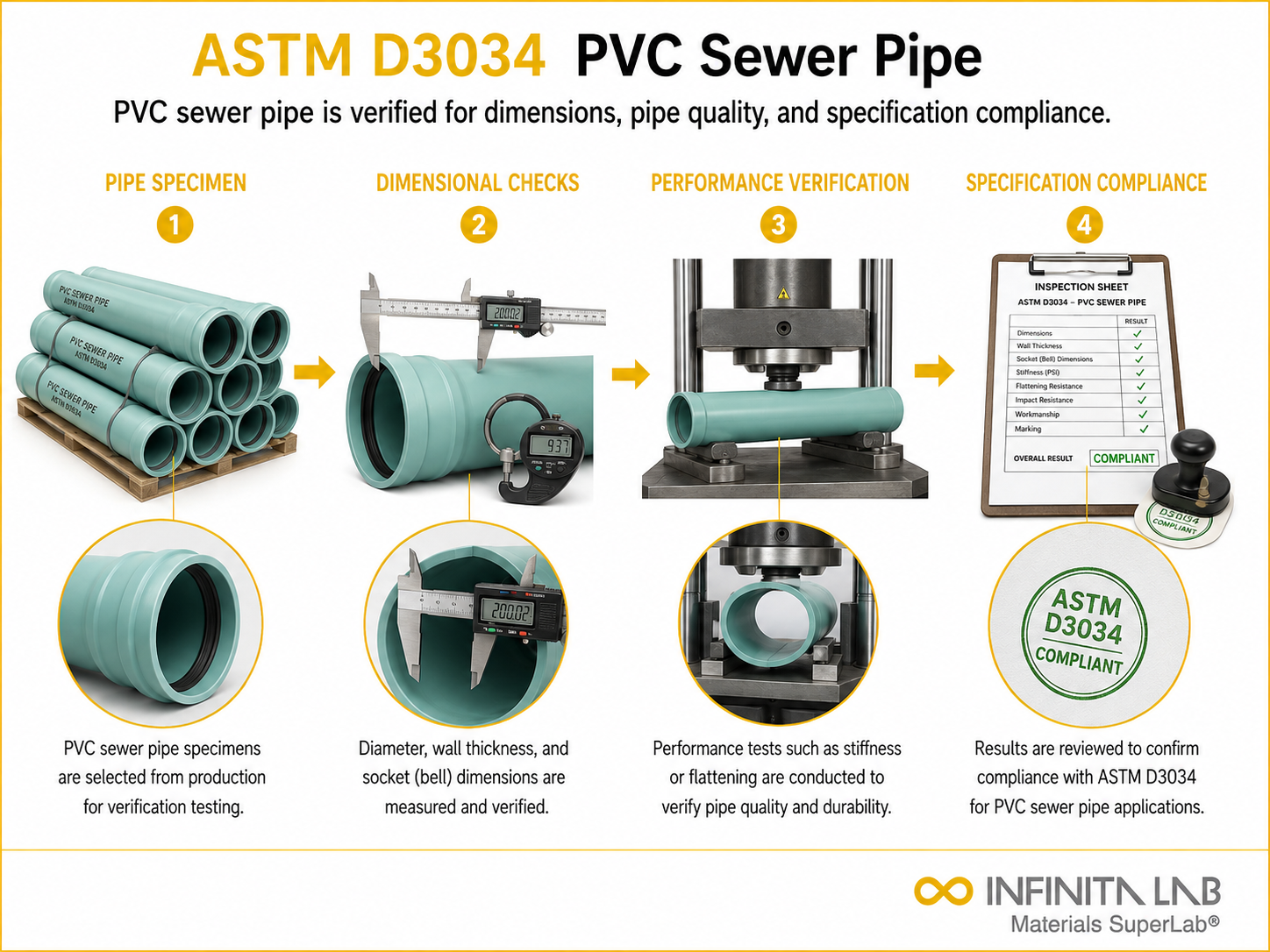
Inspect the Samples
Measure pipe dimensions and check for visible defects or poor workmanship.
1Test Stiffness and Flattening
Apply parallel-plate compression and inspect for cracking, splitting, or failure.
2Test Impact and Extrusion Quality
Evaluate impact resistance and perform acetone immersion to assess PVC fusion quality.
3Evaluate and Report
Compare all results with ASTM D3034 requirements and document the pass/fail outcome.
4ASTM D3034 Test Parameters and Requirements
| Parameter | Details |
|---|---|
| Product | Type PSM PVC gravity sewer pipe and fittings |
| Material | PVC compound per specification requirements |
| Dimensions | Diameter, wall thickness, tolerances (standard dimension ratios) |
| Pipe Stiffness | Parallel-plate loading per ASTM D2412 |
| Flattening | Deflection to specified level without splitting/cracking |
| Impact Resistance | Per specified impact test method |
| Extrusion Quality | Acetone immersion test (fusion/under-extrusion) |
| Joining Systems | Elastomeric gasketed or solvent-cement joints |


- Parallel-plate loading apparatus / universal testing machine (pipe stiffness per ASTM D2412)
- Impact test apparatus for pipe
- Acetone immersion test setup (extrusion quality)
- Calibrated dimensional measuring equipment (callipers, micrometres, gauges)
- Flattening test fixtures
- Visual inspection tooling for workmanship assessment
Equipment and Instrumentation Used for ASTM D3034 Testing
What You Receive: Test Report, Data, and Certification
- Test report – measured results for dimensions, workmanship, pipe stiffness, flattening, impact, and extrusion quality against the ASTM D3034 requirements
- Pipe stiffness results – parallel-plate stiffness values (per ASTM D2412) against the specification
- Flattening and impact results – outcomes of the flattening and impact tests with pass/fail determination
- Extrusion quality result – acetone immersion test outcome confirming proper PVC fusion
- Dimensional and workmanship results – measured dimensions against tolerances and the workmanship inspection findings
- Sample records – pipe/fitting identification, size, dimension ratio, marking, and lot information
ASTM D3034 PVC Sewer Pipe FAQs
No. ASTM D3034 is a product specification containing several testing and inspection requirements. These include dimensional checks, flattening resistance, impact resistance, pipe stiffness, joint tightness and extrusion-quality testing.
Pipe-stiffness testing measures the pipe’s resistance to deflection under an external compressive load. It helps evaluate whether the pipe can withstand soil and installation loads without excessive deformation.
A pipe section is compressed between parallel plates to evaluate its ability to deform without cracking, splitting or separating. The test also helps reveal poor fusion, weak walls or manufacturing defects.
Joint testing verifies that assembled pipes and fittings remain tight under specified test conditions. Proper socket dimensions, sealing components and assembly procedures are important for preventing leakage and infiltration.
The pipe and fittings must be homogeneous and free from visible cracks, holes, foreign inclusions and other harmful defects. Surface quality and extrusion consistency are inspected to confirm acceptable manufacturing.
Why Choose Infinita Lab for PVC Sewer Pipe Testing
At the core of this breadth is our network of 2,000+ accredited laboratories across the USA, offering access to over 10,000 testing methods and analytical services. From advanced materials characterization (SEM, TEM, RBS, XPS) to mechanical, chemical, environmental, biological, and standardized ASTM/ISO-compliant testing, we deliver unmatched flexibility, specialization, and scale. You are never limited by geography, facility, or methodology — Infinita Lab connects you to the right expertise and testing solution, every time.

Need ASTM D3034 PVC Sewer Pipe Testing You Can Rely On?
Send query us at hello@infinitalab.com or call us at (888) 878-3090 to learn more about our services and how we can support you.



Request a Quote
Submit your material details and receive testing procedures, pricing, and turnaround time within 24 hours.
 Quick Turnaround and Hasslefree process
 Confidentiality Guarantee
 Free, No-obligation Consultation
 100% Customer Satisfaction
