


ASTM D4001: Polymer Molecular Weight Light Scattering Testing Services
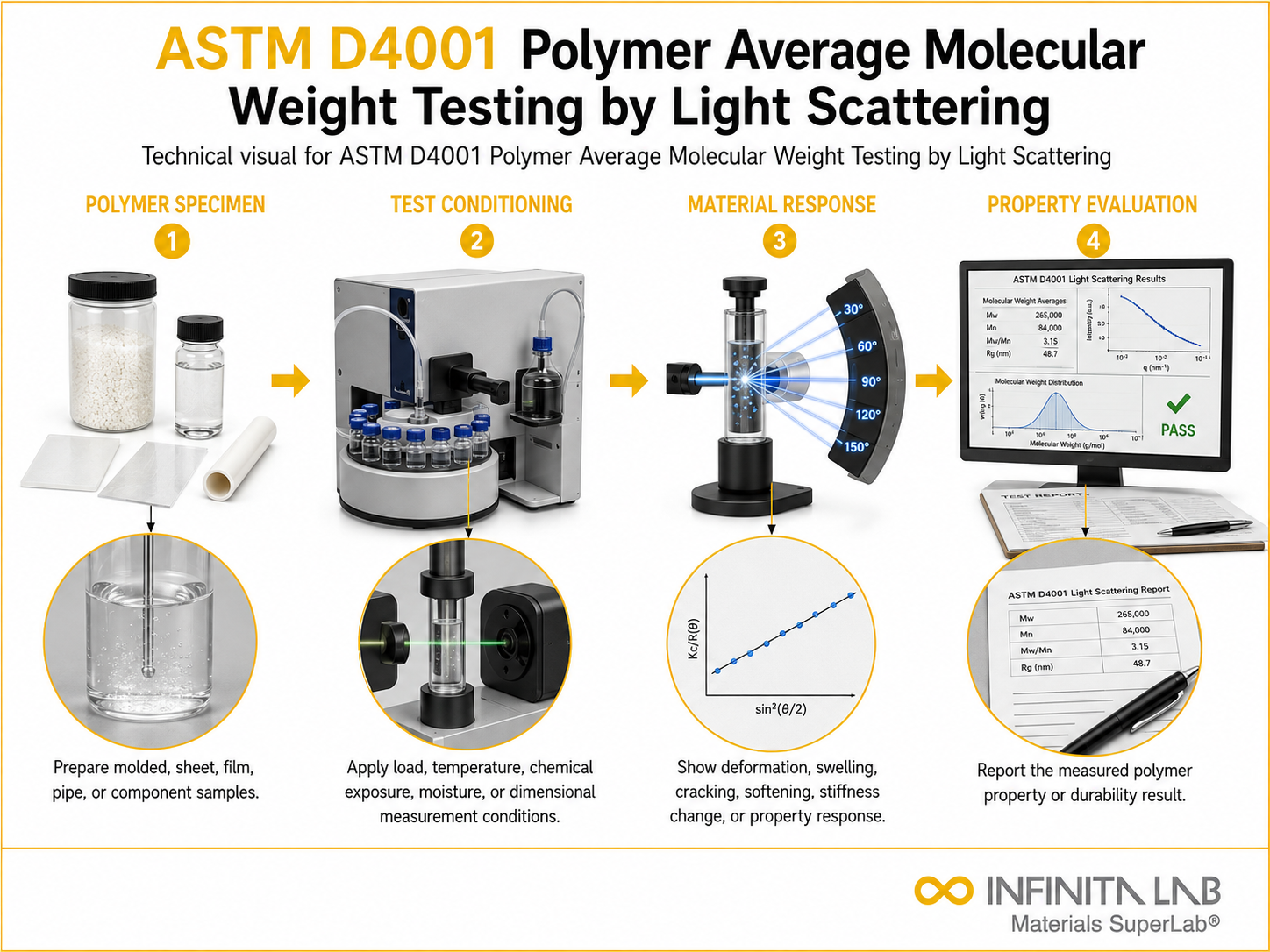
ASTM D4001 test method describes the test procedures for determining the weight-average molecular weight (Mw) of polymers by using the light scattering method. All nonionic homopolymers that dissolve entirely without reaction or degradation to generate stable solutions are covered by ASTM D4001.
TRUSTED BY


Get ASTM D4001 compliant results — request your polymer molecular weight light scattering testing quote
- Overview
- Scope, Applications, and Benefits
- Test Process
- Specifications
- Instrumentation
- Results and Deliverables
What Is ASTM D4001 Polymer Molecular Weight Light Scattering?
ASTM D4001 describes a standardized method for determining the weight-average molecular weight (Mw) of polymers in solution using static light scattering. Molecular weight is one of the most fundamental characteristics of a polymer, directly influencing its mechanical properties, melt viscosity, processability, and end-use performance. Light scattering provides an absolute measure of Mw without the need for polymer-specific calibration standards required by other techniques such as GPC/SEC.
The method is based on the Zimm or Berry plot approach, in which the angular dependence of scattered light intensity from a dilute polymer solution is measured at multiple angles and concentrations. By extrapolating to zero angle and zero concentration, the weight-average molecular weight, the second virial coefficient (A₂), and the root-mean-square radius of gyration (Rg) are obtained simultaneously from a single experiment.

Applications and Benefits of ASTM D4001 Polymer Molecular Weight Light Scattering Testing
Scope
ASTM D4001 evaluates:
- Weight-average molecular weight (Mw) of polymers
- Second virial coefficient (A₂) in solution
- Root-mean-square radius of gyration (Rg)
- Molecular weight distribution information (when combined with SEC)
- Polymer-solvent interaction parameters
- Absolute Mw for calibration reference purposes
Applications
- Polymer resin characterization and grade verification
- Biopolymer and protein molecular weight determination
- Polyelectrolyte and hydrogel characterization
- Pharmaceutical polymer excipient qualification
- Research and development in polymer synthesis
- Reference standard development for GPC/SEC calibration
- Quality control in specialty polymer production
Benefits
- Provides absolute Mw without polymer-specific calibration
- Simultaneously yields Mw, A₂, and Rg
- Applicable to a wide range of polymer types and molecular weights
- Sensitive to high-molecular-weight species
- Enables thorough molecular characterization in one measurement
- Supports correlation of molecular weight with material performance
Our ASTM D4001 Testing Procedure
Solution Preparation
Polymer solutions at multiple concentrations are prepared in the appropriate solvent and filtered to remove dust.
1Instrument Calibration
Light scattering instrument is calibrated with a known standard (e.g., toluene or polystyrene).
2Angular Intensity Measurement
Scattered light intensity is measured at multiple angles for each polymer concentration.
3Zimm/Berry Plot Construction
Data is plotted and extrapolated to zero angle and zero concentration; Mw, A₂, and Rg are extracted.
4ASTM D4001 Test Parameters and Requirements
| Parameter | Details |
|---|---|
| Test Principle | Static multi-angle light scattering (MALS) in dilute solution |
| Measurement Approach | Zimm plot or Berry plot |
| Applicable Materials | Polymers soluble in appropriate solvents |
| Output Units | g/mol (Mw), cm³·mol/g² (A₂), nm (Rg) |
| Measured Outputs | Weight-average Mw, second virial coefficient, radius of gyration |


- Multi-angle light scattering (MALS) photometer
- Laser light source (He-Ne or solid-state)
- Precision syringe filters (0.2–0.45 µm)
- Analytical balance (0.01 mg resolution)
- Volumetric glassware for solution preparation
- Data analysis software (Zimm/Berry plot)
Equipment and Instrumentation Used for ASTM D4001 Testing
What You Receive: Test Report, Data, and Certification
- Weight-average molecular weight (Mw)
- Second virial coefficient (A₂)
- Root-mean-square radius of gyration (Rg)
- Zimm or Berry plot
- Refractive index increment (dn/dc) data
- Compliance reports
ASTM D4001 Polymer Molecular Weight Light Scattering FAQs
ASTM D4001 determines average molecular weight of polymers using light scattering techniques. It evaluates polymer chain size and distribution, helping assess material properties, processing behavior, and performance in various applications.
Key parameters include solution concentration, solvent quality, temperature, scattering angle, and instrument calibration. Controlled conditions ensure accurate measurement of molecular weight using light scattering methods.
The test measures weight-average molecular weight of polymers. Results indicate polymer chain length and distribution, influencing mechanical properties, viscosity, and processing performance.
ASTM D4001 applies to polymer materials such as plastics, resins, and elastomers requiring molecular weight characterization for research, quality control, and product development.
ASTM D4001 requires clear solutions and proper sample preparation. Impurities or aggregation may affect accuracy, and additional methods may be needed for comprehensive molecular weight distribution analysis.
Why Choose Infinita Lab for Polymer Molecular Weight Light Scattering Testing?
At the core of this breadth is our network of 2,000+ accredited laboratories across the USA, offering access to over 10,000 testing methods and analytical services. From advanced materials characterization (SEM, TEM, RBS, XPS) to mechanical, chemical, environmental, biological, and standardized ASTM/ISO-compliant testing, we deliver unmatched flexibility, specialization, and scale. You are never limited by geography, facility, or methodology — Infinita Lab connects you to the right expertise and testing solution, every time.

Looking for an Accredited Partner for ASTM D4001 Polymer Molecular Weight Light Scattering Testing?
Send query us at hello@infinitalab.com or call us at (888) 878-3090 to learn more about our services and how we can support you.



Request a Quote
Submit your material details and receive testing procedures, pricing, and turnaround time within 24 hours.
 Quick Turnaround and Hasslefree process
 Confidentiality Guarantee
 Free, No-obligation Consultation
 100% Customer Satisfaction
