


ASTM D1146: Blocking Point Testing Services
Some potentially sticky materials are both thermoplastic and hygroscopic, ASTM D1146 test method allows for the estimation of both thermoplastic and hygroscopic blocking on the same material. Because certain restrictions are more strict than others, there are 2 varying degrees of blocking: (i) first degree and (ii) second degree blocking. (1) Cohesive blocking and (2) Adhesive blocking are the two types of blocking methods. Using the adhesive blocking test method, we are able to estimate potential adhesive layer properties.
TRUSTED BY


Get ASTM D1146 compliant results — request your blocking point testing quote
- Overview
- Scope, Applications, and Benefits
- Test Process
- Specifications
- Instrumentation
- Results and Deliverables
What Is ASTM D1146 Blocking Point?
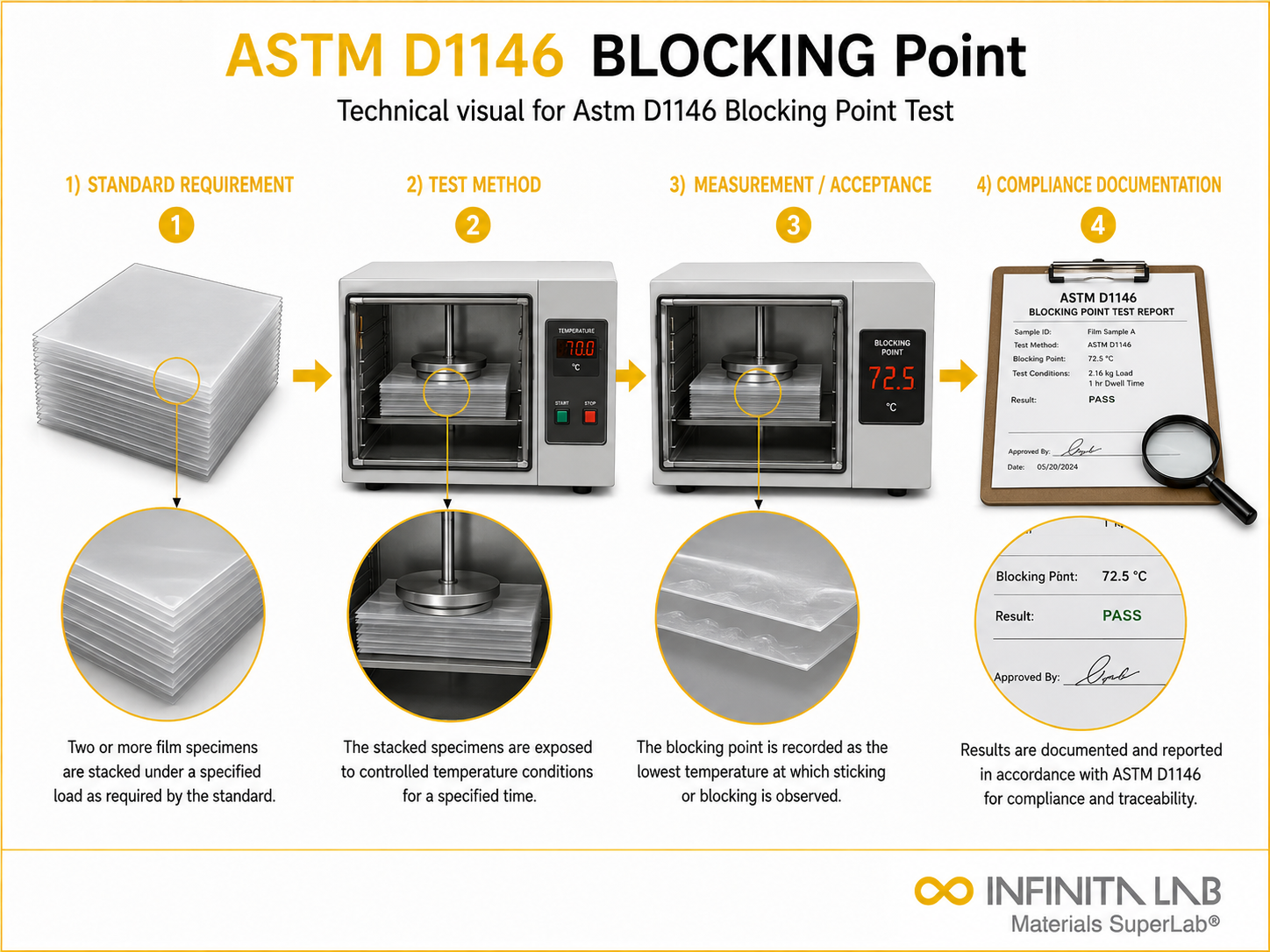
ASTM D1146 is a standard test method for determining the blocking point of thermoplastic or hygroscopic layers and coatings of potentially adhesive materials. Blocking occurs when two surfaces in contact under pressure and temperature stick together, resisting separation for materials that are non-adhesive under normal conditions but can become adhesive when exposed to heat or moisture. Knowing where that transition point is matters greatly for how those materials are handled, packaged, and stored.
The standard covers two types of blocking: cohesive blocking, in which two comparable adhesive faces bond, and adhesive blocking, in which an adhesive face bonds to a non-adhesive surface, such as standard test paper. It also recognizes two degrees of blocking severity, first degree and second degree, to account for the fact that some applications have stricter requirements than others.
Because many potentially adhesive materials are both thermoplastic and hygroscopic, ASTM D1146 is designed to allow evaluation of both thermoplastic and hygroscopic blocking on the same specimen. This makes it a practical and efficient tool for characterizing adhesive behavior without needing separate test setups for each trigger mechanism.

Applications and Benefits of ASTM D1146 Blocking Point Testing
Scope
ASTM D1146 covers the determination of the blocking point for thermoplastic and hygroscopic layers or coatings of potentially adhesive materials. Potentially adhesive materials are those that are substantially non-adhesive under normal conditions but can be activated by heat or solvents. The standard applies to both cohesive blocking (adhesive face to adhesive face) and adhesive blocking (adhesive face to standard test paper). Two degrees of blocking severity are defined to accommodate different performance requirements, and the test can evaluate thermoplastic and hygroscopic blocking on the same material sample. The standard falls under ASTM Committee D14 and is published in BOS Vol. 15.06.
Applications
- Adhesive film and tape blocking resistance evaluation
- Hot melt and heat-seal adhesive characterization
- Packaging material storage and handling assessment
- Pressure-sensitive adhesive (PSA) performance testing
- Label stock and release liner compatibility testing
- Coated paper and film blocking behavior in roll storage
- Adhesive product shelf life and temperature sensitivity studies
- Quality control of adhesive coatings during manufacturing
Benefits
- Evaluates both thermoplastic and hygroscopic blocking on the same specimen
- Covers two blocking types and two severity levels in a single standard
- Helps set storage and shipping temperature limits for adhesive products
- Identifies the risk of blocking before a product reaches the customer
- Supports material selection for packaging and adhesive applications
- Reproducible results that can be compared across labs and material lots
- Applicable to a wide range of adhesive coatings, films, and laminates
ASTM D1146 Test Parameters and Requirements
Specimen Conditioning
Test specimens are conditioned at the specified temperature and humidity before testing.
1Specimen Assembly
For cohesive blocking, two specimens are placed adhesive face to adhesive face on a glass plate.
2Load and Temperature Application
A defined load is applied to the assembly. Specimens are then exposed to a series of increasing temperatures.
3Separation and Evaluation
After exposure, specimens are separated and examined.
4ASTM D1146 Blocking Point Testing Technical Specifications
| Parameter | Details |
|---|---|
| Standard | ASTM D1146-00 (Reapproved 2018) |
| ASTM Committee | D14 – Adhesives |
| BOS Volume | 15.06 |
| Material Types | Thermoplastic and hygroscopic adhesive layers and coatings |
| Blocking Types Covered | Cohesive blocking, Adhesive blocking |
| Blocking Degrees Defined | First degree, Second degree |
| Reported Output | Blocking point temperature or humidity condition, blocking type, blocking degree |


- Temperature-controlled oven or environmental chamber
- Humidity-controlled conditioning chamber
- Glass plates for specimen assembly
- Standard test paper (per ASTM specification)
- Dead-weight loading blocks or a press for applying a defined load
- Thermometer or temperature monitoring device
- Timer for controlled exposure duration
Equipment and Instrumentation Used for ASTM D1146 Testing
What You Receive: Test Report, Data, and Certification
- Blocking point temperature or humidity condition for the tested material
- Blocking type identified (cohesive or adhesive)
- Blocking degree classification (first or second degree)
- Separate results for thermoplastic and hygroscopic blocking, where both are evaluated
- Observation notes on the nature and extent of blocking at each test condition
- Test report with specimen description, conditioning details, and all recorded values
ASTM D1146 Blocking Point FAQs
ASTM D1146 evaluates the temperature or condition at which two adhesive or coated surfaces begin to stick or block under pressure. It helps determine the “blocking point” where materials lose free-release properties.
Blocking can cause layers to fuse during storage or handling, leading to product failure. Knowing the blocking point helps ensure coatings remain stable under real-world packaging and environmental conditions.
The method is commonly applied to pressure-sensitive adhesives, coated films, papers, tapes, and polymer-based multilayer systems where surface tack or adhesion may develop under heat or load.
Samples are typically placed under controlled pressure and temperature for a defined time, then assessed for adhesion or separation difficulty. The degree of sticking indicates whether blocking has occurred.
Blocking behavior can be affected by coating chemistry, surface roughness, curing level, temperature exposure, applied pressure, and storage duration before testing.
Why Choose Infinita Lab for Blocking Point Testing?
At the core of this breadth is our network of 2,000+ accredited laboratories across the USA, offering access to over 10,000 testing methods and analytical services. From advanced materials characterization (SEM, TEM, RBS, XPS) to mechanical, chemical, environmental, biological, and standardized ASTM/ISO-compliant testing, we deliver unmatched flexibility, specialization, and scale. You are never limited by geography, facility, or methodology — Infinita Lab connects you to the right expertise and testing solution, every time.

Looking for an Accredited Partner for ASTM D1146 Blocking Point Testing?
Send query us at hello@infinitalab.com or call us at (888) 878-3090 to learn more about our services and how we can support you.



Request a Quote
Submit your material details and receive testing procedures, pricing, and turnaround time within 24 hours.
 Quick Turnaround and Hasslefree process
 Confidentiality Guarantee
 Free, No-obligation Consultation
 100% Customer Satisfaction
