


ASTM E292: Notch Tension Rupture Time Testing Services
Accredited ASTM E292 notch tension rupture time testing from Infinita Lab, performed to the exact standard requirements - accurate, reproducible results with full documentation for compliance, R&D, and quality control programs.
TRUSTED BY


Get ASTM E292 compliant results - request your notch tension rupture time testing quote
- Overview
- Scope, Applications, and Benefits
- Test Process
- Specifications
- Instrumentation
- Results and Deliverables
What Is ASTM E292 Notch Tension Rupture Time?
ASTM E292, Standard Test Methods for Conducting Time-for-Rupture Notch Tension Tests of Materials, is an active ASTM International standard. The current edition is E292-24. It sets out the procedure for determining how long a notched specimen takes to rupture under a constant tensile force and a constant elevated temperature. Subcommittee E28.04 on Uniaxial Testing develops and maintains the standard under ASTM Committee E28 on Mechanical Testing, and it’s published in Book of Standards Volume 03.01 alongside the wider family of elevated-temperature and creep-rupture test methods. The method is written in inch-pound units; SI values are given for information only.
The core premise is simple: rupture life measured on a notched specimen shows how a material behaves around a stress concentration. Specifically, can it deform locally without cracking under the multiaxial stress state a notch creates, rather than deforming uniformly the way a smooth bar would? Because of that, ASTM E292 works mainly as a qualitative comparison tool, not a source of absolute design allowables. Engineers use it to judge whether a material is notch-strengthening or notch-weakening in service, and to compare candidate alloys for components that will unavoidably carry geometric discontinuities such as fillets, holes, threads, or fastener interfaces. The scope covers specimen requirements, the essential capabilities of the loading and heating equipment, and what gets measured: applied stress, test temperature, elongation, and time to rupture. E292 is closely tied to ASTM E139 (creep and creep-rupture testing of metallic materials), and it references ASTM E4, E8/E8M, E220, E633, and E691 for force verification, tension-test practice, thermocouple calibration, and interlaboratory precision, respectively.

Applications and Benefits of ASTM E292 Notch Tension Rupture Time Testing
Scope
ASTM E292 measures the time required for a notched specimen to rupture under a constant tensile load. It helps evaluate material performance under stress concentration conditions.
The test evaluates:
- ASTM E292 covers test methods for determining time-to-rupture of notched tension specimens under a constant applied force and a constant elevated test temperature.
- It applies to metallic materials evaluated for service where sustained load and heat act together over extended periods.
- Results compare a notched specimen’s rupture behavior against an unnotched (smooth) specimen tested under the same conditions.
- Is the material notch-strengthening (longer notched rupture life) or notch-weakening (shorter notched rupture life)? The method answers that relative to smooth-bar behavior.
- Loading apparatus, temperature-control equipment, and specimen alignment all carry essential requirements, defined so results stay repeatable between laboratories.
- Measured quantities: applied stress on the net notch section, test temperature, elapsed time to rupture, plus post-test elongation and reduction of area where applicable.
- Units are primarily inch-pound, with SI equivalents given for reference, not as governing values.
- ASTM E292 gets used alongside ASTM E139 and other elevated-temperature mechanical test methods, not as a stand-alone qualification tool.
- Notch geometry isn’t fixed by the scope for every material; the testing laboratory and requesting party agree on specimen notch configuration based on the application.
- Results from E292 testing serve for material comparison and screening. They aren’t a substitute for full-scale component testing.
Applications
- Screening high-temperature alloys and superalloys for components that contain stress concentrators.
- Used to compare candidate materials for gas turbine, jet engine, and power-generation hardware operating under sustained load and heat.
- Material selection support for fastener, thread, and fillet regions, where geometric discontinuities can’t be avoided.
- Validates alloy behavior for pressure vessel and piping components in elevated-temperature service.
- Failure analysis and root-cause investigations lean on this data when notch-sensitive cracking shows up in service.
- Generates comparative data for material substitution or qualification programs.
- Feeds research on creep-rupture and notch-sensitivity behavior of new alloy compositions.
Benefits
- Identifies notch-sensitive materials before they get committed to safety-critical, stress-concentrated designs.
- A direct, side-by-side comparison between notched and smooth rupture behavior, run under the same test conditions.
- Better-informed material selection for components that can’t dodge geometric discontinuities.
- Generates standardized, repeatable data that holds up for engineering comparison across laboratories.
- Cuts the risk of in-service rupture failures that start at stress concentrators.
- Rounds out creep-rupture data from ASTM E139 into a fuller elevated-temperature material profile.
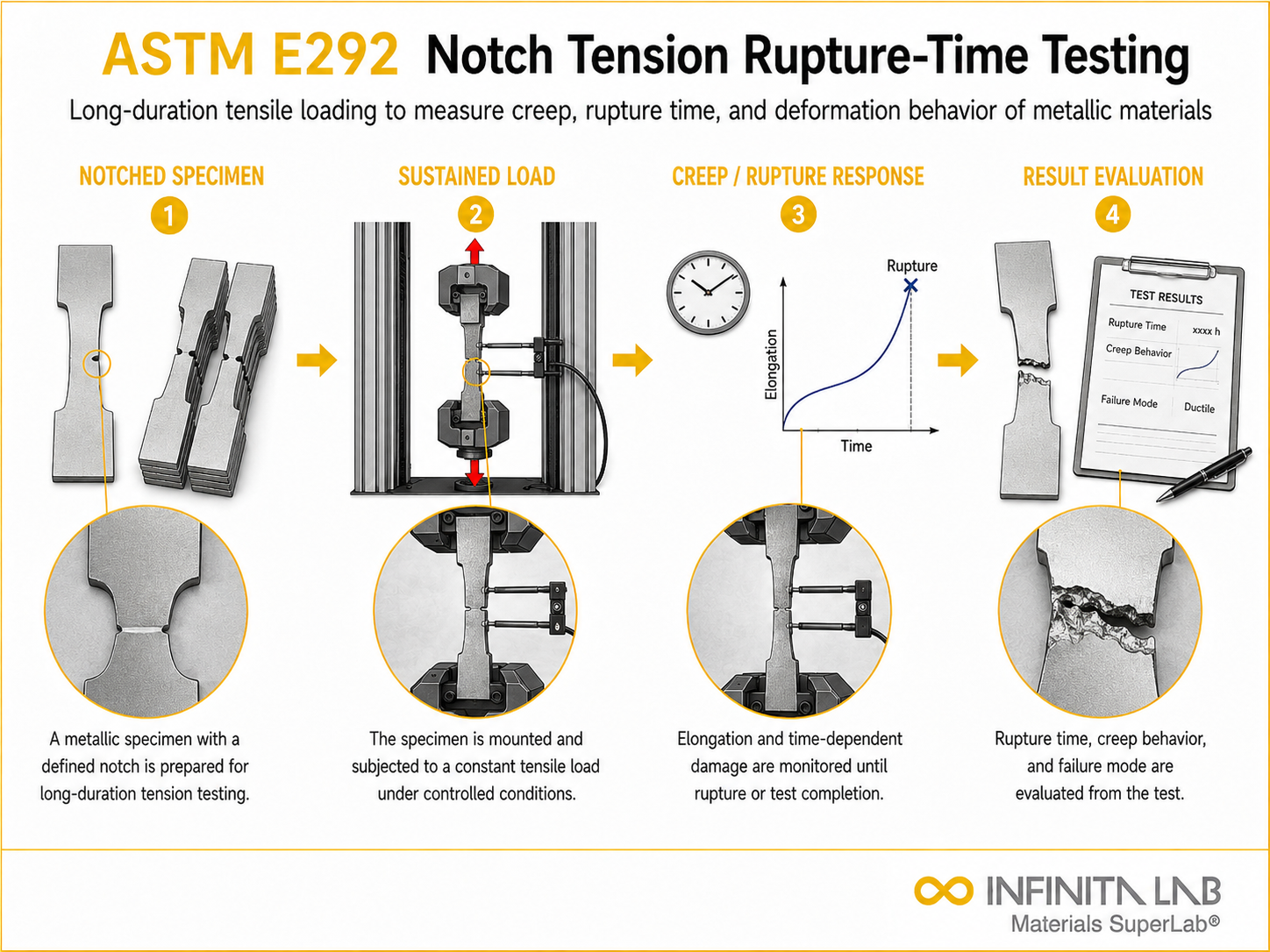
Our ASTM E292 Testing Procedure
Sample Preparation
Notched specimen is machined to standard geometry.
1Load Application
Constant tensile load is applied.
2Time Monitoring
Time until rupture is recorded.
3Rupture behavior is analyzed.
Rupture behavior is analyzed.
4ASTM E292 Test Parameters and Requirements
| Parameter | Details |
|---|---|
| Applicable Materials | Metals and alloys |
| Loading Condition | Constant tensile load |
| Temperature Range | Ambient to high temperatures |
| Specimen Type | Ambient to high temperatures |
| Time to rupture, stress level | Time to rupture, stress level |


- Creep-Rupture Testing Machine – Applies and holds a constant tensile force on the notched specimen for as long as the test runs.
- Resistance or Induction Furnace – Keeps the specimen at the specified, constant elevated test temperature.
- Thermocouples and Temperature Controllers – Monitor and control specimen temperature, calibrated per the referenced ASTM practices.
- Load Cells / Force Calibration Equipment – Confirm the applied force meets the accuracy requirements referenced from ASTM E4.
- Extensometers or Displacement Sensors – Track specimen elongation during the test, where applicable.
- Precision Specimen Machining Equipment – Produces the notched and smooth specimens to the required geometry and surface finish.
- Data Acquisition System – Logs load, temperature, and time data continuously for traceability and reporting.
Equipment and Instrumentation Used for ASTM E292 Testing
What You Receive: Test Report, Data, and Certification
- Time-to-rupture results for notched specimens, tested under the specified stress and temperature conditions.
- Comparative rupture data between notched and smooth specimens, used to characterize notch sensitivity.
- Post-test measurements of elongation and reduction of area, where applicable.
- A detailed test report covering specimen geometry, test conditions, instrumentation, and raw data.
- Supporting data for material comparison, selection, or failure-analysis work.
- Traceable calibration records for the force and temperature measurement equipment used during testing.
ASTM E292 Notch Tension Rupture Time FAQs
ASTM E292 determines the time for rupture of notched specimens under constant force and temperature. The values are in imperial units.
ASTM E292 is important because it helps assess material resistance to creep and failure in notched components, ensuring safety and reliability in high-temperature applications like turbines and pressure vessels.
ASTM E292 involves applying constant tensile load to a notched specimen at elevated temperature until rupture occurs, measuring time to failure and creep behavior.
ASTM E292 requires a creep testing machine, high-temperature furnace, load application system, and measurement devices to monitor deformation and rupture time accurately.
ASTM E292 results are reported as time to rupture and stress conditions, indicating creep resistance and material performance under long-term loading at high temperatures.
A notched specimen is subjected to a controlled tensile load until fracture or a specified failure condition occurs. The test measures the material’s resistance to fracture at the notch, where stress is concentrated. ASTM E338 covers sharp-notch tension testing of high-strength sheet materials.
Notched tensile strength is determined by applying tensile force to a specimen containing a notch and measuring the maximum load it can withstand. It indicates the material’s resistance to fracture in the presence of a stress concentrator.
Why Choose Infinita Lab for Notch Tension Rupture Time Testing
When your Notch Tension Rupture Time results have to hold up - for compliance, a customer audit, or an engineering decision - ASTM E292 accuracy and an unbiased third-party report matter more than price. Infinita Lab routes your ASTM E292 notch tension rupture time testing to ISO/IEC 17025-accredited U.S. partner labs with hands-on method experience, so you get defensible data, transparent reporting, and turnaround times built around your project deadline - not ours.

Need ASTM E292 Notch Tension Rupture Time Testing You Can Rely On?
Send query us at hello@infinitalab.com or call us at (888) 878-3090 to learn more about our services and how we can support you.



Request a Quote
Submit your material details and receive testing procedures, pricing, and turnaround time within 24 hours.
 Quick Turnaround and Hasslefree process
 Confidentiality Guarantee
 Free, No-obligation Consultation
 100% Customer Satisfaction
