


ASTM D7681 Glass Sphere Gradation Testing by Digital Image Analysis
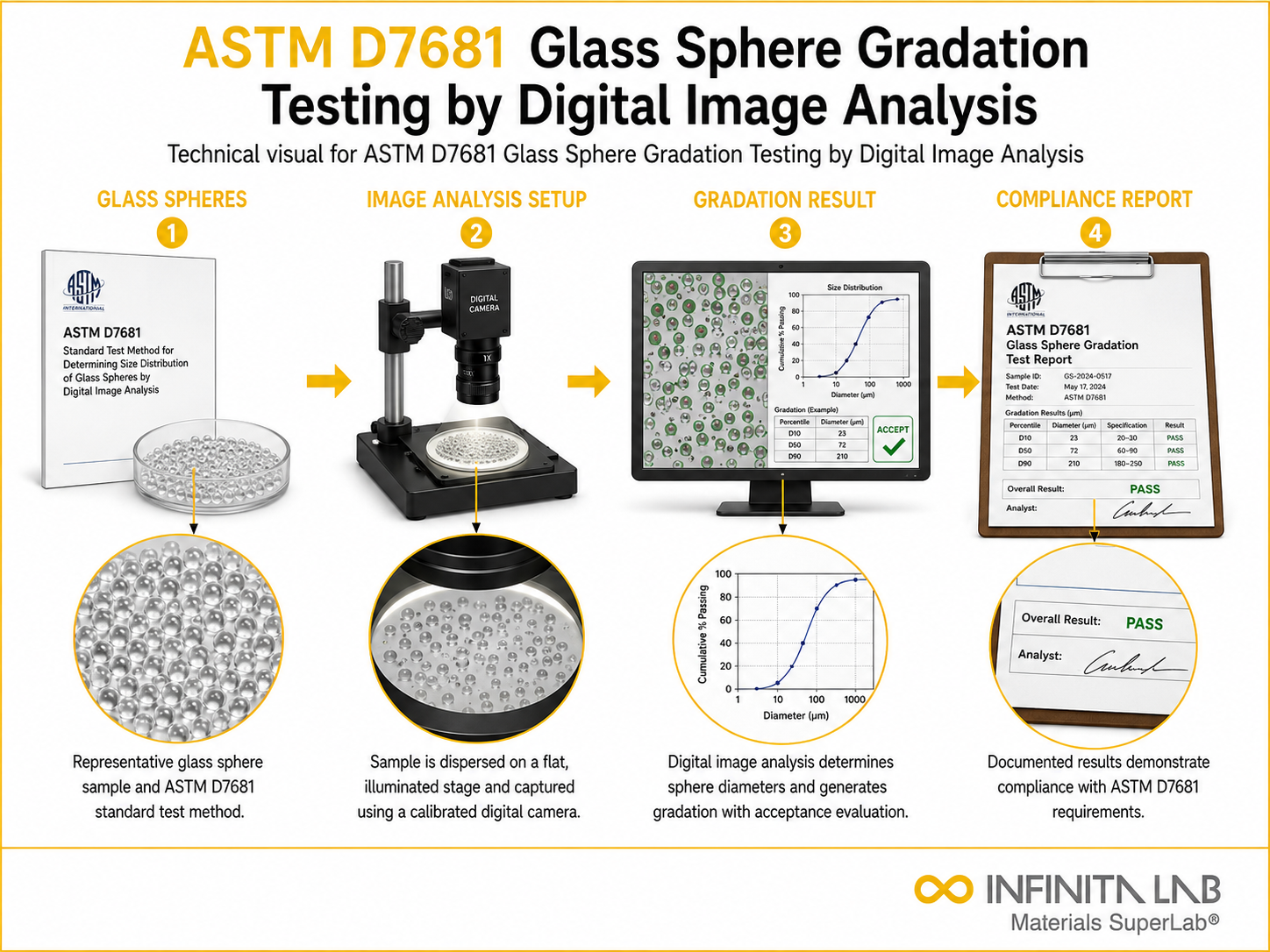
ASTM D7681 involves the usage of a flowing stream digital analyzer, which determines the gradation (size distribution) of glass spheres used in pavement marking systems. The SI units should be considered as standard.
TRUSTED BY


Precision-driven testing for dimensional accuracy and compliance
- Overview
- Scope, Applications, and Benefits
- Test Process
- Specifications
- Instrumentation
- Results and Deliverables
Overview
ASTM D7681 describes a standard test method for measuring the size distribution and gradation of glass spheres (glass beads) using a stream digital image analyzer. Glass spheres are used in highway pavement markings, blasting abrasives, reflective coatings, and filtration media, where precise size gradation is critical to performance.
Digital image analysis provides an automated, high-throughput approach to glass sphere sizing that offers advantages in speed, objectivity, and statistical robustness compared to traditional sieve analysis methods.

Scope, Applications, and Benefits
Scope
ASTM D7681 covers the measurement of:
- Particle size distribution of glass sphere populations
- Gradation compliance with specification limits
- Sphere diameter statistics (D10, D50, D90 and similar)
- Shape characterization alongside size in some configurations
Applications
- Pavement marking glass bead gradation quality control
- Blasting and peening glass bead qualification
- Retroreflective sheeting glass sphere sizing
- Water filtration media gradation testing
- Industrial glass bead specification compliance
Benefits
- Rapid, automated high-count particle analysis
- Objective, operator-independent sizing results
- Measures thousands of particles per sample for excellent statistics
- Detects out-of-specification particles quickly
- Applicable across a wide size range
Test Process
Sample Preparation
Dry the glass sphere sample if necessary; disperse to prevent agglomeration and prepare a representative sub-sample.
1Instrument Setup & Calibration
Calibrate the stream digital image analyzer with certified reference spheres; set appropriate magnification and sampling parameters.
2Particle Analysis
Feed the glass spheres through the imaging stream; the instrument captures and analyzes images of individual particles to measure diameter and shape.
3Gradation Reporting
Generate the particle size distribution; calculate cumulative passing percentages at specification sieve sizes for gradation compliance assessment.
4Technical Specifications
| Parameter | Details |
|---|---|
| Test Principle | Stream digital image analysis |
| Applicable Materials | Glass spheres and beads |
| Measured Output | Particle size distribution, gradation percentages |
| Particle Count | Thousands per analysis |
| Size Range | Dependent on instrument optics configuration |


- Stream digital image analyzer
- High-speed camera
- Image processing software
- Sample feeding system
- Calibration standards
- Data acquisition system
Instrumentation Used for Testing
Results and Deliverables
- Particle size distribution histogram and cumulative curve
- Gradation table (% passing at defined sieve sizes)
- D10, D50, D90 characteristic diameters
- Pass/fail assessment against gradation specifications
- Shape parameters (circularity, aspect ratio) if applicable
- Batch quality control reports for glass bead production
Frequently Asked Question
Sieve analysis separates spheres by physical size using a series of sieves and measures retained mass fractions. Image analysis measures the actual diameter of thousands of individual spheres optically, providing more detailed and statistically robust size distributions without the variability of sieve blinding or agglomeration.
Glass beads embedded in pavement marking paint provide retroreflectivity for nighttime visibility. Proper gradation ensures optimal bead embedment depth for maximum retroreflective performance and durability.
The method is designed for relatively small samples, as thousands of particles can be analyzed from gram-scale quantities. The exact sample size depends on the particle size range and the required statistical precision.
Yes, digital image analyzers measure actual particle shape as well as size. Non-spherical particles (broken spheres, elongated particles) can be identified and quantified, which is important for quality control of glass bead products where sphericity is specified.
ASTM D7681 offers advantages in automation, objectivity, and statistical power, and is increasingly used alongside or in place of sieve analysis. However, sieve analysis remains the reference method in many existing specifications. Both methods may be used together for comprehensive characterization.
Why Choose Infinita Lab for Advanced Materials Testing and Characterization?
At the core of this breadth is our network of 2,000+ accredited laboratories across the USA, offering access to over 10,000 testing methods and analytical services. From advanced materials characterization (SEM, TEM, RBS, XPS) to mechanical, chemical, environmental, biological, and standardized ASTM/ISO-compliant testing, we deliver unmatched flexibility, specialization, and scale. You are never limited by geography, facility, or methodology — Infinita Lab connects you to the right expertise and testing solution, every time.

Looking for a Trusted Partner for Accurate and Reliable Testing Services?
Send query us at hello@infinitalab.com or call us at (888) 878-3090 to learn more about our services and how we can support you.



Request a Quote
Submit your material details and receive testing procedures, pricing, and turnaround time within 24 hours.
 Quick Turnaround and Hasslefree process
 Confidentiality Guarantee
 Free, No-obligation Consultation
 100% Customer Satisfaction
