


ASTM D6138: Lubricating Grease Corrosion Preventive Testing Services
The ASTM D6138 test technique uses grease-lubricated ball bearings in dynamic wet circumstances to determine the corrosion-preventive capabilities of greases. The performance of specimens assessed by this method is quantified in terms of the SI units.
TRUSTED BY


Get ASTM D6138 compliant results — request your lubricating grease corrosion preventive testing quote
- Overview
- Scope, Applications, and Benefits
- Test Process
- Specifications
- Instrumentation
- Results and Deliverables
What Is ASTM D6138 Lubricating Grease Corrosion Preventive?
ASTM D6138 evaluates the ability of lubricating greases to protect metal surfaces from corrosion under specific conditions. It assesses how effectively a grease prevents rust formation when metal components are exposed to moisture or corrosive environments.
This test is essential for determining the protective performance of greases used in bearings, machinery, and storage conditions. It helps ensure that selected lubricants provide both lubrication and corrosion resistance, improving equipment reliability and service life.

Applications and Benefits of ASTM D6138 Lubricating Grease Corrosion Preventive Testing
Scope
This test method determines the corrosion-preventive properties of lubricating greases by exposing metal specimens coated with grease to controlled environmental conditions and evaluating rust formation.
Includes:
- Evaluation of rust prevention capability
- Exposure of metal specimens to moisture or corrosive media
- Assessment of grease protective performance
- Visual inspection for corrosion
- Suitability for lubricating grease applications
Applications
- Industrial machinery and equipment
- Bearings and moving components
- Automotive lubrication systems
- Marine and offshore equipment
- Storage protection of metal parts
- Heavy-duty mechanical systems
Benefits
- Ensures corrosion protection of metal surfaces
- Improves equipment reliability and lifespan
- Supports lubricant selection and development
- Reduces maintenance and repair costs
- Enhances performance in harsh environments
- Enables comparison of grease formulations
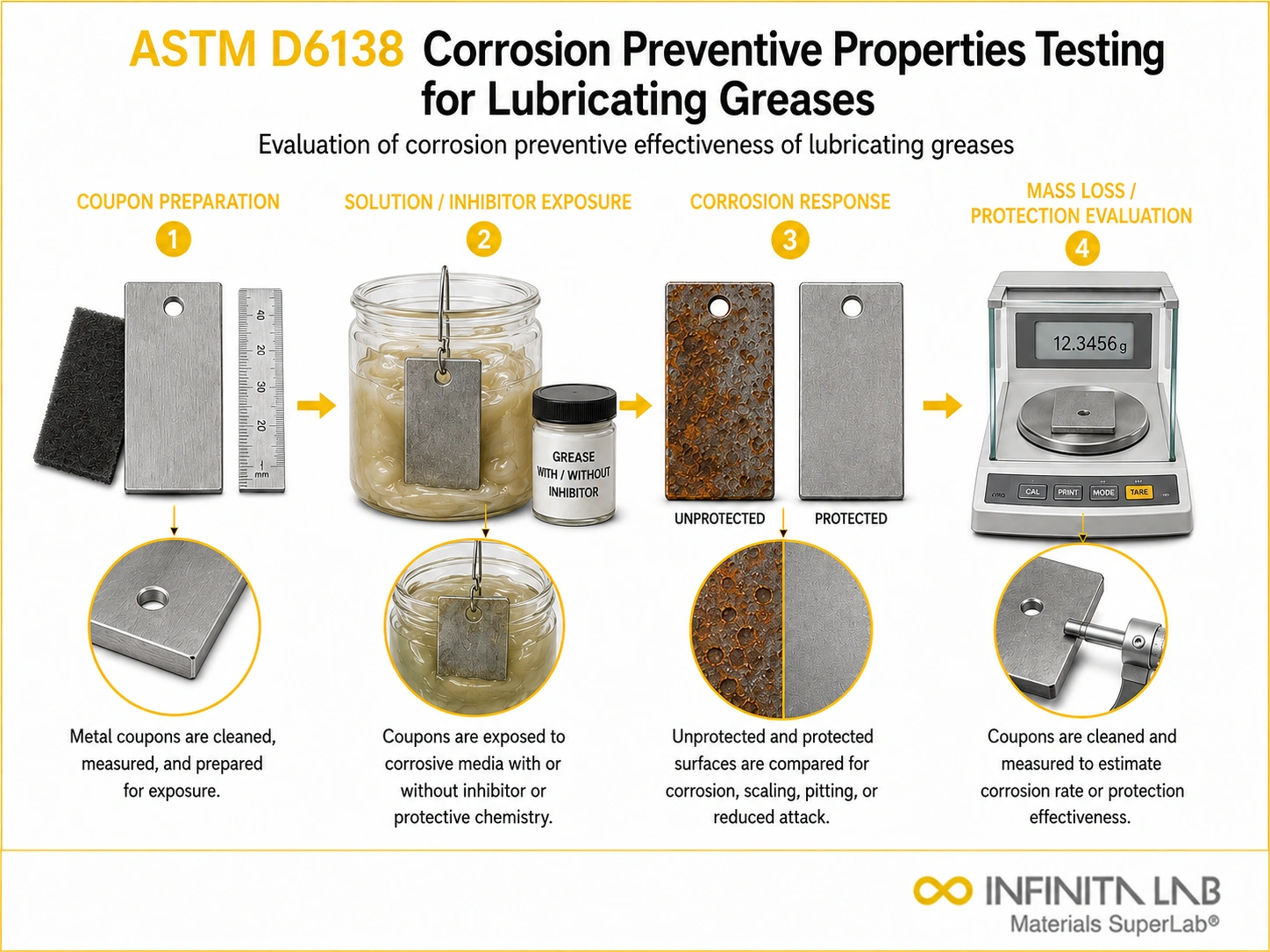
Our ASTM D6138 Testing Procedure
Specimen Preparation
Metal test specimens are cleaned, coated with grease, and prepared under specified conditions.
1Exposure Setup
Specimens are placed in a controlled environment simulating moisture or corrosive conditions.
2Corrosion Evaluation
After exposure, specimens are examined for rust or corrosion formation.
3Result Assessment
The extent of corrosion is rated and recorded to determine grease performance.
4ASTM D6138 Test Parameters and Requirements
| Parameter | Details |
|---|---|
| Property Measured | Corrosion prevention |
| Material Type | Lubricating greases |
| Test Medium | Moisture or corrosive environment |
| Specimen | Metal panels or bearings |
| Evaluation | Visual rust rating |
| Environment | Controlled temperature and humidity |
| Duration | Defined exposure period |


- Corrosion test chamber
- Metal test specimens
- Cleaning and preparation tools
- Environmental control system
- Inspection tools (visual or optical)
- Data recording system
Equipment and Instrumentation Used for ASTM D6138 Testing
What You Receive: Test Report, Data, and Certification
- Corrosion rating or classification
- Visual inspection results
- Performance comparison of greases
- Test condition details
- Compliance with ASTM D6138
- Detailed evaluation report
ASTM D6138 Lubricating Grease Corrosion Preventive FAQs
ASTM D6138 verifies whether a grease can prevent rust under moisture exposure. This ensures selected lubricants protect metal components during operation and storage, reducing failure risks and extending equipment life in demanding environments.
A failed result indicates insufficient corrosion protection, meaning the grease cannot adequately shield metal surfaces from moisture or contaminants. This can lead to rust formation, component degradation, and increased maintenance requirements.
Lubrication reduces friction and wear, while corrosion protection prevents chemical degradation of metal surfaces. A high-performance grease must provide both properties to ensure reliable operation and long-term durability of mechanical components.
Manufacturers can enhance corrosion resistance by adding rust inhibitors, optimizing base oil composition, and improving thickener systems. Proper formulation ensures better surface coverage and protection against moisture-induced corrosion.
Poor protection can lead to rust formation, reduced component life, increased friction, and potential equipment failure. This results in higher maintenance costs and operational downtime.
Why Choose Infinita Lab for Lubricating Grease Corrosion Preventive Testing?
At the core of this breadth is our network of 2,000+ accredited laboratories across the USA, offering access to over 10,000 testing methods and analytical services. From advanced materials characterization (SEM, TEM, RBS, XPS) to mechanical, chemical, environmental, biological, and standardized ASTM/ISO-compliant testing, we deliver unmatched flexibility, specialization, and scale. You are never limited by geography, facility, or methodology — Infinita Lab connects you to the right expertise and testing solution, every time.

Need ASTM D6138 Lubricating Grease Corrosion Preventive Testing You Can Rely On?
Send query us at hello@infinitalab.com or call us at (888) 878-3090 to learn more about our services and how we can support you.



Request a Quote
Submit your material details and receive testing procedures, pricing, and turnaround time within 24 hours.
 Quick Turnaround and Hasslefree process
 Confidentiality Guarantee
 Free, No-obligation Consultation
 100% Customer Satisfaction
