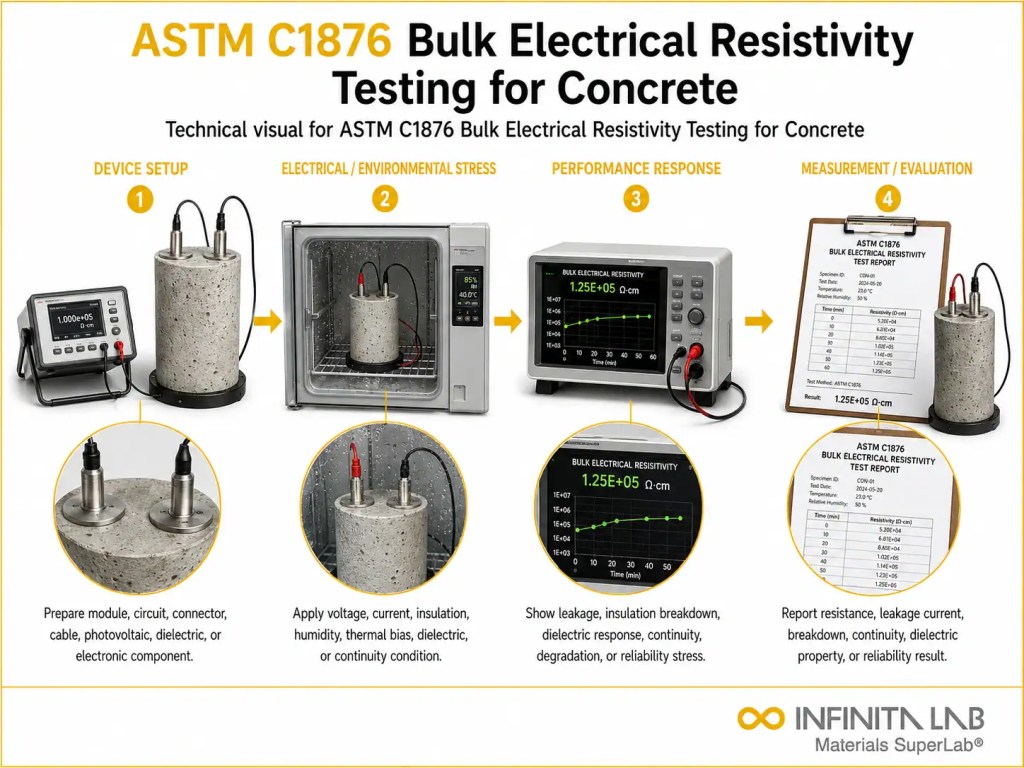


What Is ASTM C1876 Concrete Bulk Electrical Resistivity?
ASTM C1876 is a standard test method for measuring the bulk electrical resistivity or bulk conductivity of concrete specimens using a uniaxial current application technique. It quantifies how readily electrical current passes through concrete, which directly correlates with pore structure, moisture content, and ionic concentration of the pore solution.
This method is widely used to assess concrete durability and resistance to chloride ion penetration without destructive testing. It applies to cylindrical concrete specimens and is suitable for quality control, mix design evaluation, and durability-based acceptance criteria in infrastructure and precast concrete applications.
Applications and Benefits of ASTM C1876 Concrete Bulk Electrical Resistivity Testing
Scope
ASTM C1876 covers the measurement of bulk electrical resistivity and conductivity of cylindrical concrete specimens using externally applied alternating current. The test is non-destructive and performed on saturated or conditioned specimens under controlled conditions.
The scope includes:
- Testing of standard 100 × 200 mm or 150 × 300 mm cylindrical specimens
- Measurement of bulk resistivity in kΩ·cm and conductivity in mS/cm
- Applicable to plain, blended, and SCM-containing concrete mixes
- Testing at various curing ages to monitor resistivity development
- Suitable for laboratory-cast and core-extracted field specimens
- Applicable under AASHTO T 358 and related durability frameworks
Applications
- Chloride penetration resistance evaluation in concrete
- Durability assessment of bridge decks, marine structures, and pavements
- Mix design optimization for high-performance and low-permeability concrete
- Quality control of precast and ready-mix concrete production
- Evaluation of SCM effectiveness (fly ash, slag, silica fume)
- Corrosion risk assessment for reinforced concrete elements
- Service life prediction and performance-based specification compliance
- Comparative evaluation of w/c ratio effects on pore structure
- Monitoring of concrete curing efficiency over time
- Research on novel binders and admixture systems
Benefits
- Rapid, non-destructive alternative to ponding or migration tests
- Strong correlation with chloride diffusion and permeability
- Applicable across all concrete types including blended and low-carbon mixes
- Supports performance-based durability specifications
- Enables continuous monitoring of resistivity gain during curing
- Simple specimen preparation with no chemical reagents required
- Results available within minutes of test setup
- Cost-effective for large-scale quality control programs
- Compatible with field cores for in-situ durability evaluation
Our ASTM C1876 Testing Procedure
Specimen Conditioning
Cylindrical concrete specimens are vacuum-saturated with limewater to ensure full pore saturation before testing.
1Electrode Setup
Conductive plates are applied to both flat ends of the specimen with coupling gel to ensure contact.
2Resistivity Measurement
Alternating current is applied uniaxially; the instrument records voltage and current to calculate bulk resistivity.
3Reporting
Resistivity is converted to kΩ·cm, adjusted for temperature, and reported against durability limits.
4ASTM C1876 Test Parameters and Requirements
| Parameter | Details |
|---|---|
| Specimen Geometry | Cylindrical – 100×200 mm or 150×300 mm |
| Measurement Type | Bulk electrical resistivity / bulk conductivity |
| Reporting Units | kΩ·cm (resistivity); mS/cm (conductivity) |
| Current Type | Alternating current (AC) |
| Conditioning Method | Vacuum saturation with limewater |
| Test Temperature | 23 ± 2°C |
| Frequency Range | Typically 1 kHz AC signal |


- Bulk resistivity meter (AC-based, compliant with ASTM C1876)
- Vacuum saturation chamber and pump
- Conductive rubber electrode plates with coupling gel
- Calibrated thermometer or temperature probe
- Vernier caliper for specimen dimension measurement
- Analytical balance for saturated surface-dry mass recording
Equipment and Instrumentation Used for ASTM C1876 Testing
What You Receive: Test Report, Data, and Certification
- Bulk electrical resistivity value in kΩ·cm per specimen
- Bulk conductivity value in mS/cm where required
- Temperature-corrected resistivity values
- Durability classification per published resistivity thresholds
- Tabulated results by curing age for time-series evaluations
- Statistical summary for replicate specimens (mean, standard deviation)
- Full test report with specimen details, conditioning method, and test conditions
- QA/QC records including instrument calibration data
ASTM C1876 Concrete Bulk Electrical Resistivity FAQs
Higher resistivity indicates a denser, less permeable pore structure, reducing chloride ingress and corrosion risk. Low resistivity signals high porosity and ionic concentration, indicating greater vulnerability to durability-related deterioration mechanisms.
Vacuum saturation ensures uniform pore saturation across the specimen, eliminating variability from partial drying. Inconsistent moisture content significantly affects resistivity readings, making saturation essential for accurate and reproducible results.
Bulk resistivity measures through the full specimen cross-section using uniaxial current flow. Surface resistivity uses a four-probe Wenner array on the curved surface. Both correlate well but bulk resistivity is considered more direct.
ASTM C1876 is widely accepted as a more reliable alternative to ASTM C1202, which is susceptible to temperature rise and pore solution chemistry effects. Many specifications now accept bulk resistivity as an equivalent or preferred indicator.
Pore solution ionic concentration directly governs bulk conductivity. High alkali or chloride content lowers resistivity regardless of pore structure. This is why resistivity must be interpreted alongside pore solution chemistry for accurate durability assessment.
ASTM C1876 determines the bulk electrical resistivity or conductivity of hardened concrete using molded specimens or concrete core samples. The specimen is conditioned in a simulated pore solution to achieve near-complete pore saturation and then placed between conductive plate electrodes. A controlled alternating electrical voltage is applied, and the resulting current and voltage drop are measured to calculate bulk electrical resistivity. The results provide an indication of the concrete's resistance to chloride ion penetration and the movement of other fluids and aggressive ions, supporting durability assessment and quality control.
Why Choose Infinita Lab for Concrete Bulk Electrical Resistivity Testing?
When your Concrete Bulk Electrical Resistivity results have to hold up - for compliance, a customer audit, or an engineering decision - ASTM C1876 accuracy and an unbiased third-party report matter more than price. Infinita Lab routes your ASTM C1876 concrete bulk electrical resistivity testing to ISO/IEC 17025-accredited U.S. partner labs with hands-on method experience, so you get defensible data, transparent reporting, and turnaround times built around your project deadline - not ours.

Need ASTM C1876 Concrete Bulk Electrical Resistivity Testing You Can Rely On?
Send query us at hello@infinitalab.com or call us at (888) 878-3090 to learn more about our services and how we can support you.



