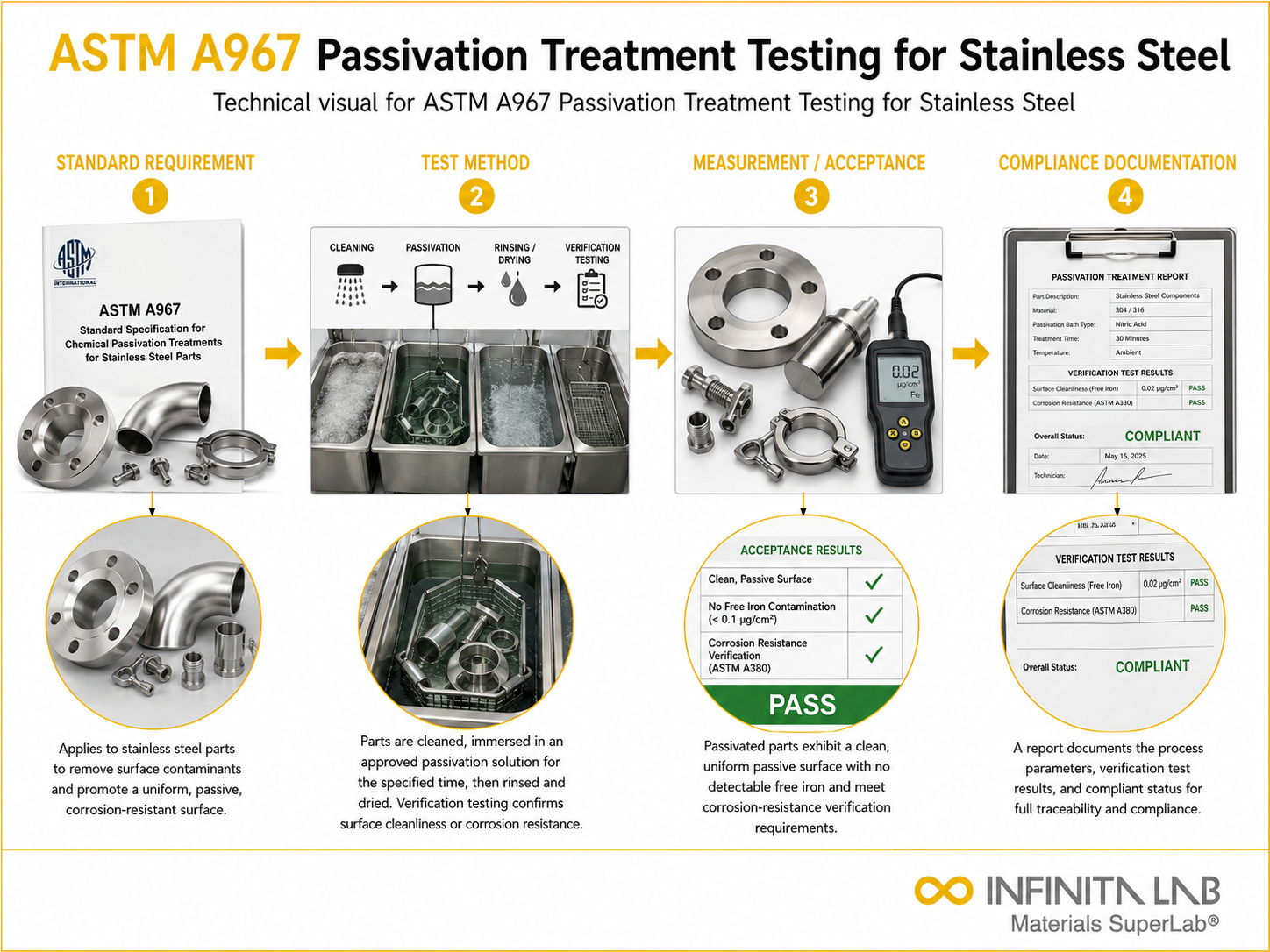


What Is ASTM A967 Stainless Steel Passivation?
ASTM A967/A967M-17 specifies chemical passivation treatments for stainless steel parts to enhance corrosion resistance by removing free iron and contaminants from the surface. The process promotes the formation of a uniform, protective oxide layer that improves the material’s durability in corrosive environments.
This standard is widely used in industries such as aerospace, medical devices, food processing, and manufacturing where stainless steel components require high cleanliness and corrosion resistance. ASTM A967 ensures consistent passivation quality, supporting product reliability and compliance with stringent industry requirements.

Applications and Benefits of ASTM A967 Stainless Steel Passivation Testing
Scope
ASTM A967/A967M-17 covers chemical passivation treatments for stainless steel to remove contaminants and improve corrosion resistance through controlled chemical processes.
- Applicable to stainless steel parts and components
- Removes free iron and surface contaminants
- Enhances corrosion resistance
- Includes multiple passivation methods (nitric, citric acid)
- Ensures compliance with ASTM standards
- Covers testing methods to verify passivation effectiveness
- Suitable for precision and critical applications
Applications
- Medical and surgical instruments
- Aerospace components
- Food processing equipment
- Pharmaceutical manufacturing parts
- Industrial stainless steel components
Benefits
- Improves corrosion resistance
- Removes surface contamination
- Enhances product lifespan
- Ensures regulatory compliance
- Maintains surface cleanliness and quality
Our ASTM A967 Testing Procedure
Surface Cleaning
Stainless steel parts are cleaned to remove oils, grease, and contaminants.
1Chemical Treatment
Parts are treated with nitric or citric acid solutions to remove free iron.
2Rinsing & Drying
Components are thoroughly rinsed and dried to prevent residue formation.
3Verification Testing
Passivation effectiveness is checked using standard corrosion or contamination tests.
4ASTM A967 Test Parameters and Requirements
| Parameter | Details |
|---|---|
| Method | Chemical passivation (nitric or citric acid) |
| Material | Stainless steel parts |
| Objective | Removal of free iron and contaminants |
| Temperature | Controlled based on solution type |
| Duration | Varies depending on process method |
| Output | Clean, passive oxide surface |
| Environment | Controlled chemical processing conditions |


- Chemical treatment tanks
- Temperature control systems
- Rinsing and drying systems
- Surface inspection tools
- Corrosion testing equipment
Equipment and Instrumentation Used for ASTM A967 Testing
What You Receive: Test Report, Data, and Certification
- Passivation treatment report
- Surface cleanliness verification
- Corrosion resistance test results
- Compliance certification as per ASTM A967
- Detailed inspection and process documentation
ASTM A967 Stainless Steel Passivation FAQs
ASTM A967 defines chemical passivation treatments for stainless steel to remove free iron and contaminants. It enhances corrosion resistance by forming a stable oxide layer on the material surface.
Passivation removes contaminants that can cause corrosion. It improves the natural oxide layer, ensuring better resistance to rust and extending the service life of stainless steel components.
Factors include surface cleanliness, chemical concentration, temperature, and treatment time. Proper control of these parameters ensures effective passivation and consistent results.
Nitric acid passivation is a traditional method offering strong oxidation and cleaning, while citric acid is more environmentally friendly and safer. Both effectively remove free iron, but selection depends on application requirements and regulatory considerations.
Temperature affects reaction rates during passivation. Higher temperatures can improve cleaning efficiency but must be controlled to prevent surface damage or inconsistent results.
ASTM A967/A967M high humidity testing evaluates the effectiveness of stainless steel passivation by detecting contaminant iron and other surface contaminants. Specimens are placed in a humidity chamber at 97 ± 3% relative humidity and 35–40°C for at least 24 hours. After exposure, the surfaces are inspected for rust or staining attributable to embedded contaminant iron.
Passivation according to ASTM A967/A967M is a chemical treatment of stainless steel, typically using nitric acid, citric acid, or an electrochemical process, to remove free iron and other surface contaminants. This treatment promotes the formation of a protective passive oxide film, helping preserve the stainless steel’s corrosion resistance.
ASTM A967/A967M is a standard specification covering chemical passivation treatments for stainless steel parts and methods for verifying treatment effectiveness. Verification options include water immersion, high humidity, salt spray, copper sulfate, and other specified tests. Acceptance depends on the selected test method and applicable requirements.
Why Choose Infinita Lab for Stainless Steel Passivation Testing
When your Stainless Steel Passivation results have to hold up - for compliance, a customer audit, or an engineering decision - ASTM A967 accuracy and an unbiased third-party report matter more than price. Infinita Lab routes your ASTM A967 stainless steel passivation testing to ISO/IEC 17025-accredited U.S. partner labs with hands-on method experience, so you get defensible data, transparent reporting, and turnaround times built around your project deadline - not ours.

Need ASTM A967 Stainless Steel Passivation Testing You Can Rely On?
Send query us at hello@infinitalab.com or call us at (888) 878-3090 to learn more about our services and how we can support you.





