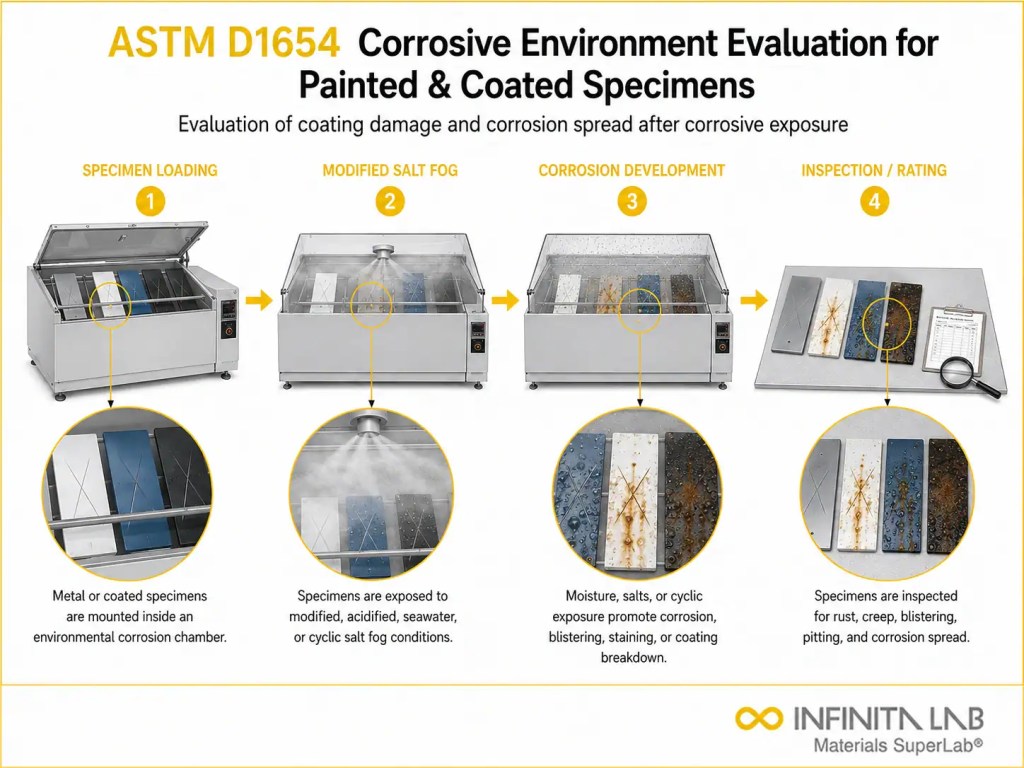


What Is ASTM D1654 Painted Specimen Corrosive Environment?
ASTM D1654 evaluates the performance of painted or coated specimens after exposure to corrosive environments by assessing the degree of coating degradation and corrosion spread from defects such as scribe marks. It provides a standardized rating system to quantify coating failure.
This test is widely used to determine the protective effectiveness of coatings against corrosion. It helps identify coating durability, adhesion performance, and resistance to underfilm corrosion, ensuring long-term protection of substrates in harsh environmental conditions.
Applications and Benefits of ASTM D1654 Painted Specimen Corrosive Environment Testing
Scope
ASTM D1654 defines a visual evaluation method for assessing corrosion and coating degradation on specimens exposed to corrosive conditions. It is commonly used after tests such as salt spray or humidity exposure to quantify coating performance.
- Applicable to painted or coated metal specimens
- Evaluates corrosion creepage from intentional defects
- Uses standardized rating scales for assessment
- Suitable for post-exposure evaluation (e.g., salt spray tests)
- Supports comparison of coating systems
- Used for quality control and performance validation
- Helps determine coating adhesion and resistance to corrosion
Applications
- Protective coatings for metal structures
- Automotive and industrial coatings
- Marine and offshore applications
- Infrastructure and construction coatings
- Coating performance evaluation after corrosion testing
Benefits
- Provides standardized corrosion rating system
- Helps identify coating failures and weaknesses
- Supports comparison between coating systems
- Enhances product durability and reliability
- Assists in improving coating formulations
Our ASTM D1654 Testing Procedure
Specimen Preparation
Coated specimen is scribed to expose substrate and prepared for exposure.
1Corrosive Exposure
Specimen is subjected to corrosive conditions such as salt spray or humidity.
2Visual Examination
Coating is inspected for corrosion, blistering, and creepage from scribe.
3Rating Assignment
Corrosion extent is rated using standardized ASTM scales.
4ASTM D1654 Test Parameters and Requirements
| Parameter | Details |
|---|---|
| Substrate | Coated metal specimens |
| Exposure | Post-corrosion test evaluation |
| Defect Method | Scribed line for corrosion initiation |
| Measurement | Creepage distance from scribe |
| Output | Corrosion and coating degradation rating |
| Environment | Salt spray or controlled corrosion exposure |


- Scribing tool for defect creation
- Salt spray chamber or corrosion test chamber
- Measuring scale or microscope
- Visual inspection tools
- Documentation and imaging system
Equipment and Instrumentation Used for ASTM D1654 Testing
What You Receive: Test Report, Data, and Certification
- Corrosion rating (0–10 scale)
- Creepage measurement from scribe
- Visual observations (blistering, rusting, delamination)
- Test conditions and exposure details
- Compliance statement with ASTM D1654
ASTM D1654 Painted Specimen Corrosive Environment FAQs
ASTM D1654 is used to evaluate how well coatings resist corrosion after exposure to aggressive environments. It provides a standardized method to assess coating degradation and corrosion spread from defects such as scribed areas.
It provides a consistent way to measure corrosion resistance and coating durability, helping manufacturers ensure their products meet performance expectations in harsh environments.
Creepage indicates how far corrosion spreads beneath the coating. Greater creepage suggests poor adhesion or protection, while minimal creepage indicates strong resistance.
Factors include coating thickness, surface preparation, exposure conditions, and material quality. Proper control ensures reliable and comparable results.
It ensures coatings provide effective protection against corrosion, reducing maintenance costs and extending the lifespan of metal structures in aggressive environments.
ASTM D1654 evaluates the corrosion resistance and coating performance of painted or coated specimens after exposure to corrosive environments. Test specimens may undergo accelerated corrosion testing or atmospheric exposure before evaluation. The coating is examined for rust formation, blistering, corrosion around damaged areas, and loss of adhesion along intentionally made scribe marks. The results are rated to compare the corrosion protection provided by different coating systems and assess their durability.
Why Choose Infinita Lab for Painted Specimen Corrosive Environment Testing
When your Painted Specimen Corrosive Environment results have to hold up - for compliance, a customer audit, or an engineering decision - ASTM D1654 accuracy and an unbiased third-party report matter more than price. Infinita Lab routes your ASTM D1654 painted specimen corrosive environment testing to ISO/IEC 17025-accredited U.S. partner labs with hands-on method experience, so you get defensible data, transparent reporting, and turnaround times built around your project deadline - not ours.

Need ASTM D1654 Painted Specimen Corrosive Environment Testing You Can Rely On?
Send query us at hello@infinitalab.com or call us at (888) 878-3090 to learn more about our services and how we can support you.