


ASTM D570 Water Absorption of Plastics
ASTM D570 test method is used for measuring the relative water absorption by plastic samples. A specimen is immersed in distilled water for different duration at different temperatures, and at last, its absorbance is compared with other plastics, and data is calculated. Read more about ASTM D570 Water Absorption of Palstics below.
TRUSTED BY


Precision-driven testing for dimensional accuracy and compliance
- Overview
- Scope, Applications, and Benefits
- Test Process
- Specifications
- Instrumentation
- Results and Deliverables
ASTM D570: Water Absorption of Plastics Overview
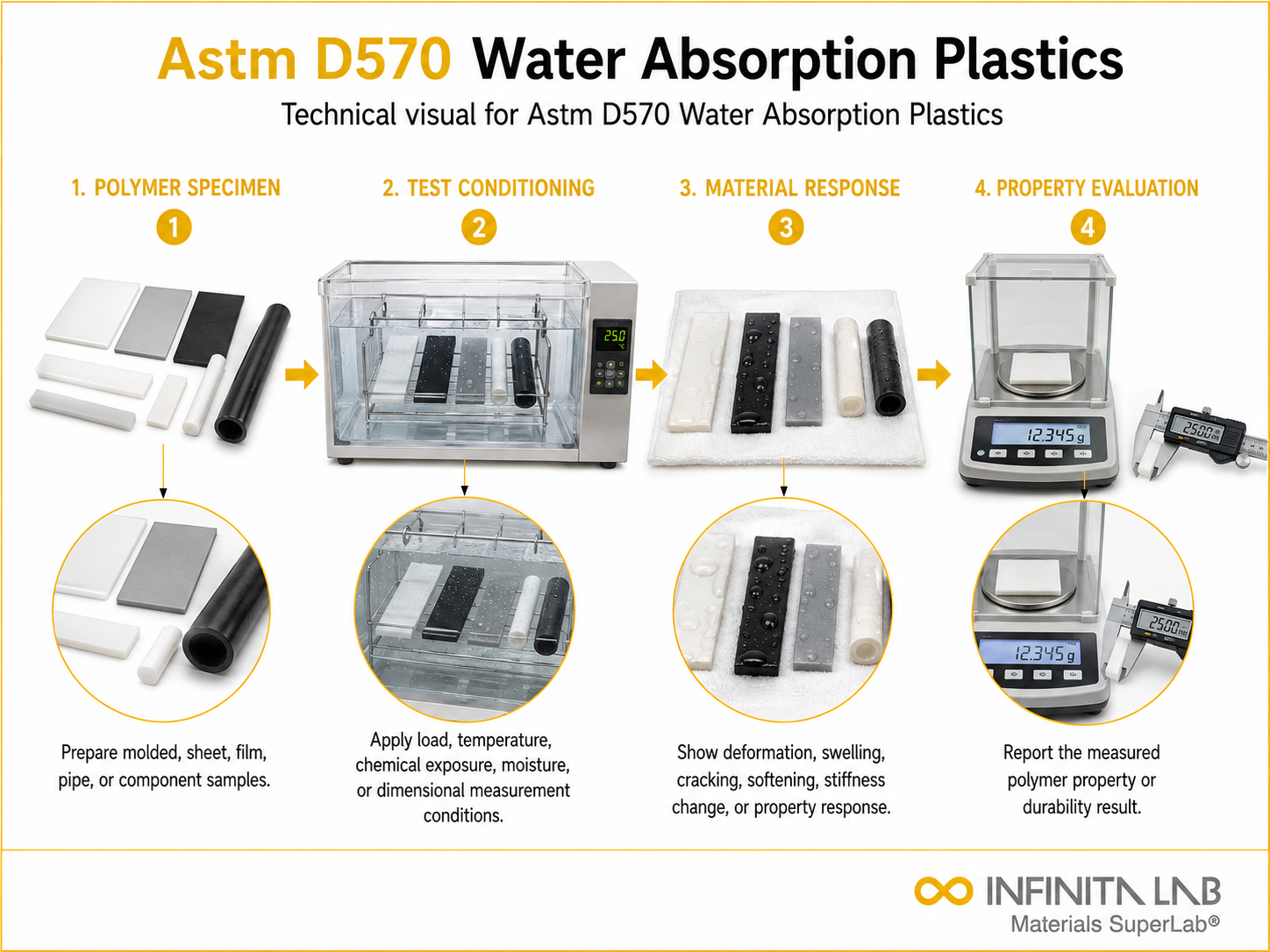
ASTM D570 is the standard test method for determining the water absorption of plastics. The test measures the increase in specimen mass after immersion in water under controlled conditions and reports the result as a percentage of the original dry mass. This provides a direct indication of how much moisture a plastic material can absorb during exposure to water or humid environments.
Water absorption is an important property because moisture uptake can affect a plastic’s dimensional stability, mechanical strength, electrical performance, and appearance. ASTM D570 is widely used for material selection, product development, quality control, and specification compliance across industries. The results help engineers evaluate the suitability of plastic materials for applications where long-term exposure to moisture may influence performance and durability.

ASTM D570: Water Absorption of Plastics Scope, Applications, and Benefits
Scope
ASTM D570 applies to rigid and semi-rigid plastics in the form of molded or machined test specimens. The standard specifies multiple test conditions — immersion temperature, immersion duration, and pre-conditioning procedure — that are selected based on the material type and the intended application of the data. The result in each case is the percentage increase in mass relative to the conditioned dry mass, calculated from the before-and-after weighings.
Test conditions defined within the standard include:
- 24-hour immersion at 23°C — the standard short-term condition used for general material comparison and datasheet reporting
- Immersion to equilibrium at 23°C — extended immersion continued until mass gain stabilizes, representing the maximum absorption the material will reach under ambient temperature water exposure
- Immersion at 50°C — an accelerated condition used to estimate long-term absorption behavior more rapidly than equilibrium testing at 23°C permits
- 2-hour immersion in boiling water — severe conditioning used to assess absorption under aggressive thermal and aqueous exposure, or to evaluate materials intended for high-temperature water contact service
- Long-term immersion variations — as specified in applicable product standards or customer requirements for specific end-use simulations
Applications
- Material selection and comparison — ranking candidate materials by water absorption to identify grades with the lowest moisture sensitivity for humid or wet service environments
- Datasheet characterization — generating the water absorption value reported on material datasheets and in material property databases under standardized 24-hour and equilibrium conditions
- Dimensional stability assessment — supplying absorption data as an input to dimensional change calculations for components with tight tolerances in humid or wet environments
- Electrical insulation qualification — evaluating moisture-induced degradation of dielectric properties for electrical and electronic enclosures, connectors, and insulation components
- Food contact and medical device compliance — assessing water absorption behavior as part of material approval programs for applications involving sustained contact with aqueous media
- Quality control and incoming inspection — verifying that production lots and incoming raw materials meet specified absorption limits before processing or use
- Formulation and compound development — quantifying the effect of resin grade, filler type, coupling agent, or moisture stabilizer additions on the absorption behavior of a compound relative to the base resin
Benefits
- Universal applicability — the method applies to the full range of thermoplastic, thermoset, filled, and unfilled plastic materials, making it the single most widely used absorption characterization method for plastics
- Multiple test conditions in one standard — 24-hour, equilibrium, elevated temperature, and boiling water conditions are all defined within ASTM D570, allowing the appropriate condition to be selected for the application without referencing multiple standards
- Simple, accessible procedure — the test requires only a precision balance, a temperature-controlled water bath, and a drying oven, making it practical for quality control laboratories without specialized equipment
- Direct input to material selection and design — the percentage absorption value feeds directly into swelling calculations, property retention assessments, and comparative material rankings used in design and specification decisions
- Lot-to-lot quality verification — absorption is sensitive to changes in resin molecular weight, filler content, moisture stabilizer concentration, and processing history, making it a useful indicator of material consistency across production lots
- Supports accelerated aging programs — elevated-temperature and boiling-water conditions provide accelerated estimates of long-term moisture uptake behavior, reducing the time required to generate service-relevant data.
ASTM D570: Water Absorption of Plastics Test Process
Test Planning & Specimen Preparation
Select the immersion condition, prepare specimens to the required dimensions, and inspect for defects.
1Drying & Initial Weighing
Dry specimens, cool in a desiccator, and record the initial dry mass.
2Water Immersion & Weighing
Immerse specimens in water under specified conditions, then remove them, blot them dry, and record the wet mass.
3Calculation & Reporting
Calculate water absorption as the percentage increase in mass and report individual and average results.
4ASTM D570: Water Absorption of Plastics Technical Specifications
| Parameter | Details |
|---|---|
| Result Expression | Percentage increase in mass relative to dry conditioned mass |
| Standard Immersion Condition | 24 hours at 23°C ± 1°C |
| Equilibrium Condition | Immersion at 23°C until mass gain stabilizes |
| Elevated Temperature Condition | Immersion at 50°C ± 1°C |
| Boiling Water Condition | 2 hours in boiling distilled water |
| Pre-Test Drying | 24 hours at 50°C (standard); higher temperature for hygroscopic resins |
| Water Type | Distilled water |
| Weighing Precision | Balance readable to 0.1 mg |
| Equilibrium Criterion | Mass change within specified tolerance between successive weighings |


Instrumentation Used for ASTM D570: Water Absorption of Plastics
- Analytical balance readable to 0.1 mg for pre- and post-immersion mass measurements
- Ventilated drying oven with temperature control calibrated to drying temperature requirements
- Temperature-controlled immersion bath maintained at 23°C ± 1°C or 50°C ± 1°C as required
- Boiling water apparatus for elevated temperature condition testing
- Desiccator with drying agent for specimen cooling after oven drying
- Distilled water supply and water quality verification
- Calibrated thermometer or thermocouple for bath temperature verification
- Timer for immersion period control
- Dry lint-free blotting cloth for surface water removal before weighing
- Calibrated reference masses for balance verification
ASTM D570: Water Absorption of Plastics Results and Deliverables
- Test report — complete documentation of standard applied, material and specimen identification, specimen geometry, pre-conditioning procedure, immersion condition applied, individual mass measurements, and calculated absorption values for each specimen
- Water absorption values — percentage mass increase for each replicate specimen and reported mean for the test lot under the applied immersion condition.
- Equilibrium absorption profile — tabulated mass gain versus immersion time for equilibrium testing, showing the progression to saturation and the final equilibrium value
- Pass/fail determination — compliance assessment against specified maximum absorption limits, with acceptance criteria defined in a product standard or purchase specification.n
- Descriptive statistics — mean, standard deviation, and range of absorption values across the replicate specimen set
Frequently Asked Questions
A conditioned specimen is weighed, immersed in water for a specified period and weighed again after surface water is removed. The increase in mass represents the amount of water absorbed.
Water absorption is calculated by dividing the increase in specimen mass by its original conditioned mass and multiplying by 100. The result is generally reported as a percentage by mass.
Absorbed moisture can affect dimensional stability, mechanical strength, appearance and electrical insulation properties. The degree of change depends on the plastic, specimen shape and exposure conditions.
Polymer type, specimen thickness, porosity, fillers, temperature and immersion duration can influence absorption. Cut edges may also absorb water differently from moulded surfaces.
ASTM D570 and ISO 62 are technically equivalent when the specimen configuration specified in ASTM D570 is used. Testing laboratories should still report the exact standard and procedure followed.
Why Choose Infinita Lab for Advanced Materials Testing and Characterization?
At the core of this breadth is our network of 2,000+ accredited laboratories across the USA, offering access to over 10,000 testing methods and analytical services. From advanced materials characterization (SEM, TEM, RBS, XPS) to mechanical, chemical, environmental, biological, and standardized ASTM/ISO-compliant testing, we deliver unmatched flexibility, specialization, and scale. You are never limited by geography, facility, or methodology — Infinita Lab connects you to the right expertise and testing solution, every time.

Looking for a Trusted Partner for Accurate and Reliable Testing Services?
Send query us at hello@infinitalab.com or call us at (888) 878-3090 to learn more about our services and how we can support you.



Request a Quote
Submit your material details and receive testing procedures, pricing, and turnaround time within 24 hours.
 Quick Turnaround and Hasslefree process
 Confidentiality Guarantee
 Free, No-obligation Consultation
 100% Customer Satisfaction
