


ASTM C136 Sieve Analysis of Aggregates
ASTM C136/C136-19 explains measuring the particle-size distribution of fine and coarse aggregates by sieving. Some specifications for aggregates contain grading requirements for both fine and coarse fractions. Its values are stated in SI units as they are considered as standards.
TRUSTED BY


Precision-driven testing for dimensional accuracy and compliance
- Overview
- Scope, Applications, and Benefits
- Test Process
- Specifications
- Instrumentation
- Results and Deliverables
ASTM C136 Sieve Analysis of Aggregates Overview
ASTM C136 is the standard test method for determining the particle-size distribution (gradation) of fine and coarse aggregates by sieving. Aggregates – sand, gravel, crushed stone, and similar granular materials – are a major constituent of concrete, asphalt, mortar, and base courses, and the way their particle sizes are distributed has a direct effect on the properties of the finished material. The gradation influences workability, density, strength, void content, and the amount of cement or binder required, which is why grading requirements are written into most aggregate specifications.
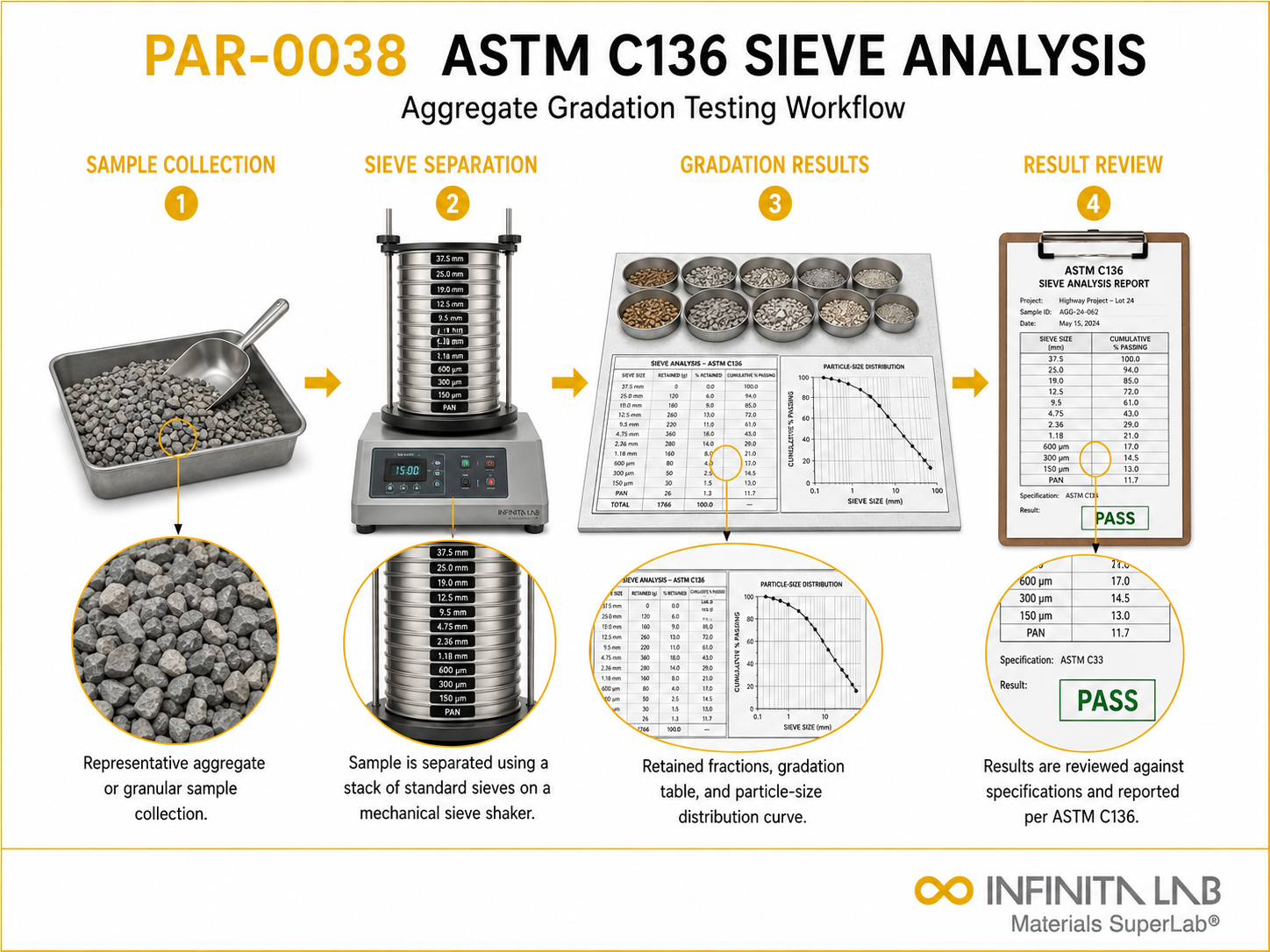
The test is conceptually simple: a representative, dried sample of known mass is passed through a stack of sieves arranged with the largest openings at the top and progressively smaller openings below. The sieves are agitated so that each particle falls until it reaches a sieve it cannot pass through. The mass of aggregate retained on each sieve is then weighed, and from these masses the percentage passing (or retained on) each sieve size is calculated, producing the gradation of the sample.
ASTM C136 results are reported in SI units and are used to confirm that an aggregate meets the grading limits specified for its intended use. The data also supports calculation of the fineness modulus of fine aggregate, a single number summarizing its overall fineness. The method is fundamental in construction materials testing, quality control of aggregate production, and concrete and asphalt mix design.

ASTM C136 Sieve Analysis of Aggregates Scope, Applications, and Benefits
Scope
ASTM C136 covers the determination of the particle-size distribution of fine and coarse aggregates by sieving a dried, representative sample through a nested set of sieves and weighing the mass retained on each.
Key aspects of the test scope include:
- Aggregate types – both fine aggregate (e.g., sand) and coarse aggregate (e.g., gravel, crushed stone), and combined fine/coarse fractions where specifications require grading of both
- Particle-size distribution – the percentage of the sample passing and retained on each sieve, defining the gradation
- Sieve set – a nested stack of standard sieves with progressively smaller openings, selected to suit the aggregate size range, with a pan at the bottom
- Sample preparation – the sample is dried to constant mass and reduced to a representative test portion of adequate size for the aggregate’s nominal maximum size
- Fineness modulus – for fine aggregate, the fineness modulus is calculated from the cumulative percentages retained on specified sieves
- Agitation – sieving by hand or mechanical shaker for sufficient time to achieve adequate separation, with a check that the process is complete
- Units – results reported in SI units
Applications
- Concrete aggregate grading – confirming that fine and coarse aggregates for concrete meet the grading requirements (such as those in ASTM C33) that affect workability, strength, and durability
- Asphalt mix aggregates – verifying the gradation of aggregates used in asphalt paving mixtures, where gradation strongly affects mix performance
- Base and subbase materials – checking the gradation of aggregates used in road bases, subbases, and fill
- Aggregate production quality control – routine gradation testing at quarries and aggregate producers to confirm product consistency and conformance
- Mix design – providing the gradation data needed to proportion concrete and asphalt mixes and to optimize aggregate blends
- Construction acceptance – verifying delivered aggregate meets the project specification grading before use
- Fineness modulus determination – characterizing fine aggregate fineness for concrete mix design and consistency monitoring
Benefits
- Determines a property that governs mix performance – aggregate gradation directly affects workability, density, strength, void content, and binder demand, so the gradation result is fundamental to how the finished concrete or asphalt performs
- Simple, reliable, and well-established – the sieving method is straightforward, robust, and universally recognized, giving dependable gradation data with basic equipment
- Supports specification conformance – the percentage-passing results allow direct comparison against the grading bands in aggregate specifications, confirming the material is suitable for use
- Enables mix design and optimization – gradation data is an essential input for proportioning and optimizing concrete and asphalt mixtures
- Provides fineness modulus – for fine aggregate, the calculated fineness modulus gives a single, convenient measure of overall fineness for design and consistency control
- Fast quality-control tool – gradation can be run quickly and routinely, making it practical for ongoing production and incoming-material control
ASTM C136 Sieve Analysis of Aggregates Test Process
Prepare the Sample
Obtain, dry, size, and weigh a representative aggregate sample.
1Set Up the Sieves
Arrange clean sieves from largest to smallest opening with a pan below.
2Perform Sieving
Shake the sieve stack until the particles are fully separated.
3Calculate and Report
Weigh retained material, calculate percentage passing and fineness modulus, and report the gradation.
4ASTM C136 Sieve Analysis of Aggregates Technical Specifications
| Parameter | Details |
|---|---|
| Measured Property | Particle-size distribution (gradation); percent passing/retained per sieve |
| Aggregate Types | Fine aggregate, coarse aggregate, and combined fractions |
| Sieve Set | Nested standard sieves, largest to smallest, with pan |
| Sample Condition | Dried to constant mass; representative test portion |
| Agitation | Hand or mechanical shaker, sufficient duration |
| Derived Value | Fineness modulus (fine aggregate) |
| Mass Balance Check | Retained masses reconciled against original sample mass |


Instrumentation Used for ASTM C136 Sieve Analysis of Aggregates
- Standard test sieves of required opening sizes, with pan and cover
- Mechanical sieve shaker (or hand sieving)
- Analytical/laboratory balance of adequate capacity and resolution
- Drying oven for sample drying to constant mass
- Sample splitter/riffle for obtaining representative test portions
- Brushes for cleaning sieves
ASTM C136 Sieve Analysis of Aggregates Results and Deliverables
- Sieve analysis report – mass retained and percentage passing/retained for each sieve, defining the aggregate gradation, in SI units
- Gradation curve – tabulated and/or plotted particle-size distribution across the sieve sizes
- Fineness modulus – calculated fineness modulus for fine aggregate where applicable
- Mass balance check – confirmation that the summed retained masses reconcile with the original sample mass within tolerance
- Comparison against specification (where provided) – gradation results against the applicable grading limits with pass/fail notation
- Sample records – aggregate description, source, nominal maximum size, dry sample mass, and sieving method
Frequently Asked Questions
Sieve analysis determines aggregate grading and verifies compliance with applicable particle-size specifications. The results are also used for production control and evaluating aggregate packing characteristics.
The method applies to fine aggregates, coarse aggregates and mixtures containing both fractions. Typical materials include sand, gravel, crushed stone and aggregates used in concrete or construction products.
A representative, dry aggregate sample is passed through a stack of sieves arranged from the largest to the smallest opening. The sieves are mechanically or manually shaken until the particles are adequately separated.
Aggregate grading describes the distribution of different particle sizes within a sample. Proper grading can influence concrete workability, strength, void content and the amount of cement paste required.
ASTM C136 alone cannot accurately determine material finer than the 75 µm, or No. 200, sieve. ASTM C117 should be used for washing and measuring this fine material before completing the dry sieve analysis.
Why Choose Infinita Lab for Advanced Materials Testing and Characterization?
At the core of this breadth is our network of 2,000+ accredited laboratories across the USA, offering access to over 10,000 testing methods and analytical services. From advanced materials characterization (SEM, TEM, RBS, XPS) to mechanical, chemical, environmental, biological, and standardized ASTM/ISO-compliant testing, we deliver unmatched flexibility, specialization, and scale. You are never limited by geography, facility, or methodology — Infinita Lab connects you to the right expertise and testing solution, every time.

Looking for a Trusted Partner for Accurate and Reliable Testing Services?
Send query us at hello@infinitalab.com or call us at (888) 878-3090 to learn more about our services and how we can support you.



Request a Quote
Submit your material details and receive testing procedures, pricing, and turnaround time within 24 hours.
 Quick Turnaround and Hasslefree process
 Confidentiality Guarantee
 Free, No-obligation Consultation
 100% Customer Satisfaction
