


ASTM D4890: Polyurethane Foam Cup Testing Services
ASTM D4890-18 describes test method A in which the color of the material to be tested is compared to a set of color standards that have been prepared in one of three prescribed ways and have specific chromaticity coordinates. The color of the item to be tested is compared to a series of platinum-cobalt color standards, which are indicated by mg of Pt/mL of standard solution in Test Method B.
TRUSTED BY


Get ASTM D4890 compliant results — request your polyurethane foam cup testing quote
- Overview
- Scope, Applications, and Benefits
- Test Process
- Specifications
- Instrumentation
- Results and Deliverables
What Is ASTM D4890 Polyurethane Foam Cup?
ASTM D4890 defines a standardized back-titration method for determining the isocyanate content (NCO%) of methylene diphenyl diisocyanate (MDI) prepolymers and quasi-prepolymers used in polyurethane production. Prepolymers are formed by reacting excess MDI with a polyol to create a liquid product of intermediate molecular weight and reduced NCO content, which provides improved processing characteristics and a broader range of final polyurethane properties compared to neat MDI.
The NCO content of a prepolymer is the single most critical characterization parameter because it determines the stoichiometric quantity of polyol required to achieve the target isocyanate index. The method involves reacting the prepolymer with excess di-n-butylamine, which reacts quantitatively with all free isocyanate groups, and back-titrating the unreacted amine with standardized hydrochloric acid. The NCO content is calculated from the amine consumption.

Applications and Benefits of ASTM D4890 Polyurethane Foam Cup Testing
Scope
ASTM D4890 evaluates:
- NCO content (%) of MDI prepolymers and quasi-prepolymers
- Free isocyanate group concentration in prepolymer systems
- Batch-to-batch NCO content consistency
- Compliance with prepolymer NCO specification limits
- Monitoring of NCO content change during prepolymer storage
- Amine equivalent weight of MDI prepolymers
Applications
- Polyurethane adhesive and sealant prepolymer systems
- Moisture-cure one-component polyurethane formulations
- Polyurethane elastomer prepolymer qualification
- Footwear and cast elastomer systems
- Automotive polyurethane sealant raw material testing
- Prepolymer manufacturer quality control
- Research and development in MDI prepolymer systems
Benefits
- Enables accurate isocyanate index calculation for prepolymer systems
- Detects NCO drift from moisture contamination or storage degradation
- Supports consistent adhesive and elastomer formulation
- Provides batch release data for prepolymer quality control
- Enables stoichiometric precision in one-component cure systems
- Reduces formulation errors from incorrect NCO content assumptions
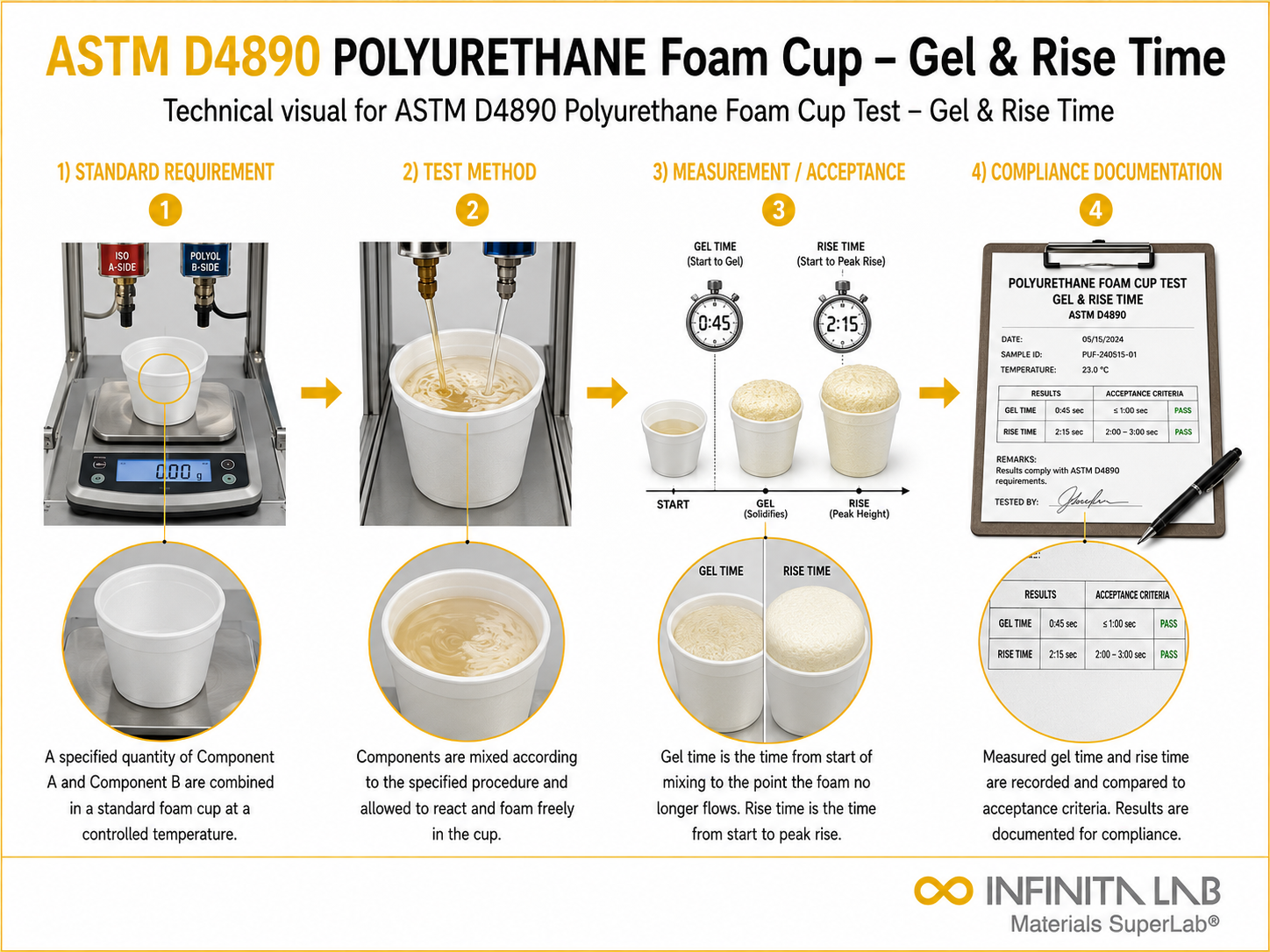
Our ASTM D4890 Testing Procedure
Sample Weighing
Prepolymer sample is accurately weighed under inert atmosphere to prevent moisture reaction.
1Di-n-Butylamine Reaction
Excess standardized di-n-butylamine solution is added; the mixture reacts with all free NCO groups.
2Back Titration
Unreacted amine is back-titrated with standardized hydrochloric acid to the indicator endpoint.
3NCO Calculation
NCO content is calculated from the amine consumed and the sample weight.
4ASTM D4890 Test Parameters and Requirements
| Parameter | Details |
|---|---|
| Test Principle | Di-n-butylamine back-titration |
| Titrant | Standardized HCl solution |
| Applicable Materials | MDI prepolymers and quasi-prepolymers |
| Output Units | Weight percent (%) NCO |
| Measured Outputs | Isocyanate (NCO) content |


- Burette and titration apparatus
- Standardized di-n-butylamine solution
- Standardized HCl titrant
- Analytical balance
- Inert nitrogen atmosphere for sample handling
- Data recording system
Equipment and Instrumentation Used for ASTM D4890 Testing
What You Receive: Test Report, Data, and Certification
- NCO content (weight percent)
- Amine equivalent weight
- Titration volume records and blank data
- Batch compliance evaluation
- Storage stability NCO trend data
- Compliance reports
ASTM D4890 Polyurethane Foam Cup FAQs
ASTM D4890-18 determines Gardner and APHA color of polyols. It evaluates color clarity and purity, helping ensure consistent appearance and quality in polyurethane raw materials used across industrial applications.
Key parameters include sample preparation, color comparison method, lighting conditions, calibration standards, and instrument setup. Controlled conditions ensure accurate determination of color values in polyol samples.
The test measures Gardner and APHA color numbers. Results indicate degree of coloration, reflecting purity and consistency of polyols affecting final product appearance.
ASTM D4890-18 applies to polyols used in polyurethane foams, coatings, adhesives, sealants, and elastomers where color consistency is important for product quality.
ASTM D4890-18 results depend on proper lighting and calibration. Sample turbidity or impurities may affect readings, requiring additional methods for accurate color evaluation.
Why Choose Infinita Lab for Polyurethane Foam Cup Testing?
At the core of this breadth is our network of 2,000+ accredited laboratories across the USA, offering access to over 10,000 testing methods and analytical services. From advanced materials characterization (SEM, TEM, RBS, XPS) to mechanical, chemical, environmental, biological, and standardized ASTM/ISO-compliant testing, we deliver unmatched flexibility, specialization, and scale. You are never limited by geography, facility, or methodology — Infinita Lab connects you to the right expertise and testing solution, every time.

Looking for an Accredited Partner for ASTM D4890 Polyurethane Foam Cup Testing?
Send query us at hello@infinitalab.com or call us at (888) 878-3090 to learn more about our services and how we can support you.



Request a Quote
Submit your material details and receive testing procedures, pricing, and turnaround time within 24 hours.
 Quick Turnaround and Hasslefree process
 Confidentiality Guarantee
 Free, No-obligation Consultation
 100% Customer Satisfaction
