


ASTM C1274: Determination Of Ceramic Surface Area Through Physical Adsorption Testing Services
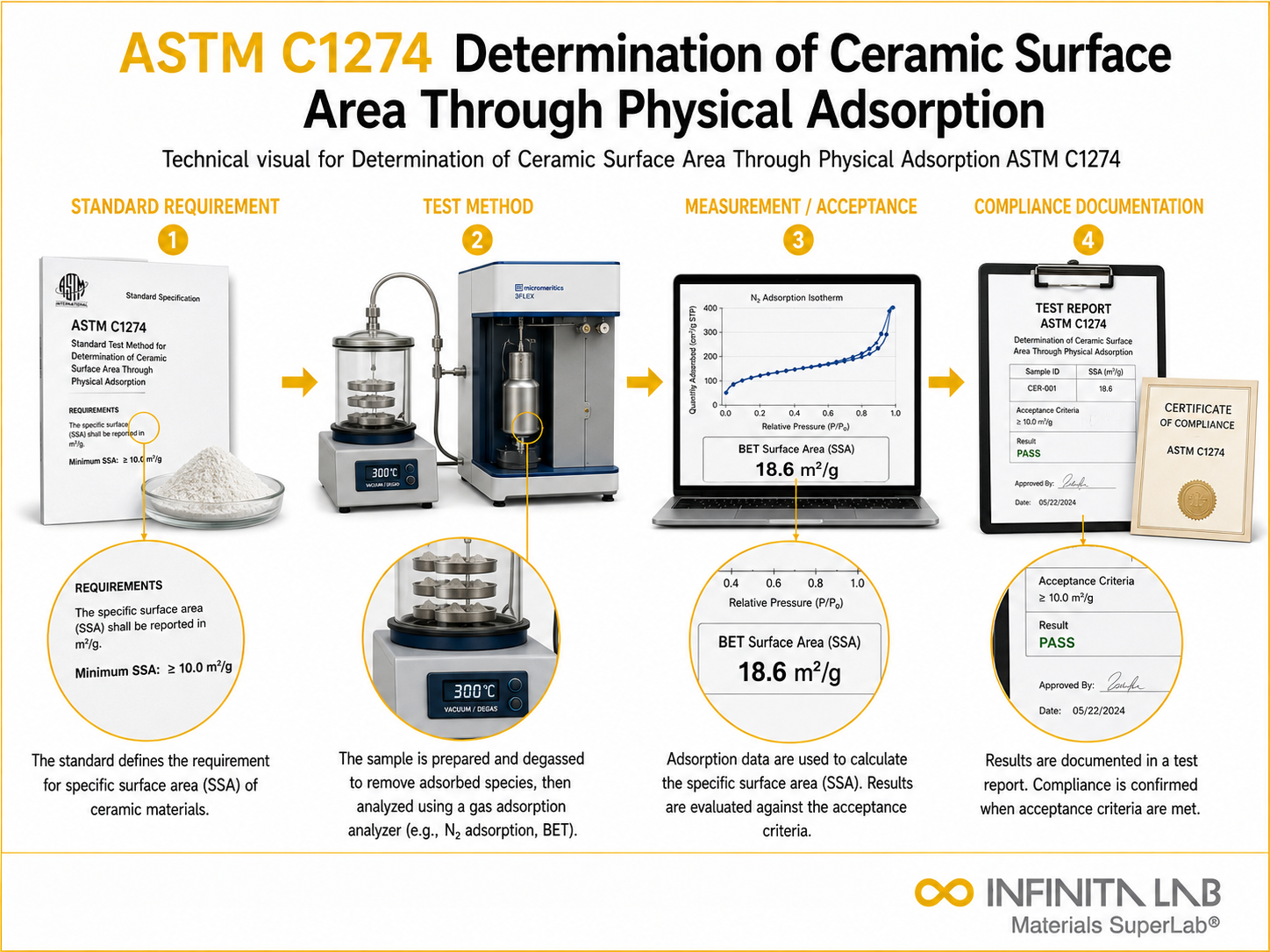
ASTM C1274 determines the ceramic surface area through physical adsorption. The process involves IUPAC-based standards of Brunauer, Emmett, and Teller (BET) standards. ASTM C1274 outlines techniques that are used in commercial adsorption and desorption instruments. The results are reported in SI units.
TRUSTED BY


Get ASTM C1274 compliant results — request your determination of ceramic surface area through physical adsorption testing quote
- Overview
- Scope, Applications, and Benefits
- Test Process
- Specifications
- Instrumentation
- Results and Deliverables
What Is ASTM C1274 Determination Of Ceramic Surface Area Through Physical Adsorption?
ASTM C1274 is the standard test method for determining the specific surface area of advanced ceramic powders and materials using physical adsorption — commonly known as BET analysis, after Brunauer, Emmett, and Teller, who developed the underlying theory. The method measures how much gas (typically nitrogen) adsorbs onto the surface of a material at cryogenic temperature, and uses that data to calculate the total surface area per unit mass expressed in m²/g.
The standard is based on IUPAC guidelines for physical adsorption and is designed for use with commercial automated adsorption instruments that generate multipoint BET isotherms. Both volumetric and gravimetric measurement approaches are covered, though volumetric instruments are by far the most commonly used in practice.
Surface area is a critical parameter for ceramic powders because it directly influences sintering behaviour, reactivity, coating adhesion, catalytic performance, and the final microstructure of densified parts. A powder with a well-characterised surface area gives process engineers the data they need to control and reproduce sintering conditions, mixing ratios, and dispersion behaviour across production batches.

Applications and Benefits of ASTM C1274 Determination Of Ceramic Surface Area Through Physical Adsorption Testing
Scope
ASTM C1274 covers the determination of the specific surface area of advanced ceramic powders and materials by the BET physical adsorption method. The test applies to a wide range of ceramic powder types and is conducted using automated adsorption instruments operating under the IUPAC physisorption framework. Results are reported in SI units (m²/g).
Key aspects of the test scope include:
- Adsorptive gas — nitrogen (N₂) at liquid nitrogen temperature (77 K) is the standard adsorbate; krypton (Kr) may be used for very low surface area materials where nitrogen sensitivity is insufficient
- Measurement approach — multipoint BET analysis using a minimum of three data points in the relative pressure range P/P₀ = 0.05 to 0.30; single-point BET is permitted only when the BET C constant is large, and a linear relationship through the origin is confirmed
- Outgassing requirements — samples must be degassed under vacuum or inert gas flow at an appropriate temperature to remove adsorbed moisture and contaminants before measurement; the outgassing conditions must be reported
- Applicable materials — ceramic powders including alumina (Al₂O₃), silicon carbide (SiC), silicon nitride (Si₃N₄), zirconia (ZrO₂), titania (TiO₂), boron carbide (B₄C), and other advanced ceramic systems
- Surface area range — typically applicable from approximately 0.1 m²/g upward; very low surface area materials may require krypton adsorption for reliable results
Applications
- Ceramic powder characterisation — establishing baseline surface area for raw powders during incoming material evaluation, used alongside particle size distribution and chemical purity data to fully characterise a powder lot
- Sintering process development — surface area strongly influences sintering onset temperature and densification kinetics; BET data is used to predict and optimise firing schedules for technical ceramic components
- Catalyst support materials — alumina, titania, and mixed oxide ceramic supports for heterogeneous catalysis require precise surface area measurement to predict active site density and catalytic performance
- Thermal spray and coating powders — surface area affects flowability, melting behaviour, and coating adhesion; BET testing is used to evaluate and compare powder lots for spray processes
- Battery and energy materials — ceramic separators, electrode materials, and solid electrolytes in lithium-ion and solid-state batteries where interfacial surface area affects ionic conductivity and electrochemical performance
- Quality control in powder production — batch-to-batch surface area consistency is a key QC metric for ceramic powder manufacturers supplying to aerospace, semiconductor, and medical industries
Benefits
- Directly relevant to processing and performance — surface area affects how a powder sinters, how it disperses, and how it interacts with binders and solvents; knowing the BET surface area gives process engineers a real handle on these variables
- Multipoint BET gives reliable, instrument-independent results — the ASTM C1274 multipoint requirement eliminates the inaccuracy of single-point assumptions and produces results that are reproducible across different instruments and labs
- Sensitive across a wide surface area range — nitrogen BET covers most ceramic powder types from a few tenths of a m²/g to several hundred m²/g; krypton extends the method to very low surface area sintered or dense materials
- Fast turnaround for routine QC — automated adsorption instruments run a complete multipoint BET measurement in under an hour per sample, making it practical for incoming inspection and production QC
- Complements particle size analysis — BET surface area and particle size distribution together give a more complete picture of powder morphology than either measurement alone, particularly for porous or aggregated particles
Our ASTM C1274 Testing Procedure
Sample Preparation
The ceramic powder is weighed and degassed under vacuum or inert gas to remove moisture and contaminants.
1Instrument Setup
The degassed sample is transferred to the BET instrument, and dead volume is measured using helium.
2Nitrogen Adsorption
Nitrogen gas is adsorbed onto the sample surface at 77 K across selected pressure points.
3Surface Area Calculation
BET analysis is used to calculate and report the specific surface area in m²/g.
4ASTM C1274 Test Parameters and Requirements
| Parameter | Details |
|---|---|
| Measurement Method | BET (Brunauer-Emmett-Teller) physical adsorption |
| Adsorptive Gas | Nitrogen (N₂) at 77 K; Krypton (Kr) for low surface area materials |
| Analysis Range | Multipoint BET: P/P₀ = 0.05 to 0.30 (minimum 3 points) |
| Applicable Materials | Al₂O₃, SiC, Si₃N₄, ZrO₂, TiO₂, B₄C, and other advanced ceramic powders |
| Outgassing Conditions | Vacuum or inert gas flow; temperature and duration recorded per sample |
| Reported Output | Specific surface area (m²/g), BET C constant, BET plot linearity |
| Units | SI units (m²/g) |
| Surface Area Range | ~0.1 m²/g and above (N₂); lower ranges with Kr |
| Related Standards | ISO 9277 (equivalent BET method), ASTM D3663, ASTM D6556 |


- Automated volumetric gas adsorption analyser (e.g., Micromeritics ASAP, Quantachrome Autosorb, or equivalent)
- Liquid nitrogen Dewar for cryogenic analysis
- Vacuum degassing station with temperature control
- Analytical balance for sample mass determination
- Helium gas supply for dead volume measurement
- Nitrogen and krypton gas supplies (high purity)
Equipment and Instrumentation Used for ASTM C1274 Testing
What You Receive: Test Report, Data, and Certification
- BET surface area report — specific surface area value in m²/g with associated measurement uncertainty
- BET plot — linear transform plot of the adsorption data showing the multipoint fit, slope, intercept, and R² value
- BET C constant — reported alongside surface area as an indicator of adsorbate-adsorbent interaction strength and isotherm quality
- Outgassing conditions — temperature, duration, and method used for sample preparation before analysis
- Sample mass and identification records — pre- and post-outgassing mass, sample description, and lot information
ASTM C1274 Determination Of Ceramic Surface Area Through Physical Adsorption FAQs
Nitrogen is commonly used as the adsorption gas, with the measurement performed at liquid nitrogen temperature.
Outgassing removes moisture, adsorbed gases, and surface contaminants before analysis to improve result accuracy.
Surface area affects sintering behaviour, reactivity, dispersion, coating performance, and powder processing characteristics.
Outgassing temperature, sample mass, contamination, pore structure, particle size, and adsorption data quality can influence the result.
The BET C constant indicates the strength of interaction between the adsorbate gas and the sample surface.
Why Choose Infinita Lab for Determination Of Ceramic Surface Area Through Physical Adsorption Testing?
At the core of this breadth is our network of 2,000+ accredited laboratories across the USA, offering access to over 10,000 testing methods and analytical services. From advanced materials characterization (SEM, TEM, RBS, XPS) to mechanical, chemical, environmental, biological, and standardized ASTM/ISO-compliant testing, we deliver unmatched flexibility, specialization, and scale. You are never limited by geography, facility, or methodology — Infinita Lab connects you to the right expertise and testing solution, every time.

Looking for an Accredited Partner for ASTM C1274 Determination Of Ceramic Surface Area Through Physical Adsorption Testing?
Send query us at hello@infinitalab.com or call us at (888) 878-3090 to learn more about our services and how we can support you.



Request a Quote
Submit your material details and receive testing procedures, pricing, and turnaround time within 24 hours.
 Quick Turnaround and Hasslefree process
 Confidentiality Guarantee
 Free, No-obligation Consultation
 100% Customer Satisfaction
