


ASTM D542 Refractive Index of Plastics
ASTM D542 is used to determine the Index of Refraction of Transparent Organic Plastics (Refractive Index). Index of refraction is used in the construction of optical lenses as well as a quality management check on clear plastics. This test is done using a refractometer.
TRUSTED BY


ASTM D542 Refractive Index of Plastics
- Overview
- Scope, Applications, and Benefits
- Test Process
- Specifications
- Instrumentation
- Results and Deliverables
ASTM D542 Refractive Index of Plastics Overview
ASTM D542 defines the method for determining the refractive index of transparent organic plastics. The refractive index is the ratio of the speed of light in a vacuum to the speed of light in the material. For transparent plastics, this value governs how light bends at the material surface and how well it transmits without internal scattering or aberration.
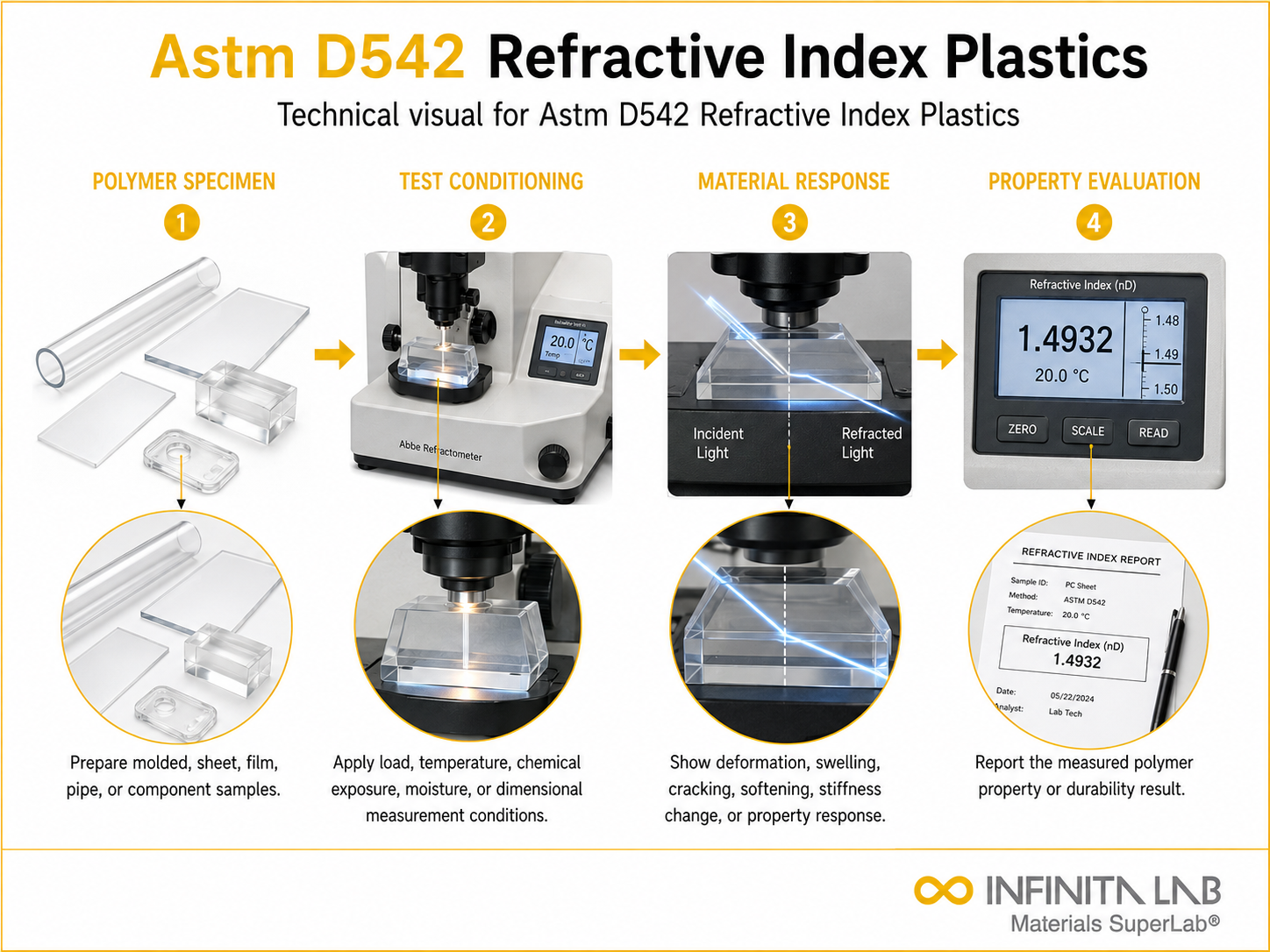
The test is performed using a refractometer, which measures the critical angle at which total internal reflection occurs between the plastic specimen and a reference prism of known refractive index. ASTM D542 permits two methods: Method A uses a refractometer directly on the polished specimen surface, while Method B uses a microscope immersion technique for materials that cannot be polished to the required flatness. Results are reported at a specified wavelength and temperature.
Refractive index is a primary design parameter for optical-grade plastics used in lenses, light guides, displays, and optical coatings. It also serves as a quality control measurement in plastic production – batch-to-batch variation in refractive index indicates changes in polymerization, additive content, or raw material composition, all of which affect optical and physical performance.

ASTM D542 Refractive Index of Plastics Scope, Applications, and Benefits
Scope
ASTM D542 applies to transparent organic plastics that can be prepared as flat-polished specimens or as small fragments suitable for the immersion method. The test is applicable across a broad range of thermoplastic and thermoset materials used in optical and general-purpose applications. The standard evaluates:
- Absolute refractive index at specified wavelength and temperature
- Optical consistency within a molded or extruded part
- Lot-to-lot variation in refractive index for quality control
- Effect of additives, fillers, or processing conditions on optical properties
- Suitability of plastic materials for optical lens applications
Applications
- Optical lens design and qualification for eyewear and camera optics
- Light guide and fiber optic component material selection
- Display panel and cover glass plastic qualification
- Anti-reflective coating design requiring matched refractive indices
- Quality control in production of optical-grade plastics
- Research and development for new optical polymer formulations
Benefits
- Provides a precise, standardized optical property value
- Enables direct comparison of different plastic materials for optical applications
- Detects formulation inconsistencies that affect optical performance
- Supports optical system design with accurate material input data
- Non-destructive for Method A when specimen is properly prepared
- Applicable to both thermoplastic and thermoset transparent materials
ASTM D542 Refractive Index of Plastics Process
Specimen Preparation
The specimen surface is polished flat and smooth for Method A, or small fragments are prepared for the immersion Method B.
1Instrument Setup and Calibration
The refractometer is calibrated using a standard glass block of known refractive index. Temperature is equilibrated to the specified test condition.
2Refractive Index Measurement
The specimen is placed in contact with the refractometer prism and the critical angle is determined.
3Data Reporting
The refractive index is calculated and reported at the test wavelength and temperature per ASTM D542 requirements.
4ASTM D542 Refractive Index of Plastics Technical Specifications
| Parameter | Details |
|---|---|
| Standard | ASTM D542 |
| Test Principle | Critical angle refractometry |
| Method A | Abbe or similar refractometer on polished surface |
| Method B | Microscope immersion technique |
| Test Wavelength | Sodium D line (589.3 nm) or specified wavelength |
| Applicable Materials | Transparent organic plastics |


Instrumentation Used for ASTM D542 Refractive Index of Plastics
- Abbe refractometer or equivalent precision refractometer
- Calibration reference glass standards
- Specimen polishing equipment for surface preparation
- Temperature-controlled measurement stage
- Optical microscope for Method B immersion technique
- Data recording software
ASTM D542 Refractive Index of Plastics Results and Deliverables
- Refractive index value at specified wavelength and temperature
- Test method used (Method A or Method B)
- Specimen identification and conditioning records
- Calibration traceability documentation
- Statistical summary for multiple specimens or measurement locations
- Quality assurance documentation
Frequently Asked Questions
ASTM D542 measures the refractive index of transparent organic plastics, indicating how much light bends as it passes through the material. This property is important for optical applications and material identification.
Refractive index affects optical performance, including light transmission, clarity, and lens functionality. It is commonly used for quality control and material verification.
The method is suitable for transparent organic plastics such as acrylics, polycarbonates, polystyrenes, and other clear polymer materials that allow light transmission.
Yes. Small changes in polymer composition, additives, or manufacturing conditions can affect refractive index, making the test useful for comparing batches and confirming material consistency.
Why Choose Infinita Lab for Advanced Materials Testing and Characterization?
At the core of this breadth is our network of 2,000+ accredited laboratories across the USA, offering access to over 10,000 testing methods and analytical services. From advanced materials characterization (SEM, TEM, RBS, XPS) to mechanical, chemical, environmental, biological, and standardized ASTM/ISO-compliant testing, we deliver unmatched flexibility, specialization, and scale. You are never limited by geography, facility, or methodology — Infinita Lab connects you to the right expertise and testing solution, every time.

Looking for a Trusted Partner for Accurate and Reliable Testing Services?
Send query us at hello@infinitalab.com or call us at (888) 878-3090 to learn more about our services and how we can support you.



Request a Quote
Submit your material details and receive testing procedures, pricing, and turnaround time within 24 hours.
 Quick Turnaround and Hasslefree process
 Confidentiality Guarantee
 Free, No-obligation Consultation
 100% Customer Satisfaction
