


ASTM C1730 Ceramic Nanoparticle Size Testing via X-Ray Sedimentation
The ASTM C1730 standard regulates the measurement of ceramic powder for particle size distribution. The size-sedimentation velocity connection utilized in the ASTM C1730 test technique implies particle sediment in a laminar regime.
TRUSTED BY


Precision-driven testing for dimensional accuracy and compliance
- Overview
- Scope, Applications, and Benefits
- Test Process
- Specifications
- Instrumentation
- Results and Deliverables
Overview
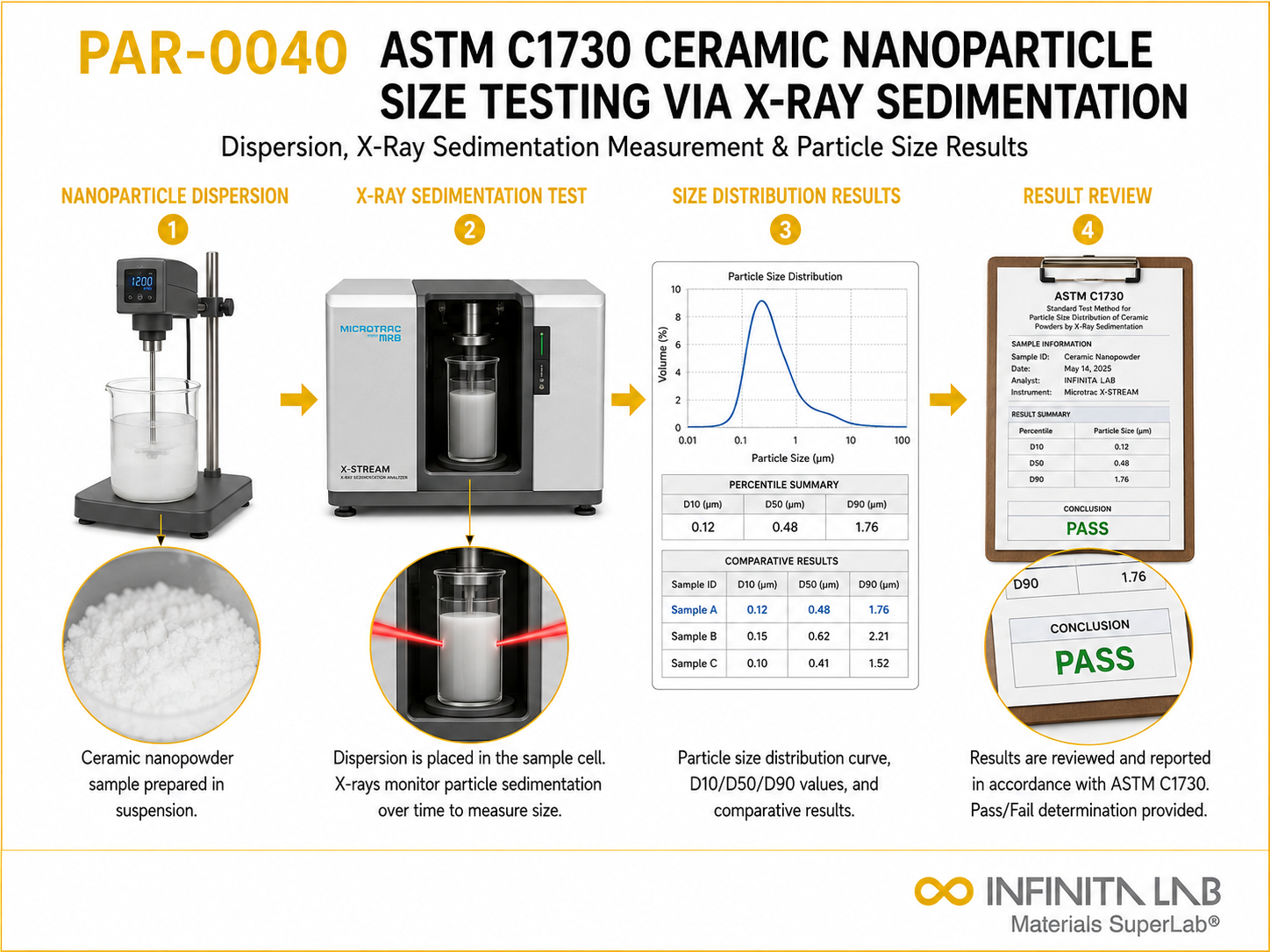
ASTM C1730 defines a standardized method for determining particle size distribution of ceramic nanoparticles using X-ray gravity sedimentation. This technique measures the rate at which particles settle in a fluid under gravity while monitoring concentration changes with X-ray absorption, enabling accurate characterization of fine particles.
This method is particularly useful for submicron and nanoparticle-sized ceramic powders where traditional sieving techniques are ineffective. ASTM C1730 supports precise material characterization, helping manufacturers and researchers control particle size, which directly influences sintering behavior, mechanical properties, and overall material performance.

Scope, Applications, and Benefits
Scope
ASTM C1730 outlines procedures for measuring particle size distribution of ceramic nanoparticles using X-ray monitoring during sedimentation under controlled conditions.
- Applicable to ceramic powders in nano and submicron ranges
- Determines particle size distribution based on sedimentation rates
- Uses X-ray absorption to monitor particle concentration
- Includes sample dispersion and fluid preparation
- Ensures controlled temperature and sedimentation conditions
- Supports research, quality control, and material development
Applications
- Characterization of ceramic nanopowders
- Advanced materials research and development
- Quality control in powder manufacturing
- Sintering process optimization
- Electronics and high-performance ceramics
- Nanotechnology and material science studies
Benefits
- Provides accurate measurement of nanoparticle size distribution
- Suitable for very fine particles beyond sieving limits
- Non-destructive and highly sensitive technique
- Supports improved material performance and consistency
- Enables precise control of powder characteristics
- Provides standardized and reproducible results
Test Process
Sample Dispersion
Disperse ceramic powder uniformly in a suitable liquid medium.
1Sedimentation Setup
Allow particles to settle under gravity in a controlled column.
2X-Ray Monitoring
Measure concentration changes using X-ray absorption during settling.
3Data Analysis
Calculate particle size distribution based on sedimentation rates.
4Technical Specifications
| Parameter | Details |
|---|---|
| Material Type | Ceramic nanopowders |
| Particle Size Range | Nano to submicron scale |
| Measurement Principle | Sedimentation rate and X-ray absorption |
| Medium | Liquid dispersion medium |
| Temperature Control | Maintained for consistent results |
| Measurement Parameter | Particle size distribution |
| Detection Method | X-ray attenuation |
| Output Result | Size distribution curve |


- X-ray sedimentation analyzer
- Sedimentation column
- Sample dispersion equipment
- Temperature control system
- Analytical balance
- Data acquisition and analysis software
Instrumentation Used for Testing
Results and Deliverables
- Particle size distribution curve
- Mean and median particle size values
- Sedimentation rate data
- Quality assessment of nanopowder
- Comparative analysis of samples
- Detailed analytical report with graphs
Frequently Asked Question
ASTM C1730 is used to determine particle size distribution of ceramic nanoparticles using X-ray gravity sedimentation. It provides accurate characterization of fine powders, helping manufacturers and researchers optimize material properties and ensure consistent quality in advanced ceramic applications.
X-ray gravity sedimentation is a technique where particles settle in a liquid under gravity, and their concentration is monitored using X-ray absorption. The settling behavior is used to calculate particle size distribution accurately.
Traditional sieving methods cannot measure nanoparticles effectively. This method provides high sensitivity and accuracy for very fine particles, making it ideal for nano and submicron ceramic powders.
Factors include particle shape, density, fluid viscosity, and temperature. These influence settling rates and must be controlled for accurate measurements.
It enables manufacturers to control powder characteristics, improve processing, reduce defects, and produce high-performance ceramic materials with consistent properties.
Why Choose Infinita Lab for Advanced Materials Testing and Characterization?
At the core of this breadth is our network of 2,000+ accredited laboratories across the USA, offering access to over 10,000 testing methods and analytical services. From advanced materials characterization (SEM, TEM, RBS, XPS) to mechanical, chemical, environmental, biological, and standardized ASTM/ISO-compliant testing, we deliver unmatched flexibility, specialization, and scale. You are never limited by geography, facility, or methodology — Infinita Lab connects you to the right expertise and testing solution, every time.

Looking for a Trusted Partner for Accurate and Reliable Testing Services?
Send query us at hello@infinitalab.com or call us at (888) 878-3090 to learn more about our services and how we can support you.



Request a Quote
Submit your material details and receive testing procedures, pricing, and turnaround time within 24 hours.
 Quick Turnaround and Hasslefree process
 Confidentiality Guarantee
 Free, No-obligation Consultation
 100% Customer Satisfaction
