


GI SAXS Testing Services
Learn about Grazing-Incidence Small-Angle X-ray Scattering (GI-SAXS) and how it compares to AFM and TEM. This article covers the introduction, scope, testing procedures, sample size considerations, and result analysis of GI-SAXS, highlighting its unique advantages in characterizing nanostructured materials and providing insights into morphology and structural properties.
TRUSTED BY


Get compliant results — request your GI SAXS testing quote
- Overview
- Scope, Applications, and Benefits
- Test Process
- Specifications
- Instrumentation
- Results and Deliverables
What Is GI SAXS?
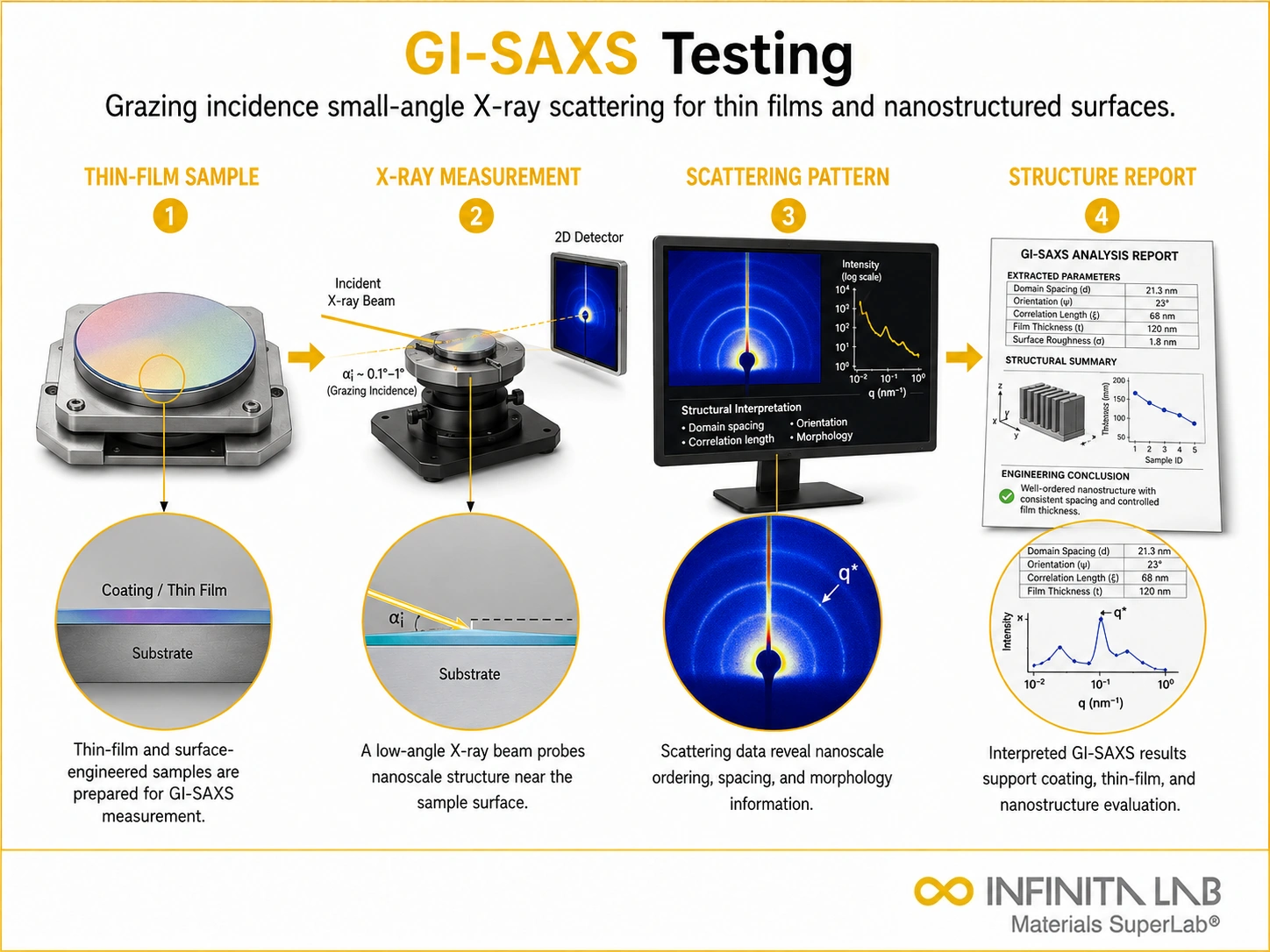
Grazing Incidence Small Angle X-Ray Scattering (GI-SAXS) is a sophisticated analytical tool used to investigate the nanostructure and surface topography of thin films and nanostructured materials. The technique examines the scattering of X-rays from a sample upon incidence at a very small (grazing) angle.
GI-SAXS is a widely used technique in nanotechnology, materials science, semiconductor studies, and thin-film analysis for examining structures at the nanoscale, including particle size, shape, and surface arrangement.

Applications and Benefits of GI SAXS Testing
Scope
GI-SAXS provides structural information about thin films, coatings, and nanoscale materials by measuring X-ray scattering patterns produced when X-rays interact with surface features.
The technique is particularly useful for studying surface and interface structures without damaging the sample, making it suitable for delicate nanostructured materials.
The scope includes:
Analysis of nanoscale structures in thin films
Surface and interface morphology characterization
Measurement of nanoparticle size and distribution
Evaluation of periodic nanostructures
Non-destructive surface analysis
Applications
Thin film and coating characterization
Semiconductor and microelectronics research
Nanoparticle and nanostructure analysis
Polymer and soft material studies
Surface science and materials research
Benefits
Provides nanoscale structural information
Non-destructive analysis method
Suitable for thin film and surface studies
High sensitivity to surface features
Useful for advanced material research
Our Testing Procedure
Sample Preparation
A thin film or nanostructured sample is mounted on the instrument stage under controlled alignment conditions.
1Grazing Incidence X-Ray Exposure
A low-angle X-ray beam is directed onto the sample surface.
2Scattering Pattern Detection
Scattered X-rays are recorded using a detector to capture the scattering pattern.
3Data Analysis
The scattering data are analyzed to determine nanoscale structural features such as particle size and spacing.
4Test parameters and requirements
| Parameter | Details |
|---|---|
| Technique Type | X-ray scattering analysis for nanoscale structures. |
| Sample Type | Thin films, coatings, nanostructured surfaces, and layered materials. |
| Principle | Measurement of X-ray scattering at small angles under grazing incidence conditions. |
| Structural Range Analyzed | Typically from 1 nm to several hundred nanometers. |
| Measured Parameters | Nanoparticle size, shape, spacing, and surface morphology. |
| Testing Environment | Controlled laboratory conditions using precision X-ray instruments. |
| Analysis Method | Interpretation of scattering patterns using specialized data analysis software. |


GI-SAXS X-Ray Scattering Instrument
X-Ray Source and Beam Optics
Sample Alignment Stage
Two-Dimensional X-Ray Detector
Data Analysis Software
Equipment and Instrumentation Used for Testing
What You Receive: Test Report, Data, and Certification
Nanostructure size and distribution analysis
Surface morphology characterization
Scattering pattern images
Structural parameter calculations
Detailed GI-SAXS analysis report
GI SAXS FAQs
The averaged data that GISAXS offers represents a broad sample region.GISAXS does not require sample preparation. Studies can be performed in a vacuum or under a controlled atmosphere at ambient or non-ambient temperatures.
GI-SAXS is effective for thin films, surfaces, and layered materials, particularly in nanotechnology, soft matter physics, and polymer science.
Using a grazing angle increases sensitivity to surface and near-surface structures, making it ideal for analyzing thin films.
GI-SAXS focuses on surface and thin-film structures, while conventional SAXS analyzes bulk material structures.
GI-SAXS requires precise sample preparation and alignment. Interpretation of the results is complex and requires advanced data analysis techniques.
Why Choose Infinita Lab for GI SAXS Testing?
At the core of this breadth is our network of 2,000+ accredited laboratories across the USA, offering access to over 10,000 testing methods and analytical services. From advanced materials characterization (SEM, TEM, RBS, XPS) to mechanical, chemical, environmental, biological, and standardized ASTM/ISO-compliant testing, we deliver unmatched flexibility, specialization, and scale. You are never limited by geography, facility, or methodology — Infinita Lab connects you to the right expertise and testing solution, every time.

Looking for an Accredited Partner for GI SAXS Testing?
Send query us at hello@infinitalab.com or call us at (888) 878-3090 to learn more about our services and how we can support you.



Request a Quote
Submit your material details and receive testing procedures, pricing, and turnaround time within 24 hours.
 Quick Turnaround and Hasslefree process
 Confidentiality Guarantee
 Free, No-obligation Consultation
 100% Customer Satisfaction
