


ASTM A709: Structural Steel Bridges Testing Services
ASTM A709/A709M-21 test method determines the carbon and high-strength low-alloy steel structural shapes, plates, and bars, quenched and tempered alloy steel, and stainless steel for structural plates intended for use in bridges. Twelve grades are available in five yield strength levels. The final results of this method are displayed keeping in view the international standards and inch-pound units.
TRUSTED BY


Get ASTM A709 compliant results — request your structural steel bridges testing quote
- Overview
- Scope, Applications, and Benefits
- Test Process
- Specifications
- Instrumentation
- Results and Deliverables
What Is ASTM A709 Structural Steel Bridges?
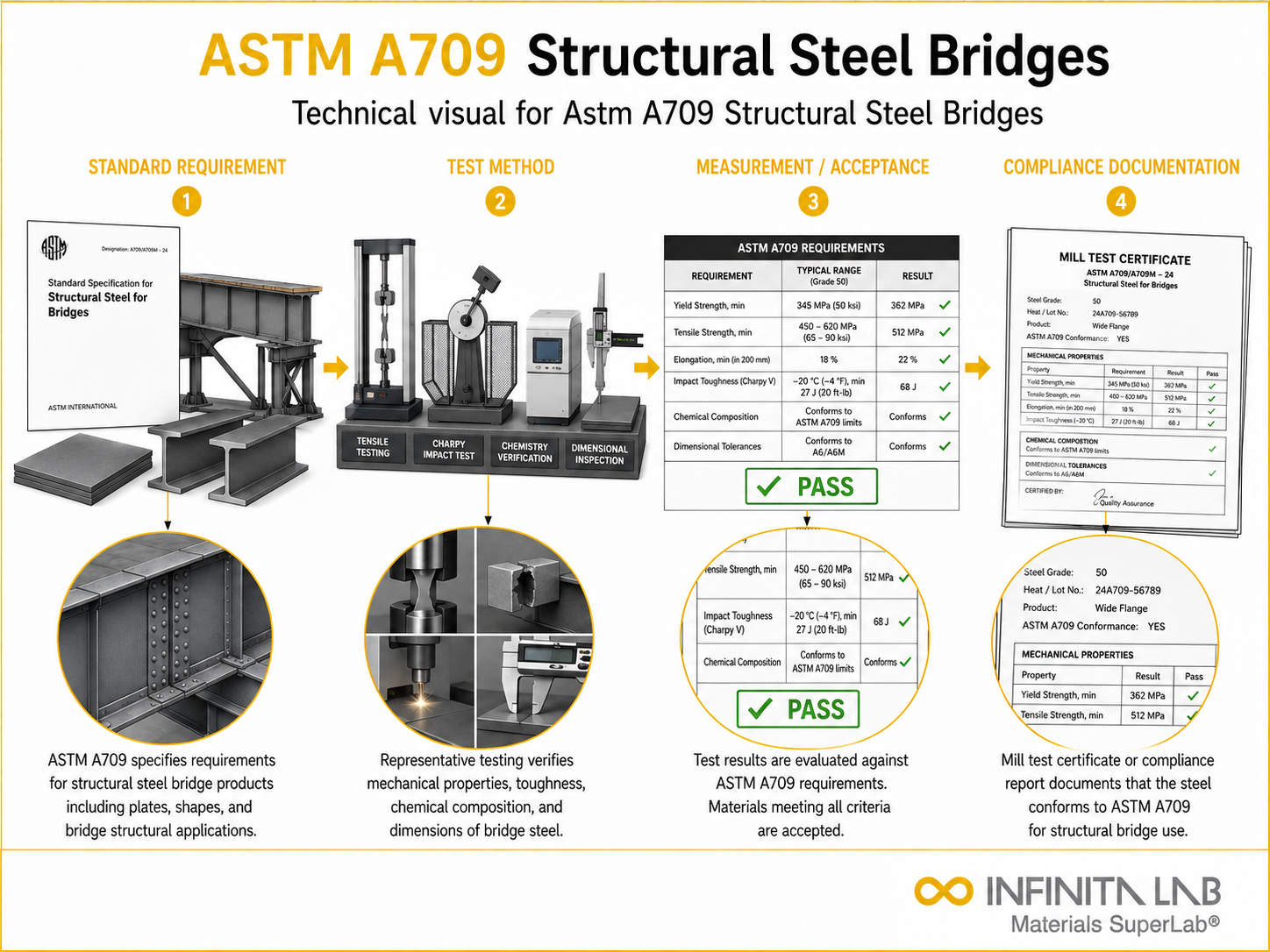
ASTM A709/A709M is the standard specification covering structural steel products intended for use in bridge construction. It addresses carbon and high-strength low-alloy steel structural shapes, plates, and bars, as well as quenched and tempered alloy steel and stainless steel plates. The specification defines 12 grades across 5 yield strength levels, ranging from Grade 36 [250 MPa] at the lower end to high-performance, quenched, and self-tempered grades at the higher end, giving engineers a broad range of material options to meet design requirements.
What sets A709 apart from general structural steel specifications like A36 or A572 is that it layers additional requirements on top of those base specs, specifically for bridge applications. These include tighter toughness requirements measured by Charpy V-notch impact testing, differentiation between fracture-critical and non-fracture-critical members, and atmospheric corrosion resistance criteria for weathering steel grades. Heat analysis is required to verify chemical composition, and tension testing is used to confirm tensile strength, yield strength, and elongation.
The specification covers the full chain of processing operations -from decoiling, forming, and cutting to heat treatment, inspection, marking, and certification. Results support quality control during fabrication, verification of incoming materials, and performance evaluation of structural steel used in bridge structures.

Applications and Benefits of ASTM A709 Structural Steel Bridges Testing
Scope
ASTM A709/A709M covers carbon and high-strength low-alloy steel structural shapes, plates, and bars, quenched and tempered alloy steel, and stainless steel plates for bridge applications. The specification defines 12 grades across 5 yield strength levels. Required testing includes heat analysis of chemical composition (carbon, manganese, phosphorus, sulfur, silicon, copper), tension testing for tensile strength, yield strength, and elongation, Charpy V-notch impact testing for both fracture-critical and non-fracture-critical members, and Brinell hardness testing for Grades 100 and 100W. Determination of atmospheric corrosion resistance is required for weathering steel grades. The specification applies to material in the form of structural shapes, plates, and bars, and governs processing operations including forming, heat treatment, inspection, and certification.
Applications
- Highway and railway bridge girder and beam fabrication
- Bridge deck plate and structural plate applications
- Fracture critical member (FCM) material qualification
- Weathering steel bridge construction requires atmospheric corrosion resistance
- Incoming material verification for bridge fabricators and contractors
- Weld procedure qualification base metal verification
- High-performance steel (HPS) applications requiring enhanced toughness
- Bridge rehabilitation and replacement material sourcing
Benefits
- Consolidates requirements for multiple bridge steel grades under one specification
- Toughness requirements tailored separately for fracture-critical and non-fracture-critical members
- Covers weathering steel grades with defined corrosion resistance criteria
- Yield strength ranges from 36 ksi to 100 ksi [250 to 690 MPa, supporting diverse design requirements
- Dual units (inch-pound and SI) accommodate both domestic and international project requirements
- Chemical and mechanical property verification provides a traceable quality record for fabrication
- Widely accepted by DOTs, bridge designers, and fabricators across the US
Our ASTM A709 Testing Procedure
Heat Analysis and Chemical Composition Verification
Heat analysis is performed to determine the percentages of carbon, manganese, phosphorus, sulfur, silicon, and copper.
1Tension Testing
Specimens are machined and tested in tension to determine yield strength, tensile strength, and elongation.
2Charpy V-Notch Impact Testing
Impact specimens are tested at the specified temperature per the toughness zone requirements
3Hardness Testing and Final Inspection
Brinell hardness testing is performed for Grades 100 and 100W.
4ASTM A709 Test Parameters and Requirements
| Parameter | Details |
|---|---|
| Standard | ASTM A709/A709M-21 |
| BOS Volume | 01.04 |
| Number of Grades | Twelve grades in five yield strength levels |
| Yield Strength Range | 36 ksi [250 MPa] to 100 ksi [690 MPa] |
| Steel Types Covered | Carbon steel, HSLA steel, quenched and tempered alloy steel, stainless steel |
| Required Tests | Heat analysis, tension test, Charpy V-notch impact test, Brinell hardness (Grades 100/100W) |
| Product Forms | Structural shapes, plates, bars |


- Universal testing machine for tension testing
- Pendulum impact tester for Charpy V-notch testing
- Specimen notching machine for CVN specimen preparation
- Temperature conditioning bath for impact specimen conditioning
- Brinell hardness tester
- Optical emission spectrometer (OES) or combustion analyzer for heat analysis
- Calibrated thermometer and thermocouple for temperature verification
- Dimensional inspection tools for product form verification
Equipment and Instrumentation Used for ASTM A709 Testing
What You Receive: Test Report, Data, and Certification
- Heat analysis report with chemical composition by element
- Tensile test data, including yield strength, tensile strength, and elongation
- Charpy V-notch impact energy values at specified test temperature
- Brinell hardness values for applicable grades
- Grade and heat identification for full material traceability
- Atmospheric corrosion resistance index for weathering steel grade, as required
- Mill test report covering all required mechanical and chemical properties
- Test report formatted for bridge fabricator and project documentation requirements
ASTM A709 Structural Steel Bridges FAQs
ASTM A709/A709M specifies structural steel grades used in bridge construction, designed to ensure strength, toughness, and weldability under service loads and environmental exposure.
Grades are chosen based on required strength, fracture toughness, and environmental conditions, with higher grades typically used for higher stress or colder climate applications.
Bridges are exposed to dynamic loads and low temperatures, so high fracture toughness is essential to prevent sudden brittle failure under impact or fatigue conditions.
Yes. Certain grades are designed as weathering steels, which form a protective oxide layer to reduce corrosion without the need for painting in suitable environments.
Unlike general structural steels, ASTM A709 includes additional requirements for fracture toughness, impact testing, and fatigue performance specifically tailored for bridge safety and durability.
Why Choose Infinita Lab for Structural Steel Bridges Testing
At the core of this breadth is our network of 2,000+ accredited laboratories across the USA, offering access to over 10,000 testing methods and analytical services. From advanced materials characterization (SEM, TEM, RBS, XPS) to mechanical, chemical, environmental, biological, and standardized ASTM/ISO-compliant testing, we deliver unmatched flexibility, specialization, and scale. You are never limited by geography, facility, or methodology — Infinita Lab connects you to the right expertise and testing solution, every time.

Need ASTM A709 Structural Steel Bridges Testing You Can Rely On?
Send query us at hello@infinitalab.com or call us at (888) 878-3090 to learn more about our services and how we can support you.



Request a Quote
Submit your material details and receive testing procedures, pricing, and turnaround time within 24 hours.
 Quick Turnaround and Hasslefree process
 Confidentiality Guarantee
 Free, No-obligation Consultation
 100% Customer Satisfaction
