


ASTM D3763: Multiaxial Impact Testing Services
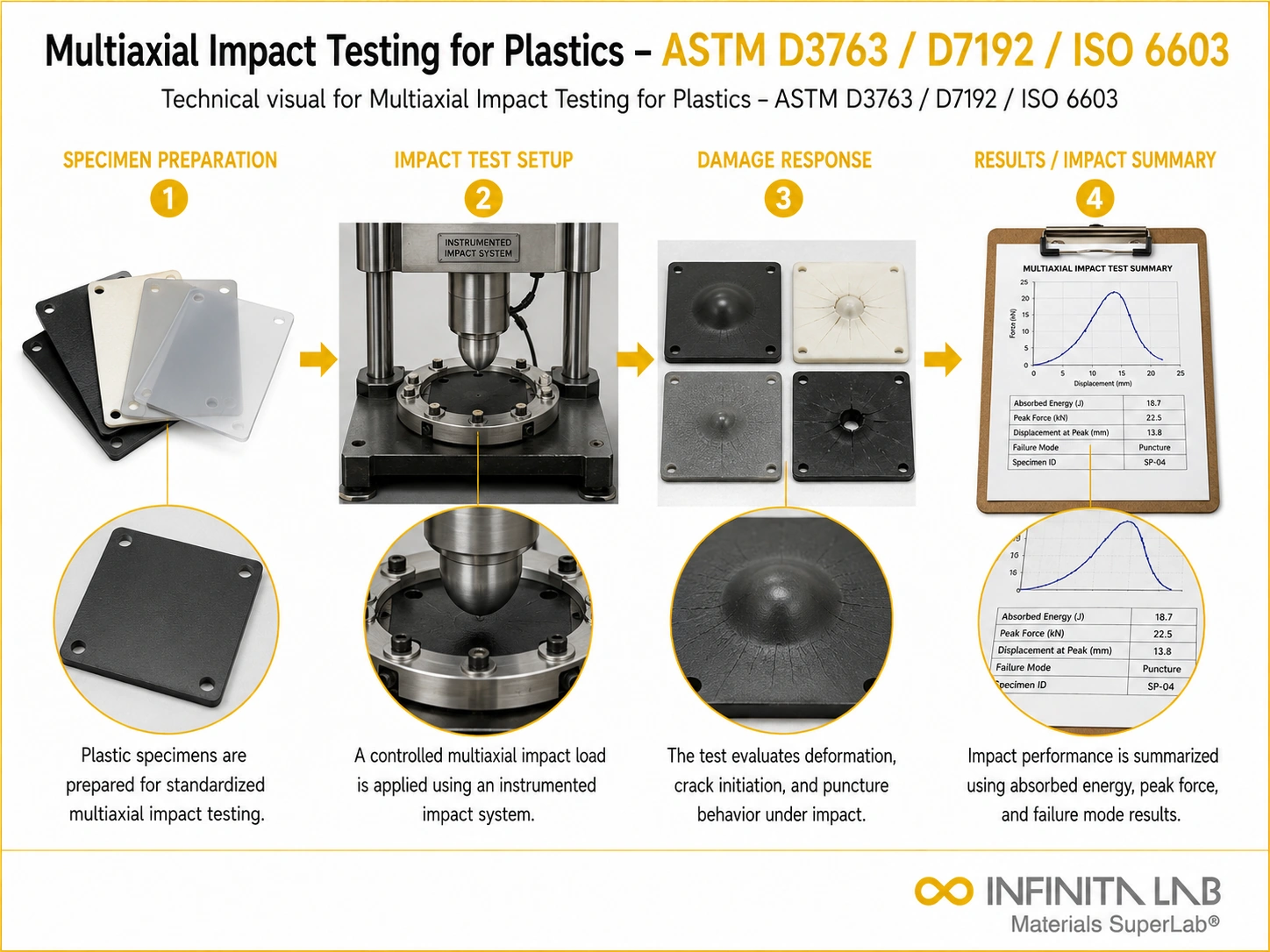
High-Speed Puncture Multiaxial Impact test by ASTM D3763 and ASTM D7192 determines toughness, load-deflection curves, and overall energy absorption of impact events in plastic materials. Effects of various environmental factors and secondary finishing operations on plastic impact properties are also measured.
TRUSTED BY


Get ASTM D3763 compliant results — request your multiaxial impact testing quote
- Overview
- Scope, Applications, and Benefits
- Test Process
- Specifications
- Instrumentation
- Results and Deliverables
What Is ASTM D3763 Multiaxial Impact?
ASTM D3763, ASTM D7192, ISO 6603, and ISO 7765 define multiaxial impact test methods used to evaluate the impact resistance of plastics and films under biaxial stress conditions. These tests simulate real-world impact scenarios where materials experience forces in multiple directions rather than a single axis.
The method measures parameters such as peak force, energy absorption, and deformation behavior during impact. It is widely used to assess toughness, puncture resistance, and failure characteristics, helping manufacturers ensure material reliability, durability, and performance under dynamic loading conditions.

Applications and Benefits of ASTM D3763 Multiaxial Impact Testing
Scope
These standards establish procedures for determining the impact performance of plastic materials and films using multiaxial loading conditions.
- Applicable to rigid plastics, sheets, and films
- Measures impact force, energy, and deformation
- Uses instrumented impact testing equipment
- Simulates real-life impact conditions
- Suitable for quality control and research
- Supports material comparison and development
- Covers both high-speed and falling-weight impact methods
Applications
- Packaging materials and films
- Automotive plastic components
- Industrial plastic sheets
- Consumer products
- Research and material development
Benefits
- Simulates realistic impact conditions
- Provides detailed impact performance data
- Helps improve material toughness
- Supports product design and optimization
- Enables comparison between materials
Our ASTM D3763 Testing Procedure
Sample Preparation
Specimens are cut to required dimensions and conditioned under standard laboratory conditions before testing.
1Specimen Mounting
The sample is securely clamped in a fixture to ensure proper support during multiaxial impact loading.
2Impact Application
A hemispherical striker impacts the specimen under controlled velocity to induce biaxial stress and deformation.
3Data Acquisition
Force, energy, and displacement are recorded throughout the impact event for analysis and reporting.
4ASTM D3763 Test Parameters and Requirements
| Parameter | Details |
|---|---|
| Material Type | Plastics, films, and sheets |
| Impact Type | Multiaxial (biaxial loading) |
| Measurement | Force, energy, displacement |
| Units | N, J, mm |
| Striker | Hemispherical impactor |
| Speed | Controlled impact velocity |
| Output | Force-energy curve |
| Conditioning | Standard temperature and humidity |


- Instrumented impact tester
- Falling weight impact tester
- Data acquisition system
- Specimen clamping fixture
- Environmental conditioning chamber
Equipment and Instrumentation Used for ASTM D3763 Testing
What You Receive: Test Report, Data, and Certification
- Peak impact force
- Energy absorption values
- Displacement and deformation data
- Failure mode analysis
- Force vs. time or energy curves
- Compliance with relevant standards
ASTM D3763 Multiaxial Impact FAQs
Multiaxial impact testing evaluates how materials behave under impact loads applied in multiple directions. It helps determine toughness, energy absorption, and resistance to puncture, ensuring materials can withstand real-world impact conditions effectively.
Multiaxial impact applies force in multiple directions simultaneously, better simulating real-life conditions, whereas uniaxial impact applies force in a single direction, providing limited insight into material behavior.
Factors include material thickness, impact velocity, temperature, and specimen preparation, all of which affect performance outcomes.
Temperature can influence material brittleness or ductility, significantly affecting impact behavior and results.
ASTM D7192 focuses more on high-speed puncture properties, while ASTM D3763 emphasizes instrumented impact testing for detailed force and energy measurements.
Why Choose Infinita Lab for Multiaxial Impact Testing
At the core of this breadth is our network of 2,000+ accredited laboratories across the USA, offering access to over 10,000 testing methods and analytical services. From advanced materials characterization (SEM, TEM, RBS, XPS) to mechanical, chemical, environmental, biological, and standardized ASTM/ISO-compliant testing, we deliver unmatched flexibility, specialization, and scale. You are never limited by geography, facility, or methodology — Infinita Lab connects you to the right expertise and testing solution, every time.

Need ASTM D3763 Multiaxial Impact Testing You Can Rely On?
Send query us at hello@infinitalab.com or call us at (888) 878-3090 to learn more about our services and how we can support you.



Request a Quote
Submit your material details and receive testing procedures, pricing, and turnaround time within 24 hours.
 Quick Turnaround and Hasslefree process
 Confidentiality Guarantee
 Free, No-obligation Consultation
 100% Customer Satisfaction
