

What Is ASTM A370 Mechanical Steel Products?
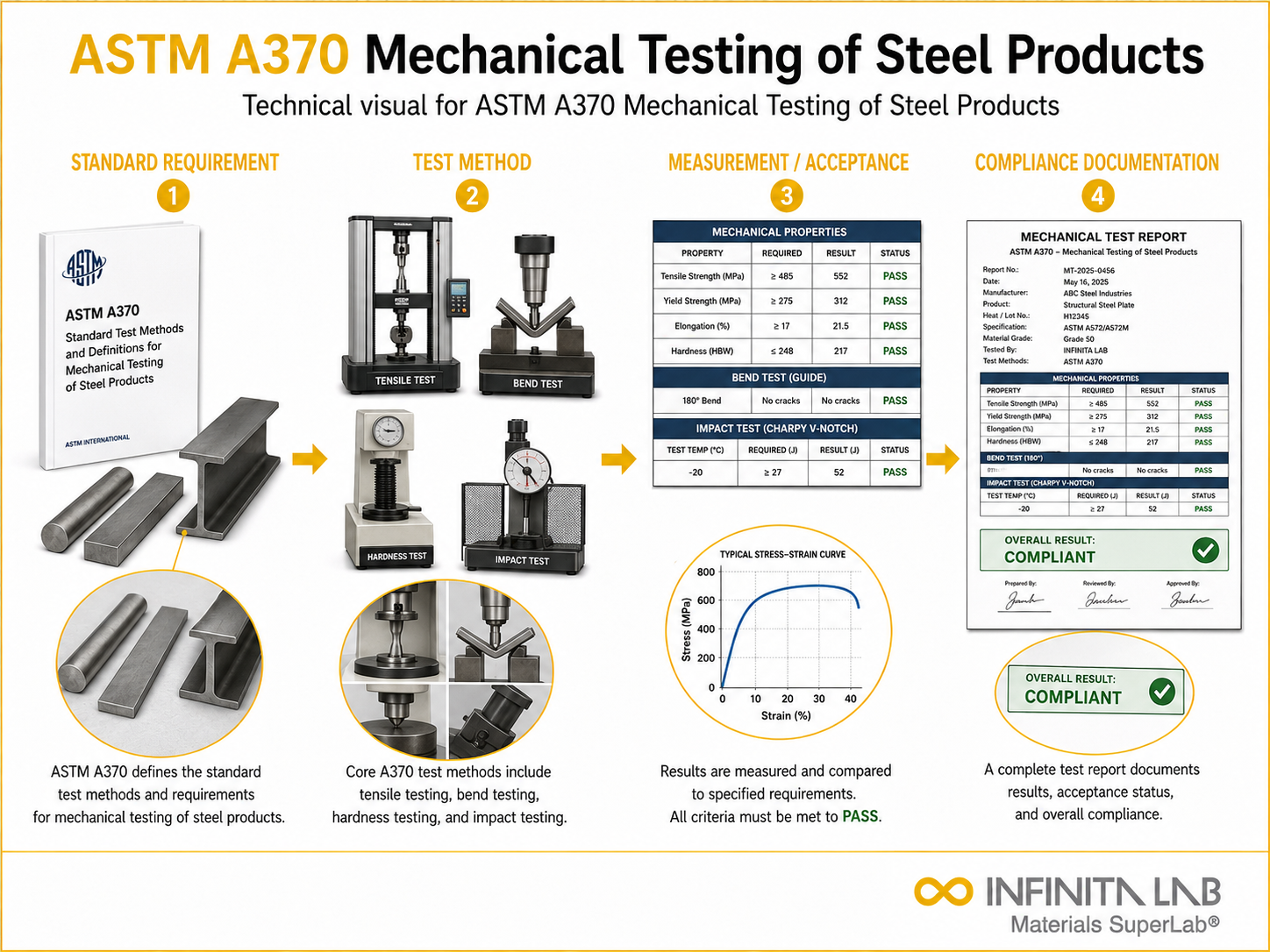
ASTM A370 defines standardized test methods for evaluating the mechanical properties of steel products. The standard includes procedures for tensile testing, bend testing, hardness testing, and impact testing to determine material performance under various loading conditions.
This method is widely used across steel manufacturing, construction, automotive, and energy industries. It ensures that steel products meet required strength, ductility, and toughness specifications for safe and reliable use.

Applications and Benefits of ASTM A370 Mechanical Steel Products Testing
Scope
ASTM A370 provides test methods for determining the mechanical properties of steel products, including plates, bars, pipes, and structural components. The standard ensures consistency in testing procedures and results.
The standard evaluates:
- Tensile strength, yield strength, and elongation
- Hardness of steel materials
- Bend performance and ductility
- Impact resistance and toughness
- Mechanical behavior under applied loads
Applications
- Structural steel and construction materials
- Steel pipes, plates, and bars
- Automotive and machinery components
- Oil and gas equipment
- Power generation systems
- Quality control in steel manufacturing
Benefits
- Provides standardized mechanical testing procedures
- Ensures reliable evaluation of steel properties
- Supports compliance with material specifications
- Assists in material selection and design
- Enables comparison of steel performance
Our ASTM A370 Testing Procedure
Sample Preparation
Specimens are machined according to required dimensions for each test type.
1Mechanical Testing
Tensile, hardness, bend, and impact tests are conducted as applicable.
2Measurement
Key properties such as strength, elongation, and hardness are measured.
3Data Recording & Evaluation
Results are compared with specified requirements for acceptance.
4ASTM A370 Test Parameters and Requirements
| Parameter | Details |
|---|---|
| Applicable Materials | Steel products (plates, bars, pipes, shapes) |
| Tensile Strength Range | ~400 MPa to 1500 MPa |
| Yield Strength Range | ~250 MPa to 1200 MPa |
| Hardness Range | ~100 HB to 400 HB |
| Impact Energy | ~20 J to 300 J |
| Test Temperature | Room temperature or specified conditions |


- Universal testing machine
- Hardness tester (Rockwell/Brinell/Vickers)
- Impact testing machine (Charpy)
- Bend test fixtures
- Dimensional measurement tools
- Data acquisition system
Equipment and Instrumentation Used for ASTM A370 Testing
What You Receive: Test Report, Data, and Certification
- Tensile and yield strength results
- Hardness and impact test data
- Bend test performance evaluation
- Mechanical property verification
- Test condition summary
- ASTM compliance report
ASTM A370 Mechanical Steel Products FAQs
ASTM A370 includes tensile strength, yield strength, elongation, reduction of area, impact energy, hardness, and bend properties, providing standardized procedures for evaluating mechanical performance of steel products under controlled testing conditions.
ASTM A370 includes tensile testing, impact testing, hardness testing, bend testing, and other mechanical evaluations used to determine properties of steel materials.
ASTM A370 is applied to carbon steels, alloy steels, stainless steels, and other steel products used in structural and industrial applications.
ASTM A370 requires universal testing machines, impact testers, hardness testers, and specimen preparation tools to perform standardized mechanical tests on steel materials.
ASTM A370 evaluates mechanical properties under controlled laboratory conditions and may not fully represent performance under complex service environments involving temperature variations, fatigue loading, or environmental effects on steel materials.
ASTM A370 provides standardized procedures for evaluating the mechanical properties of steel products, including tensile strength, yield strength, elongation, and reduction of area. During tensile testing, a prepared steel specimen is pulled in a testing machine until it deforms or fractures. The results help assess strength, ductility, and compliance with material specifications.
ASTM A370 testing involves preparing a steel specimen according to the applicable product requirements and applying a controlled mechanical load. Depending on the selected test, the specimen may undergo tension, bending, hardness, or impact testing. The measured results are used to evaluate mechanical properties and verify material quality.
Mechanical testing of steel evaluates its strength, hardness, ductility, toughness, and resistance to deformation. Specimens are subjected to controlled tensile, compression, bending, hardness, or impact tests using calibrated equipment. The results help determine whether the steel meets engineering requirements and is suitable for its intended application. ASTM A370 provides standardized methods for several mechanical tests on steel products.
Why Choose Infinita Lab for Mechanical Steel Products Testing
When your Mechanical Steel Products results have to hold up - for compliance, a customer audit, or an engineering decision - ASTM A370 accuracy and an unbiased third-party report matter more than price. Infinita Lab routes your ASTM A370 mechanical steel products testing to ISO/IEC 17025-accredited U.S. partner labs with hands-on method experience, so you get defensible data, transparent reporting, and turnaround times built around your project deadline - not ours.

Need ASTM A370 Mechanical Steel Products Testing You Can Rely On?
Send query us at hello@infinitalab.com or call us at (888) 878-3090 to learn more about our services and how we can support you.