


VDA Stone Impact Testing Services
Accredited VDA stone impact testing from Infinita Lab, performed to the exact standard requirements - accurate, reproducible results with full documentation for compliance, R&D, and quality control programs.
TRUSTED BY


Get compliant results - request your VDA stone impact testing quote
- Overview
- Scope, Applications, and Benefits
- Test Process
- Specifications
- Instrumentation
- Results and Deliverables
What Is VDA Stone Impact?
VDA 230-219 evaluates the resistance of automotive paint systems and coated substrates to stone chipping caused by impacts from road debris under controlled laboratory conditions. The test simulates real-world gravel and debris strikes at defined velocity, angle, and temperature conditions to assess coating durability, adhesion performance, substrate exposure, and long-term corrosion resistance after coating damage. It is widely used by automotive OEMs, Tier 1 suppliers, and coating manufacturers for production approval, supplier qualification, and material validation of painted metal and plastic automotive components.
The test is particularly important for predicting long-term surface integrity, corrosion initiation at chip sites, and overall aesthetic durability in harsh road environments. VDA 230-219 is commonly applied to automotive body panels, underbody coatings, primers, clear coats, electrocoats, powder coatings, and multilayer paint systems that are exposed to gravel impacts during vehicle operation.

Applications and Benefits of VDA Stone Impact Testing
Scope
VDA 230-219 applies to painted metallic substrates, coated plastic components, multilayer automotive coating systems, and protective surface treatments evaluated for resistance to gravel impacts and stone-chipping damage. The test assesses coating adhesion, chip severity, crack formation, delamination behavior, substrate exposure, and the potential for corrosion initiation after impact exposure.
Typical materials evaluated include:
- Electrocoated steel body panels
- Aluminum automotive panels
- Powder-coated components
- Automotive bumper coatings
- Polymeric protective coatings
- Underbody anti-chip coatings
- Multilayer primer-basecoat-clearcoat systems
- Plastic trim and composite automotive parts
Applications
- Automotive paint systems, clearcoats, primers, and corrosion protection coatings
- Plastic exterior components, including bumpers, side skirts, and wheel arch liners
- Body panel steel and aluminum substrates with applied coating systems
- Underbody protection coatings and stone chip-resistant treatments
- Exterior trim, mirror housings, and surface components requiring OEM stone impact qualification
Benefits
- Supports VDA 230-219 qualification and automotive OEM production approval compliance
- Provides certified stone impact test data for supplier qualification submittals
- Identifies coating adhesion and chip resistance vulnerabilities before production release
- Delivers traceable test documentation aligned with automotive OEM quality requirements
- Reduces production risk by detecting stone impact failure modes early in the development cycle
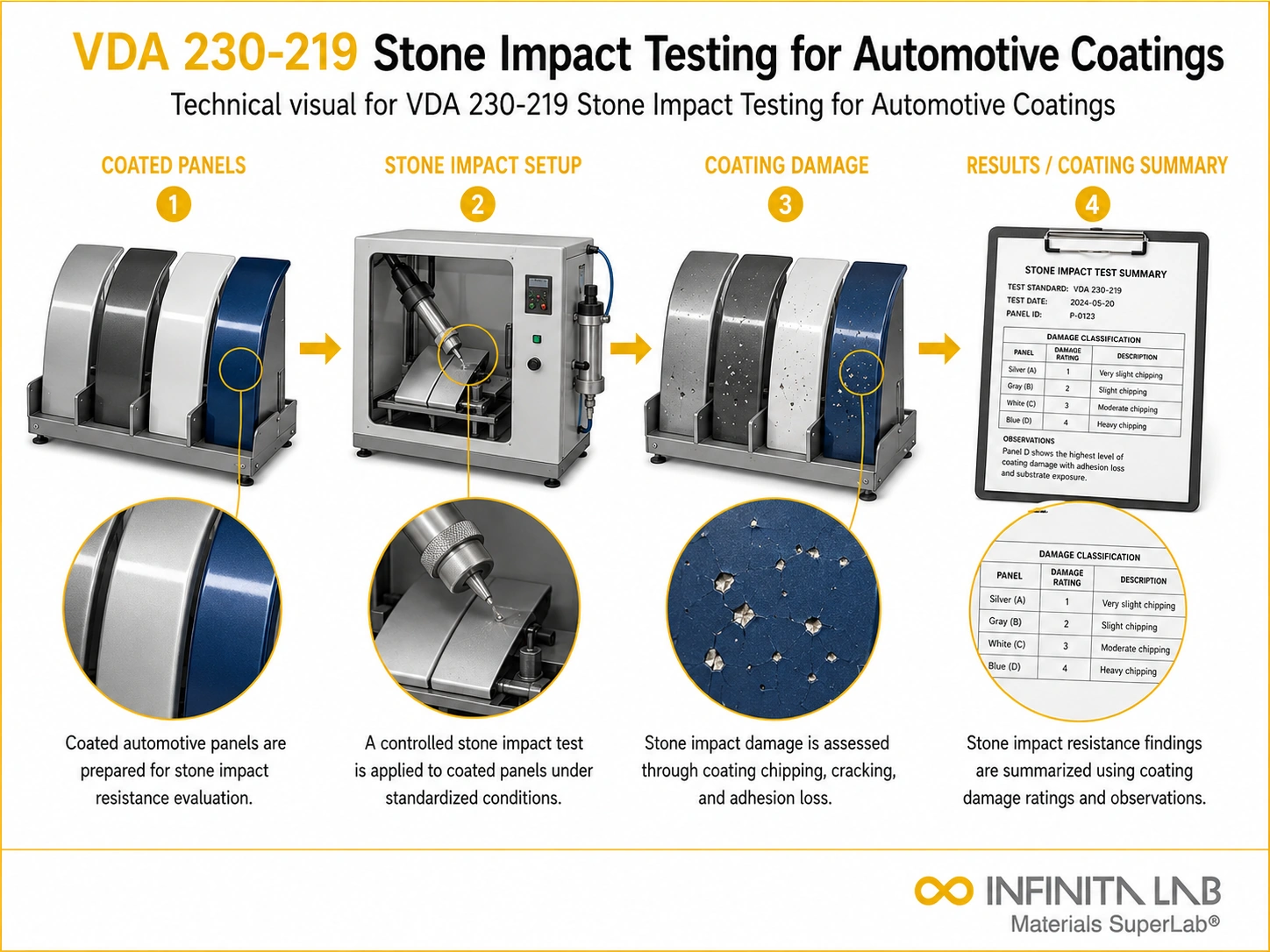
Our Testing Procedure
Sample Preparation
Coated panels are prepared under controlled curing conditions to ensure uniform coating thickness and adhesion.
1Impact Exposure Setup
Specimens are exposed to controlled stone or gravel impact at specified velocity and angle
2Impact Loading
Controlled particle bombardment is applied to simulate road debris striking the coated surface.
3Damage Evaluation
Coating damage, chipping severity, and substrate exposure are visually and instrumentally analyzed.
4Test parameters and requirements
| Parameter | Details |
|---|---|
| Applicable Materials | Automotive paint systems, coatings, plastic exterior components, body panels, and underbody protection treatments |
| Impact Media | Standardized gravel or chilled cast-iron shot |
| Typical Shot Size | 4–5 mm gravel or equivalent shot media |
| Specimen Size | Typically 100 mm × 300 mm panels |
| Impact Angle | Usually 45° to 90° depending on OEM specification |
| Air Pressure | Approximately 450–500 kPa |
| Test Temperature | Ambient or sub-zero conditioning (commonly −20 °C) |
| Number of Impacts | Defined by OEM or customer requirement |
| Evaluation Method | Visual chip severity and substrate exposure assessment |
| Measurement Focus | Coating adhesion, stone chip resistance, corrosion initiation |


- Calibrated stone impact test apparatus per VDA 230-219 specifications
- Temperature conditioning chamber for pre-test specimen preparation
- Defined gravel or steel shot projectile delivery system
- Precision impact velocity and energy measurement equipment
- Visual inspection and surface damage rating tools
- Data acquisition and test documentation system
Equipment and Instrumentation Used for Testing
What You Receive: Test Report, Data, and Certification
- Stone impact exposure records, including impact conditions, temperature, and shot quantity data
- Visual damage assessment, including chip count, damage area, and delamination observations
- Surface damage severity rating per VDA 230-219 evaluation criteria
- Test compliance result assessed against VDA 230-219 stone impact qualification requirements
- VDA 230-219 Compliance report
VDA Stone Impact FAQs
The automotive stone impact test of VDA 230-219 assesses the resistance of vehicle exterior coatings and components to paint chipping, coating delamination, and other forms of coating damage resulting from high-velocity stone and gravel impact, simulating driving and field conditions.
Automotive paint systems, clearcoats, primers, plastics used for exterior parts, panel substrates, underbody protection coatings, and trim materials that require OEM production approvals usually require stone impact resistance qualification testing according to the VDA 230-219 standard.
VDA 230-219 assesses paint chipping, coating delamination, substrate exposure, initiation of corrosion at chip sites, and the severity of surface damage, and rates the impact resistance performance according to the acceptance criteria defined in VDA 230-219.
VDA 230-219 employs a calibrated high-velocity gravel projectile with specified impact energy, angle, and mass, simulating stone chipping and road debris impacts on the exterior of a vehicle at a specified temperature.
The VDA 230-219 simulates controlled stone-impact conditions, and it is possible that it does not reflect actual driving conditions, as factors such as stone size, vehicle speed, and impact angle affect the severity of stone-chip damage.
Why Choose Infinita Lab for VDA Stone Impact Testing
When your VDA Stone Impact results have to hold up - for compliance, a customer audit, or an engineering decision - accuracy and an unbiased third-party report matter more than price. Infinita Lab routes your VDA stone impact testing to ISO/IEC 17025-accredited U.S. partner labs with hands-on method experience, so you get defensible data, transparent reporting, and turnaround times built around your project deadline - not ours.

Looking for an Accredited Partner for VDA Stone Impact Testing?
Send query us at hello@infinitalab.com or call us at (888) 878-3090 to learn more about our services and how we can support you.



Request a Quote
Submit your material details and receive testing procedures, pricing, and turnaround time within 24 hours.
 Quick Turnaround and Hasslefree process
 Confidentiality Guarantee
 Free, No-obligation Consultation
 100% Customer Satisfaction
