


Multiaxial Impact Testing for Plastics & Composites
A Multiaxial Impact Test is a testing procedure used to evaluate the impact resistance and durability of materials and products under various loading conditions. The test involves exposing the test sample to multiple impacts from different directions and at different angles to simulate the complex loading conditions that the sample may experience in real-world applications. The Multiaxial Impact Test is a crucial tool in material and product testing.
TRUSTED BY


Precision Testing Solutions for Accurate, Reliable, and Standards-Compliant Results
- Overview
- Scope, Applications, and Benefits
- Test Process
- Specifications
- Instrumentation
- Results and Deliverables
Multiaxial Impact Testing Overview
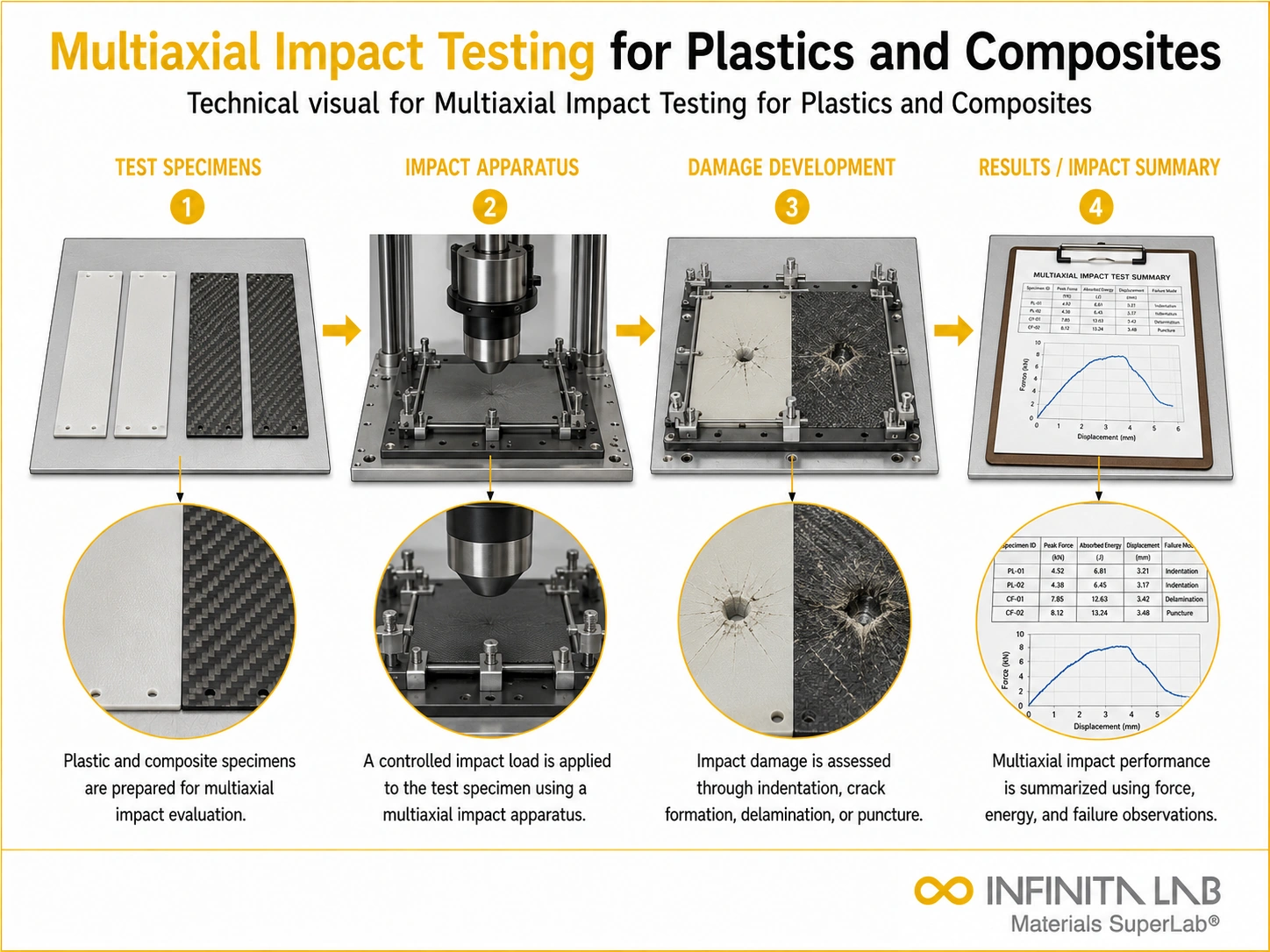
Multiaxial impact testing is used to evaluate the impact behavior of materials under multi-directional stress conditions, closely simulating real-world impact scenarios. Unlike traditional uniaxial tests (Izod or Charpy), this method applies force across multiple axes simultaneously, providing a more realistic assessment of material toughness and failure behavior.
This test is commonly performed using instrumented drop-weight or high-speed impact systems, where a striker impacts a clamped specimen. It generates detailed force–deflection and energy absorption data, helping engineers understand how materials respond to sudden, complex loading conditions.

Scope, Applications, and Benefits
Scope
Multiaxial impact testing evaluates:
- Impact energy absorption (J)
- Maximum force and deformation
- Load–deflection or force–time response
- Failure mode (ductile vs brittle)
- Multi-directional stress response
Applications
- Plastics and polymer composites
- Automotive components (interior panels, bumpers)
- Aerospace and defense materials
- Packaging and impact-resistant products
- Structural and engineering components
Benefits
- Simulates real-world multi-directional impacts
- Provides detailed force and energy data
- Identifies material weaknesses and failure modes
- Supports material selection and design optimization
- Improves product safety and durability
Multiaxial Impact Test Process
Sample Preparation
Flat specimens or molded parts are prepared and clamped securely in a fixture.
1Impact Application
A striker (tup) impacts the specimen at controlled velocity using drop-weight or high-speed systems.
2Data Acquisition
Sensors record force, displacement, and energy during impact in milliseconds.
3Data Analysis
Load–deflection curves and energy absorption values are analyzed to determine material performance.
4Multiaxial Impact Technical Specifications
| Parameter | Details |
|---|---|
| Standards | ASTM D3763, ISO 6603-2, ASTM D3029 |
| Impact Velocity | Variable (low to high speed impact) |
| Specimen Type | Flat plates, molded parts |
| Measurement Output | Force (N), energy (J), deflection (mm) |
| Energy Range | Up to ~200–300 J (equipment dependent) |
| Data Output | Load–deflection curve, force–time curve |


Instrumentation Used for Testing
- Instrumented drop-weight impact tester
- High-speed impact testing machine (e.g., Dynatup system)
- Load cells and displacement sensors
- Specimen clamping fixtures
- Environmental chamber (optional for temperature testing)
- Data acquisition and analysis software
Results and Deliverables
- Impact energy absorption (J)
- Maximum force and deformation values
- Load–deflection/force–time curves
- Failure mode analysis (crack, puncture, deformation)
- Comparative material performance data
- Test report
Frequently Asked Questions
Multiaxial impact testing measures how materials behave under impact forces applied in multiple directions, providing a more realistic assessment compared to traditional single-axis impact tests.
Izod and Charpy apply force in a single direction, while multiaxial testing applies forces across multiple axes, better simulating real-world impact conditions.
Common standards include ASTM D3763 and ISO 6603-2, which define procedures for instrumented puncture and multi-axial impact behavior evaluation.
The test provides force–deflection curves, maximum force, energy absorption, and failure behavior, helping assess material toughness and impact resistance.
It helps predict real-world performance under complex loading conditions, ensuring materials can withstand impacts in applications such as automotive, aerospace, and packaging industries.
Why Choose Infinita Lab for Advanced Materials Testing and Characterization?
At the core of this breadth is our network of 2,000+ accredited laboratories across the USA, offering access to over 10,000 testing methods and analytical services. From advanced materials characterization (SEM, TEM, RBS, XPS) to mechanical, chemical, environmental, biological, and standardized ASTM/ISO-compliant testing, we deliver unmatched flexibility, specialization, and scale. You are never limited by geography, facility, or methodology — Infinita Lab connects you to the right expertise and testing solution, every time.

Looking for a Trusted Partner for Accurate and Reliable Testing Services?
Send query us at hello@infinitalab.com or call us at (888) 878-3090 to learn more about our services and how we can support you.



Request a Quote
Submit your material details and receive testing procedures, pricing, and turnaround time within 24 hours.
 Quick Turnaround and Hasslefree process
 Confidentiality Guarantee
 Free, No-obligation Consultation
 100% Customer Satisfaction
