


ASTM A123: Hot Dip Galvanizing Coating Testing Services
Accredited ASTM A123 hot dip galvanizing coating testing from Infinita Lab, performed to the exact standard requirements - accurate, reproducible results with full documentation for compliance, R&D, and quality control programs.
TRUSTED BY


Get ASTM A123 compliant results — request your hot dip galvanizing coating testing quote
- Overview
- Scope, Applications, and Benefits
- Test Process
- Specifications
- Instrumentation
- Results and Deliverables
What Is ASTM A123 Hot Dip Galvanizing Coating?
ASTM A123/A123M, Standard Specification for Zinc (Hot-Dip Galvanised) Coatings on Iron and Steel Products, defines the requirements for zinc coatings applied to iron and steel through hot-dip galvanising. In this process, fabricated steel or iron products are cleaned, fluxed, and fully immersed in a bath of molten zinc, where the reaction between the zinc and the steel substrate forms a series of zinc-iron alloy layers metallurgically bonded to the base metal, topped by a layer of relatively pure zinc. This bonded structure is what distinguishes hot-dip galvanising from coatings simply applied to a surface: the zinc becomes an integral part of the steel rather than a separate film that can be scraped or peeled away under normal conditions.
Once the coating is formed, ASTM A123 governs how it is verified. The specification sets minimum coating thickness or weight requirements that vary according to the category of material being galvanised (structural shapes, plate, strip and bar, pipe and tubing, wire, and rebar) and the thickness of the base steel, since thicker steel sections retain heat longer in the zinc bath and develop thicker alloy layers. It also establishes requirements for finish, appearance, and coating adherence, and references recognised test methods for confirming these properties non-destructively wherever possible.
Coating thickness is the single most important variable governed by A123 because zinc protects steel sacrificially, corroding preferentially to the underlying steel while forming a stable, adherent patina that slows further attack. The thicker the zinc coating, the longer this sacrificial layer lasts before the base steel is exposed to the environment, so verified coating thickness translates directly into predictable service life for galvanised steel used outdoors or in corrosive settings. Infinita Lab’s accredited partner laboratories perform ASTM A123 testing to confirm that galvanised products meet these thickness, finish, and adherence requirements before entering service.

Applications and Benefits of ASTM A123 Hot Dip Galvanizing Coating Testing
Scope
- ASTM A123/A123M specifies minimum coating thickness or weight requirements for hot-dip galvanised zinc coatings on fabricated iron and steel products.
- Coating thickness requirements are organised by material category, including structural shapes, plate, strip and bar, pipe and tubing, wire, and reinforcing bar, since each category responds differently to the galvanising bath.
- Minimum coating requirements further vary with the thickness of the base steel article, with thicker steel sections generally requiring thicker minimum coatings.
- The specification states that all listed coating thickness values are minimums and that there are no specified maximum coating thickness limits.
- Coating thickness or weight is verified using non-destructive magnetic or eddy-current gauging referenced to ASTM E376, with weight-based stripping methods available as an alternative or referee method.
- The standard defines finish requirements calling for a coating that is continuous, smooth, and uniform in appearance across the surface of the article.
- Appearance requirements exclude uncoated areas, blisters, flux deposits, gross dross inclusions, and heavy zinc deposits that would interfere with the product’s intended use or fit-up.
- Coating adherence is addressed through visual inspection and, when peeling or flaking is suspected, a stout-knife adhesion test performed away from edges and corners, which are inherently the lowest-adhesion locations.
- Sampling procedures in the specification define lot sizes, the number of articles to be tested, and how single-specimen versus multi-specimen articles are measured and averaged.
- Testing to ASTM A123 supports quality assurance, contractual compliance, and long-term corrosion protection for galvanised products used in exposed and corrosive service environments.
Applications
- Structural steel members used in buildings, bridges, and other load-bearing construction.
- Highway and roadside guardrails, barriers, and safety hardware.
- Chain-link and security fencing components and hardware.
- Transmission and distribution utility structures, towers, and poles.
- Outdoor and exposed steel construction subject to weathering and atmospheric corrosion.
- Water and wastewater treatment structures, walkways, and handrails.
- Agricultural, industrial, and marine-adjacent steel equipment and fabrications.
Benefits
- Confirms that the sacrificial zinc coating provides the corrosion protection service life the design and specification intend.
- Verifies coating uniformity and continuity across complex fabrications, joints, and hard-to-reach surfaces.
- Documents compliance with ASTM A123 for project specifications, procurement, and contractual requirements.
- Identifies coating deficiencies such as thin spots, bare areas, or adhesion issues before installation.
- Reduces the risk of premature corrosion, unplanned maintenance, and early replacement of galvanised steel.
- Supports quality control across galvanising lots, from fabrication through final inspection and reporting.
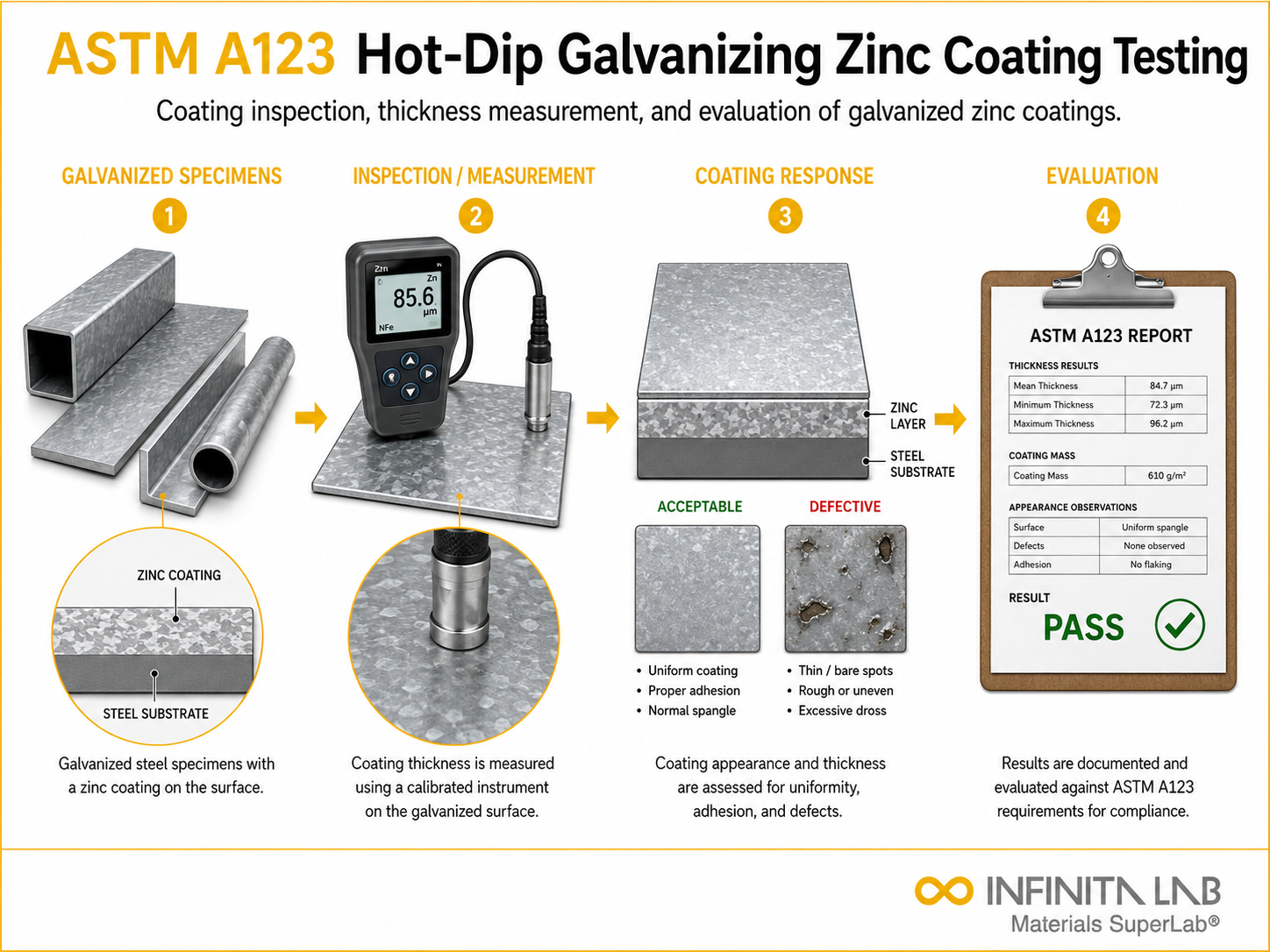
Our ASTM A123 Testing Procedure
Sample Preparation
Galvanized samples are cleaned and prepared for inspection and measurement.
1Visual Inspection
The coating is examined for surface defects, uniformity, and finish.
2Thickness Measurement
Coating thickness is measured using magnetic or electronic gauges.
3Adhesion Evaluation
Coating adherence is checked using standardized methods such as bend or impact tests.
4ASTM A123 Test Parameters and Requirements
| Parameter | Details |
|---|---|
| Coating type | Hot-dip galvanized zinc coating |
| Substrate | Iron and steel products |
| Measurement method | Magnetic thickness gauge |
| Adhesion | Verified through mechanical tests |
| Surface quality | Smooth, continuous, and uniform |
| Output | Coating thickness and inspection results |
| Environment | Controlled inspection conditions |


- Magnetic or eddy-current coating thickness gauge – Non-destructively measures zinc coating thickness at multiple points per ASTM E376.
- Calibration standards and shims – Verify and maintain gauge accuracy before and during measurement sessions.
- Stout-knife adhesion test kit – Used to evaluate coating adherence when peeling or flaking is visually suspected.
- Visual inspection tools (magnifiers, inspection lighting) – Support examination of finish, appearance, and surface defects.
- Precision scale – Supports weight-of-coating determinations when stripping methods are used as an alternative or referee measurement.
- Surface cleaning and preparation equipment – Prepares specimen surfaces for accurate, repeatable thickness and adhesion testing.
- Cross-sectional microscopy equipment – Confirms coating structure and layer formation when detailed metallurgical verification is required.
Equipment and Instrumentation Used for ASTM A123 Testing
What You Receive: Test Report, Data, and Certification
- Coating thickness measurements for each tested specimen and the calculated lot average.
- Pass/fail determination against the category-specific minimum coating requirements of ASTM A123/A123M.
- Documentation of finish and appearance, including any noted defects such as uncoated areas or dross inclusions.
- Adherence test results where stout-knife testing was performed due to suspected coating issues.
- A detailed, traceable test report suitable for project submittals, procurement records, and quality documentation.
- Guidance on next steps, including repair recommendations or retesting, when a specimen does not meet requirements.
ASTM A123 Hot Dip Galvanizing Coating FAQs
ASTM A123 testing evaluates the quality of hot-dip galvanized coatings on steel and iron products. It ensures that the coating meets specified thickness, adhesion, and uniformity requirements for effective corrosion protection.
Hot-dip galvanization is a process where steel is coated with molten zinc to protect it from corrosion. The zinc layer acts as a barrier and provides long-term durability in harsh environments.
Coating thickness determines the level of corrosion protection. Thicker coatings generally provide longer service life, making accurate measurement essential for ensuring durability and compliance.
Factors include surface preparation, bath composition, immersion time, and cooling conditions. Proper control of these factors ensures a uniform and durable coating.
Galvanization protects steel from corrosion by forming a zinc barrier. It also provides sacrificial protection, where zinc corrodes instead of the underlying steel, extending service life.
ASTM A123/A123M specifies requirements for hot-dip galvanized zinc coatings on iron and steel products. The galvanized coating is inspected for properties such as coating thickness, appearance, adherence, and uniformity to verify compliance with the specification.
ASTM A123/A123M specifies minimum required zinc coating thickness based on the steel product’s material category and thickness. Coating thickness is evaluated using defined sampling and measurement procedures, with the required minimum average varying by the applicable thickness category.
Why Choose Infinita Lab for Hot Dip Galvanizing Coating Testing
When your Hot Dip Galvanizing Coating results have to hold up - for compliance, a customer audit, or an engineering decision - ASTM A123 accuracy and an unbiased third-party report matter more than price. Infinita Lab routes your ASTM A123 hot dip galvanizing coating testing to ISO/IEC 17025-accredited U.S. partner labs with hands-on method experience, so you get defensible data, transparent reporting, and turnaround times built around your project deadline - not ours.

Need ASTM A123 Hot Dip Galvanizing Coating Testing You Can Rely On?
Send query us at hello@infinitalab.com or call us at (888) 878-3090 to learn more about our services and how we can support you.



Request a Quote
Submit your material details and receive testing procedures, pricing, and turnaround time within 24 hours.
 Quick Turnaround and Hasslefree process
 Confidentiality Guarantee
 Free, No-obligation Consultation
 100% Customer Satisfaction
