


UL 263 Fire Resistance Testing for Building Construction
UL 263 fire resistance rating test is one of the most valuable materials tests performed by fire and flammability evaluation laboratories to get certification for structural steelwork in the US. The standard is used for all types of building products and construction materials.
TRUSTED BY


Precision-driven testing for dimensional accuracy and compliance
- Overview
- Scope, Applications, and Benefits
- Test Process
- Specifications
- Instrumentation
- Results and Deliverables
UL 263 Fire Resistance Testing Overview
UL 263 evaluates the fire resistance performance of building assemblies and construction materials exposed to controlled fire conditions under standardized furnace testing. The test measures the ability of walls, floors, columns, beams, doors, ceilings, penetration seals, and structural systems to maintain structural stability, integrity, and thermal insulation during fire exposure. It is one of the primary fire endurance standards used in the United States for code-compliant fire-rated construction assemblies.
The standard follows a defined time-temperature curve to simulate realistic building fire conditions and is widely used for compliance with IBC, NFPA 101, local AHJ requirements, and commercial construction safety regulations. UL 263 testing is commonly performed for manufacturers seeking UL listing, fire-rated assembly certification, and market approval for building products used in residential, commercial, industrial, healthcare, and infrastructure projects.
UL 263 is technically equivalent to ASTM E119, with both standards using the same furnace exposure curve, acceptance criteria, and fire endurance evaluation methodology.

Scope, Applications, and Benefits
Scope
UL 263 applies to fire-rated construction assemblies, passive fire protection systems, structural elements, and building materials evaluated for fire endurance performance under controlled furnace exposure conditions. The test assesses structural stability, flame integrity, insulation performance, load-bearing capacity, and temperature rise during prolonged fire exposure.
Typical assemblies and materials evaluated include:
- Fire-rated wall and partition assemblies
- Structural steel columns and beams
- Floor-ceiling and roof-ceiling systems
- Fire-resistant doors and glazing systems
- Concrete and masonry assemblies
- Penetration firestop systems
- Intumescent coatings and fireproofing materials
- Shaft walls and corridor assemblies
- Cable tray and duct protection systems
- Prefabricated modular building assemblies
Applications
- Fire-rated wall and partition assembly qualification for commercial and residential buildings
- Structural steel fireproofing validation for beams, columns, and load-bearing frameworks
- Floor-ceiling and roof-ceiling system testing for 1-hour, 2-hour, 3-hour, and 4-hour fire endurance ratings
- UL listing and certification programs for fire-rated construction products
- Penetration firestop system qualification for pipes, ducts, cables, and utility openings
- Intumescent coating and passive fire protection material evaluation
- IBC, NFPA 101, and AHJ compliance verification for building assemblies
- Tunnel, transportation, and infrastructure fire protection system validation
- Healthcare, industrial, and data center fire barrier qualification
- Research and development of advanced fire-resistant materials and composite assemblies
- Performance benchmarking of fire-rated construction systems against industry standards
- Failure analysis of fire-damaged structural assemblies and building materials
Benefits
- Simulates realistic building fire exposure conditions
- Supports UL 263 and ASTM E119 compliance requirements
- Provides certified fire endurance ratings for construction assemblies
- Supports UL listing and U.S. market approval pathways
- Validates structural stability, integrity, and insulation performance
- Provides traceable certification documentation for project submittals and insurance underwriting
- Assists architects, contractors, and manufacturers in fire-rated assembly selection
- Supports compliance with IBC, NFPA 101, and local AHJ regulations
- Helps identify fire protection weaknesses before commercial deployment
- Enables comparison of fire-resistant materials under standardized conditions
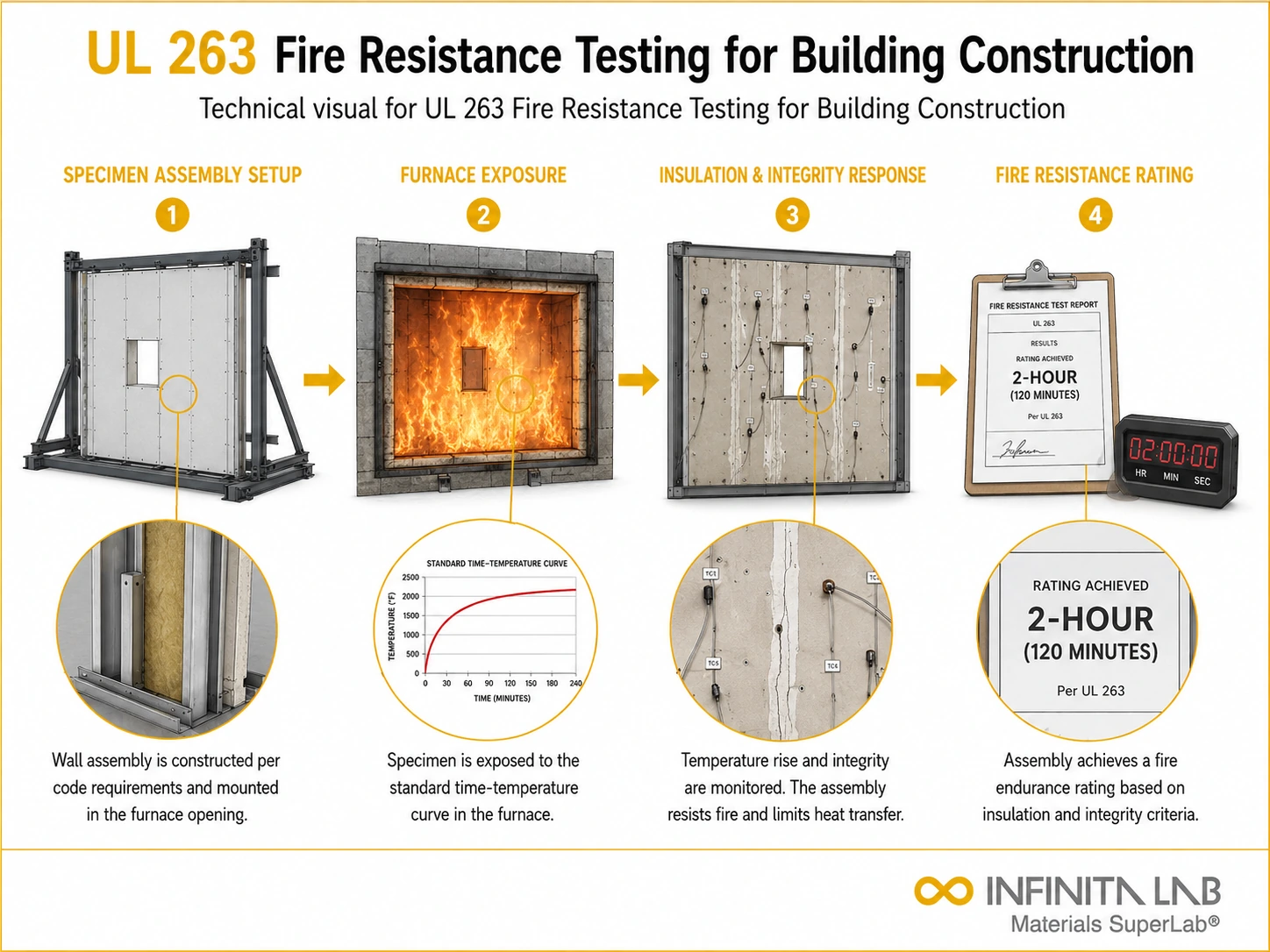
UL 263 Fire Resistance Testing Test Process
Sample Preparation
Full-scale or representative structural assemblies are constructed and conditioned according to design specifications for testing.
1Furnace Exposure Setup
The specimen is exposed in a fire furnace under a standard time–temperature curve.
2Load and Fire Exposure Testing
Load is applied as needed, and performance and temperature are monitored during fire exposure
3Performance Evaluation
Failure time, insulation performance, and structural integrity are analyzed to determine fire-resistance rating.
4UL 263 Fire Resistance Testing Technical Specifications
| Parameter | Details |
|---|---|
| Applicable Materials | Structural steel, concrete, composite assemblies, wall and floor systems, fire-resistive coatings, and construction materials |
| Fire Exposure Curve | UL 263 standardized time-temperature fire exposure within a calibrated test furnace |
| Furnace Temperature | Approximately 538 °C at 5 min, 927 °C at 60 min, 1093 °C at 4 h |
| Fire Resistance Ratings | 1-hour, 2-hour, 3-hour, and 4-hour |
| Evaluation Criteria | Structural stability, integrity, insulation |
| Temperature Monitoring | Type K thermocouples on unexposed surfaces |
| Hose Stream Test Pressure | Typically 207–310 kPa depending on assembly rating |
| Applicable Assemblies | Walls, floors, ceilings, beams, columns, firestops |
| Maximum Average Temperature Rise | 139 °C above initial temperature |
| Maximum Single-Point Temperature Rise | 181 °C above initial temperature |
| Structural Loading | Defined load applied throughout fire exposure per UL 263 requirements |
| Measured Parameters | Structural failure, integrity breach, heat transmission, and unexposed face temperature rise |
| Measured Outputs | Fire resistance rating in hours, thermal performance data, and test compliance result |


Instrumentation Used for Testing
- Large-scale UL-compliant fire resistance furnace
- High-capacity gas or oil burner system
- Type K thermocouple temperature monitoring network
- Structural loading frames and hydraulic loading systems
- Furnace pressure and airflow control instrumentation
- Hose stream testing equipment
- Digital deformation and displacement measurement systems
- Automated furnace control and data acquisition software
- High-temperature specimen mounting frames
- Optical inspection and crack monitoring systems
Results and Deliverables
- Fire exposure records, including furnace temperature curve, structural load data, and test duration
- Thermocouple temperature data for furnace and unexposed face monitoring points
- Structural failure, integrity, and insulation performance observations
- Test compliance result assessed against UL 263 fire resistance rating criteria
- UL 263 Compliance Report
Frequently Asked Questions
The UL 263 fire resistance tests evaluate the structural integrity, fire resistance, and heat transmission limits of building assemblies and construction materials under a standardized time-temperature fire exposure, and the fire resistance rating is expressed in hours.
Structural steel columns, steel beams, wall assemblies, floor assemblies, fire-rated doors, glazing systems, penetration seals, and other building materials that must meet the fire resistance rating specified in the United States building codes typically require testing to UL 263.
The fire resistance rating in hours is the time period during which a particular assembly retains its load-carrying capacity, fire integrity, and heat transmission rate within allowable limits, according to the standardized fire exposure curve defined in UL 263.
UL 263 and ASTM E119 are technically identical standards with the same time-temperature curve and acceptance criteria, one issued by Underwriters Laboratories and the other by ASTM International, both of which have been adopted in the building codes of the United States.
The UL 263 certification is required by the International Building Code, NFPA 101, and state and local codes for structural assemblies and fire-rated building products installed in occupancies where minimum fire-resistance ratings are mandated by the authorities.
Why Choose Infinita Lab for Advanced Materials Testing and Characterization?
At the core of this breadth is our network of 2,000+ accredited laboratories across the USA, offering access to over 10,000 testing methods and analytical services. From advanced materials characterization (SEM, TEM, RBS, XPS) to mechanical, chemical, environmental, biological, and standardized ASTM/ISO-compliant testing, we deliver unmatched flexibility, specialization, and scale. You are never limited by geography, facility, or methodology — Infinita Lab connects you to the right expertise and testing solution, every time.

Looking for a Trusted Partner for Accurate and Reliable Testing Services?
Send query us at hello@infinitlab.com or call us at (888) 878-3090 to learn more about our services and how we can support you.



Request a Quote
Submit your material details and receive testing procedures, pricing, and turnaround time within 24 hours.
 Quick Turnaround and Hasslefree process
 Confidentiality Guarantee
 Free, No-obligation Consultation
 100% Customer Satisfaction
