


Thermal Analysis & Calorimetry Testing Services
Thermal analysis and calorimetry testing measure the physical parameters of objects/materials to determine thermodynamic characteristics such as heat capacity, glass transition temperatures, and thermal stability. Techniques such as thermogravimetry and differential scanning calorimetry are used to analyze various materials. These measurements are used in a variety of fields, including food and cosmetics science, metallurgy, polymers, and ceramics. Companies can acquire pricing and services for thermal analysis and calorimetry by providing contact information and additional details about their requirements.
TRUSTED BY


Precision Testing Solutions for Accurate, Reliable, and Standards-Compliant Results
- Overview
- Scope, Applications, and Benefits
- Test Process
- Specifications
- Instrumentation
- Results and Deliverables
Thermal Analysis and Calorimetry Testing Overview
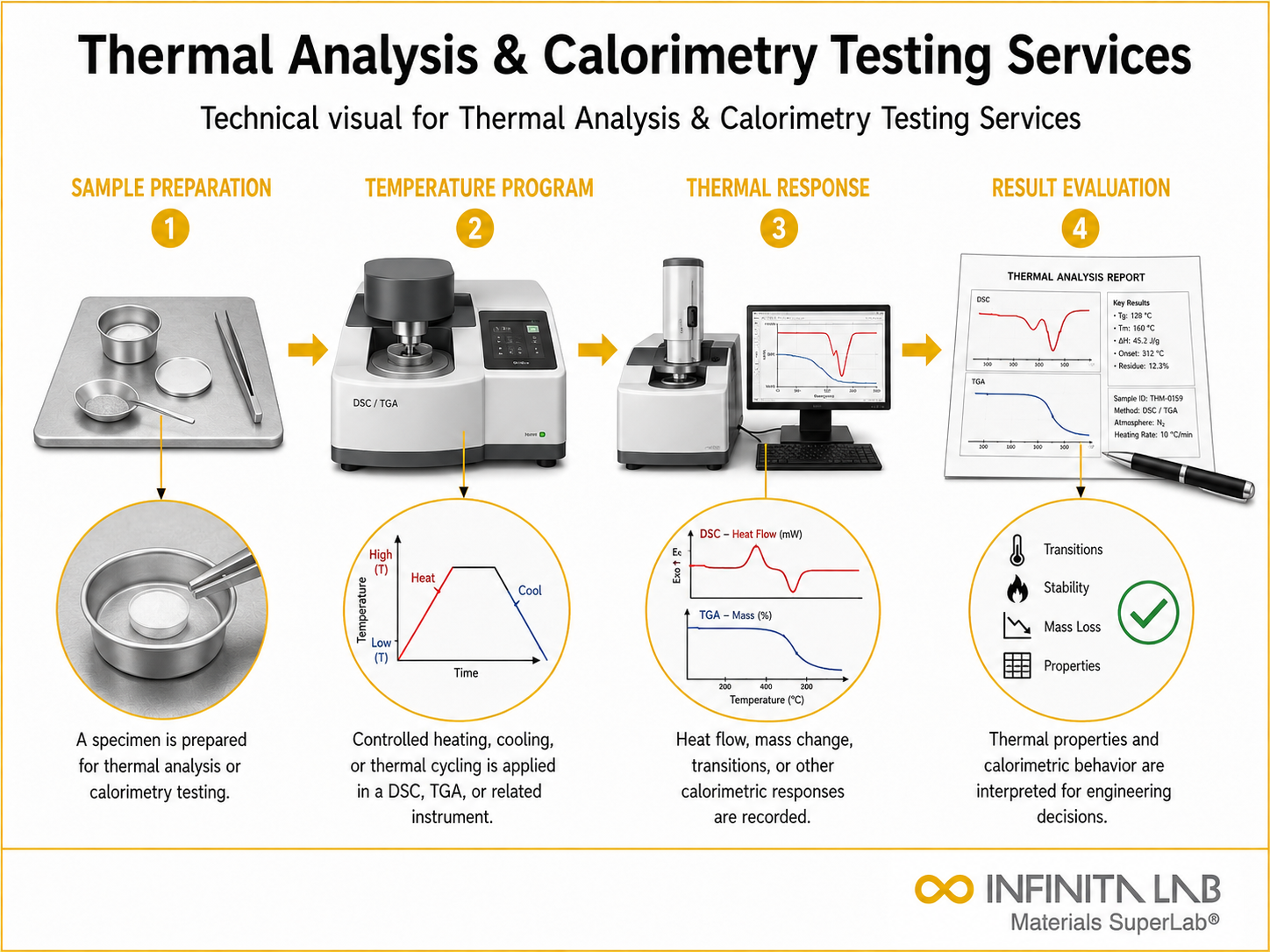
Thermal analysis and calorimetry testing are techniques used to study how material properties change with temperature. These methods measure parameters such as heat flow, mass change, and thermal transitions to understand material behavior under controlled heating or cooling conditions.
Common techniques include differential scanning calorimetry (DSC), thermogravimetric analysis (TGA), and differential thermal analysis (DTA). DSC measures heat flow during phase transitions, while TGA tracks weight changes due to decomposition or evaporation, providing comprehensive insight into thermal stability and composition.

Scope, Applications, and Benefits
Scope
Thermal analysis and calorimetry evaluate:
- Heat flow and energy changes (endothermic/exothermic)
- Phase transitions (melting, glass transition, crystallization)
- Thermal stability and decomposition behavior
- Mass change and composition analysis
- Heat capacity and reaction kinetics
Applications
- Polymers, plastics, and composites
- Pharmaceuticals and chemicals
- Metals and alloys
- Electronics and battery materials
- Food, coatings, and packaging
Benefits
- Provides detailed thermal behavior of materials
- Identifies phase transitions and degradation temperatures
- Supports material selection and product design
- Enables quality control and failure analysis
- Improves performance and thermal stability
Thermal Analysis and Calorimetry Test Process
Sample Preparation
Small sample is weighed and placed in crucible or pan.
1Temperature exposure
Controlled heating or cooling is applied at defined rate under selected atmosphere.
2Measurement
Heat flow (DSC/DTA) and/or mass change (TGA) is recorded continuously.
3Data Analysis
Thermal curves are analyzed to determine transitions, stability, and composition.
4Thermal Analysis and Calorimetry Technical Specifications
| Parameter | Details |
|---|---|
| Standards | ASTM E1269, ASTM E1131, ISO 11357 |
| Techniques | DSC, TGA, DTA, STA |
| Temperature Range | ~-150°C to 1600°C (instrument dependent) |
| Atmosphere | Nitrogen, oxygen, air, inert gases |
| Sample Size | ~5–50 mg (typical DSC/TGA) |
| Measured Outputs | Heat flow, mass change, transition temperatures |


Instrumentation Used for Testing
- Differential Scanning Calorimeter (DSC)
- Thermogravimetric Analyzer (TGA)
- Differential Thermal Analyzer (DTA)
- Simultaneous Thermal Analyzer (STA – DSC + TGA)
- Temperature-controlled furnace
- Gas flow control system
Results and Deliverables
- Heat flow vs temperature curves
- Mass loss vs temperature (TGA curve)
- Transition temperatures (Tm, Tg, Tc)
- Thermal stability and decomposition profile
- Material characterization and comparison
- Test report
Frequently Asked Questions
Thermal analysis and calorimetry testing evaluate how material properties change with temperature by measuring heat flow, mass change, and phase transitions, helping understand thermal stability, composition, and performance.
DSC measures heat flow associated with phase transitions, while TGA measures weight changes during heating, providing complementary information about thermal behavior and material composition.
Materials such as polymers, metals, ceramics, pharmaceuticals, composites, and food products can be analyzed to determine thermal properties, stability, and phase transitions under controlled temperature conditions.
Simultaneous Thermal Analysis (STA) combines DSC and TGA in one instrument, allowing measurement of both heat flow and mass change at the same time for comprehensive thermal characterization.
It helps in material selection, product design, and quality control by identifying thermal transitions, stability limits, and degradation behavior, ensuring reliable performance under temperature variations.
Why Choose Infinita Lab for Advanced Materials Testing and Characterization?
At the core of this breadth is our network of 2,000+ accredited laboratories across the USA, offering access to over 10,000 testing methods and analytical services. From advanced materials characterization (SEM, TEM, RBS, XPS) to mechanical, chemical, environmental, biological, and standardized ASTM/ISO-compliant testing, we deliver unmatched flexibility, specialization, and scale. You are never limited by geography, facility, or methodology — Infinita Lab connects you to the right expertise and testing solution, every time.

Looking for a Trusted Partner for Accurate and Reliable Testing Services?
Send query us at hello@infinitlab.com or call us at (888) 878-3090 to learn more about our services and how we can support you.



Request a Quote
Submit your material details and receive testing procedures, pricing, and turnaround time within 24 hours.
 Quick Turnaround and Hasslefree process
 Confidentiality Guarantee
 Free, No-obligation Consultation
 100% Customer Satisfaction
