


ASTM D3418: Differential Scanning Calorimetry Testing Services
Differential Scanning Calorimetry (DSC) is a thermoanalytical technique used extensively in material science to measure the temperatures and heat flows associated with thermal transitions in a material. It is important to understand the properties of polymers, pharmaceuticals, and other materials. This article focuses on DSC as defined by ASTM D3418, ASTM E1356, and ISO 11357.
TRUSTED BY


Get ASTM D3418 compliant results — request your differential scanning calorimetry testing quote
- Overview
- Scope, Applications, and Benefits
- Test Process
- Specifications
- Instrumentation
- Results and Deliverables
What Is ASTM D3418 Differential Scanning Calorimetry?
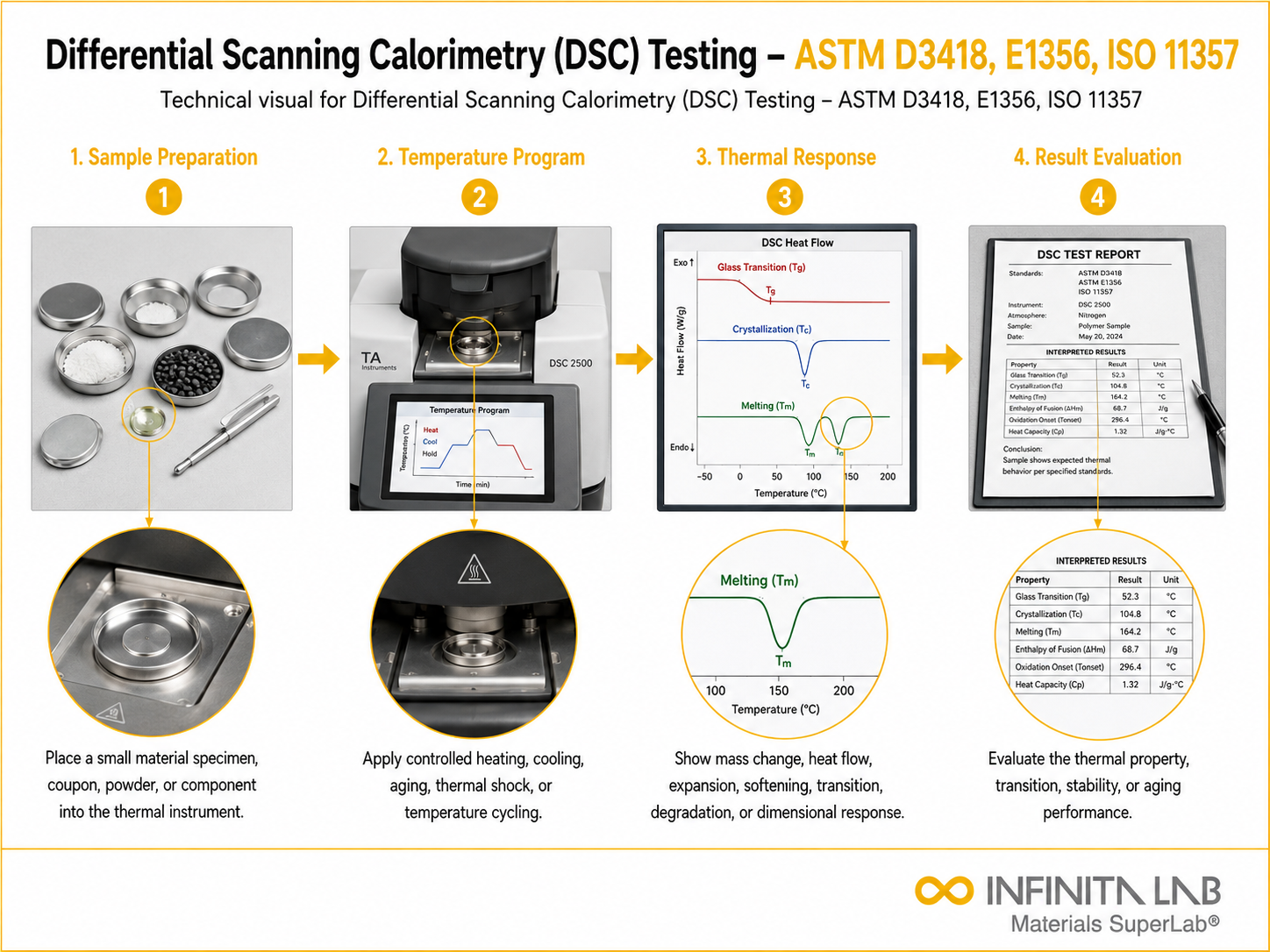
ASTM D3418, ASTM E1356, and ISO 11357 define test methods for Differential Scanning Calorimetry (DSC), used to measure thermal transitions in materials such as melting, crystallization, and glass transition temperature. DSC evaluates heat flow associated with temperature changes under controlled conditions.
These standards are widely used to characterize polymers, composites, and other materials by analyzing their thermal behavior. The test provides critical data for material identification, quality control, and performance evaluation, supporting product development and ensuring consistency in thermal properties.

Applications and Benefits of ASTM D3418 Differential Scanning Calorimetry Testing
Scope
These standards outline procedures for determining thermal properties of materials using DSC by measuring heat flow as a function of temperature or time under controlled heating or cooling conditions.
- Applicable to polymers, composites, and other materials
- Measures thermal transitions such as Tg, Tm, and Tc
- Uses controlled heating and cooling rates
- Provides quantitative heat flow data
- Suitable for quality control and research applications
- Supports material identification and comparison
- Enables evaluation of thermal stability and behavior
Applications
- Polymer and plastic characterization
- Quality control in material manufacturing
- Thermal analysis of composites
- Product development and research
- Failure analysis and material identification
Benefits
- Provides precise thermal property measurement
- Helps identify material composition and transitions
- Supports consistent product quality
- Enables comparison between materials
- Assists in optimizing processing conditions
Our ASTM D3418 Testing Procedure
Sample Preparation
Small sample is weighed and sealed in a DSC pan under controlled conditions.
1Instrument Setup
DSC instrument is calibrated with standard reference materials.
2Thermal Scanning
Sample is heated or cooled at a controlled rate to record heat flow changes.
3Data Analysis
Thermal transitions such as Tg, Tm, and enthalpy changes are determined.
4ASTM D3418 Test Parameters and Requirements
| Parameter | Details |
|---|---|
| Test Method | Differential Scanning Calorimetry (DSC) |
| Material Type | Polymers and composites |
| Measurement | Heat flow vs temperature |
| Temperature Range | Typically -150°C to 600°C |
| Heating Rate | Controlled (e.g., 10°C/min) |
| Sample Size | Few milligrams |
| Output | Tg, Tm, Tc, enthalpy |


- Differential Scanning Calorimeter (DSC)
- Sample pans and lids
- Analytical balance
- Gas supply system (nitrogen or air)
- Calibration standards
Equipment and Instrumentation Used for ASTM D3418 Testing
What You Receive: Test Report, Data, and Certification
- Glass transition temperature (Tg)
- Melting temperature (Tm)
- Crystallization temperature (Tc)
- Enthalpy values (ΔH)
- DSC thermogram and analysis report
ASTM D3418 Differential Scanning Calorimetry FAQs
DSC measures the difference in heat flow between a sample and an inert reference as heated or cooled. The differential change uncovered thermal transitions, like melting and crystallization, from which one can derive specific material properties, like the heat capacity and enthalpy changes.
They provide consistent and accurate measurements, which are meant to ensure the quality, performance, and safety of the material in every application.
The amount of sample size determines the acceptability and reliability of DSC results. Samples are often within a range of 5 to 20 milligrams. Maintaining consistent packing density, uniform thickness, also supports proper heat transfer and accurate measurement, thereby allowing proper analysis regarding heat flow and thermal transitions.
DSC is used mainly for material characterization, research and development of quality control, and testing of thermal stability. It allows the manufacturer to understand how materials behave in applications that require certain thermal properties, optimize processing conditions, and ensure performance in these applications.
DSC measures heat flow directly, while other methods may measure weight loss or dimensional changes, providing different types of information.
Why Choose Infinita Lab for Differential Scanning Calorimetry Testing
At the core of this breadth is our network of 2,000+ accredited laboratories across the USA, offering access to over 10,000 testing methods and analytical services. From advanced materials characterization (SEM, TEM, RBS, XPS) to mechanical, chemical, environmental, biological, and standardized ASTM/ISO-compliant testing, we deliver unmatched flexibility, specialization, and scale. You are never limited by geography, facility, or methodology — Infinita Lab connects you to the right expertise and testing solution, every time.

Need ASTM D3418 Differential Scanning Calorimetry Testing You Can Rely On?
Send query us at hello@infinitalab.com or call us at (888) 878-3090 to learn more about our services and how we can support you.



Request a Quote
Submit your material details and receive testing procedures, pricing, and turnaround time within 24 hours.
 Quick Turnaround and Hasslefree process
 Confidentiality Guarantee
 Free, No-obligation Consultation
 100% Customer Satisfaction
