


High Pressure Calorimetry Testing Services
High-Pressure Calorimetry is a technique to measure heat flow at constant temperatures or under self-heating conditions, used to measure material's properties and physical phenomena at elevated temperatures and pressures. It is applicable to petrochemical, polymer samples, and additive manufacturing powders and is useful for coolant liquids, crude oil, and flammable liquids. Cells can be pressurized up to 400 bar for specified pressures.
TRUSTED BY


Get compliant results — request your high pressure calorimetry testing quote
- Overview
- Scope, Applications, and Benefits
- Test Process
- Specifications
- Instrumentation
- Results and Deliverables
What Is High Pressure Calorimetry?
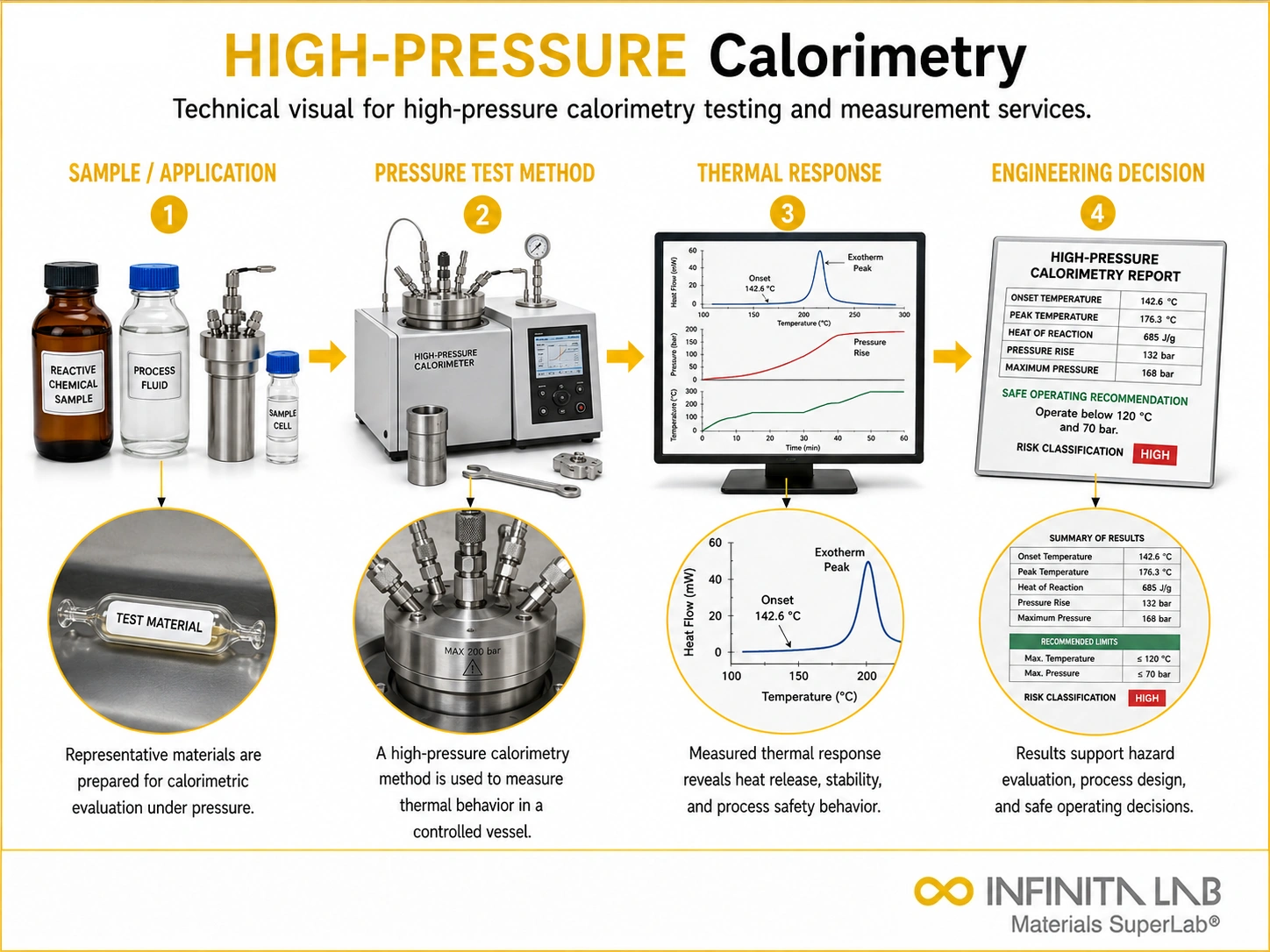
High-pressure calorimetry is a method that measures heat flow, energy changes, and chemical reactions in materials under high pressure. This testing is done to determine how materials react under extreme environmental conditions.
This type of testing is vital across various industries, such as chemical, oil & gas, pharmaceutical, and energy, where chemical reactions depend on pressure and temperature.

Applications and Benefits of High Pressure Calorimetry Testing
Scope
This test evaluates thermal properties and reaction behavior of materials at high pressures and controlled temperatures. It helps determine energy release, reaction kinetics, and thermal stability under real operating conditions.
It supports process safety, material development, and reaction optimization in high-pressure environments.
The scope includes:
Measurement of heat flow under high pressure
Evaluation of exothermic and endothermic reactions
Analysis of reaction kinetics and thermal stability
Testing under controlled temperature and pressure conditions
Support for safety assessment and process design
Applications
Chemical reaction analysis
Oil and gas processing systems
Energy storage and battery research
Material safety and hazard analysis
Benefits
Provides accurate thermal data under real conditions
Helps identify hazardous reactions
Supports safe process design and scale-up
Improves material and formulation development
Ensures compliance with safety standards
Our Testing Procedure
Sample Preparation
he sample is accurately weighed and sealed in a high-pressure calorimetry cell.
1Pressure and Temperature Setup
Required pressure and temperature conditions are established and stabilized.
2Heat Flow Measurement
Thermal reactions are monitored by measuring heat flow during controlled heating or cooling.
3Data Analysis
Results are analyzed to determine thermal properties, reaction behavior, and energy changes.
4Test parameters and requirements
| Parameter | Details |
|---|---|
| Material Tested | Solids, liquids, gases, and reactive chemicals. |
| Test Principle | Measurement of heat flow and energy changes under high-pressure conditions. |
| Pressure Range | From atmospheric up to several hundred bars. |
| Temperature Range | Sub-ambient to high temperatures depending on application. |
| Measured Parameters | Heat flow, enthalpy change, reaction rate, thermal stability. |
| Testing Environment | Sealed high-pressure calorimetry chamber. |


High-Pressure Calorimeter
Pressure Reactor/Calorimetry Cell
Temperature Control System
Heat Flow Sensors
Data Acquisition System
Equipment and Instrumentation Used for Testing
What You Receive: Test Report, Data, and Certification
Heat flow and enthalpy data
Reaction kinetics and thermal stability analysis
Identification of exothermic or endothermic behavior
Safety and hazard assessment data
Detailed calorimetry test report
High Pressure Calorimetry FAQs
It is a technique used to measure heat flow and energy changes of materials under elevated pressure conditions, helping evaluate thermal behavior, reaction kinetics, and safety in industrial processes.
It helps identify potentially hazardous reactions, ensuring safe handling, storage, and processing of materials, especially in industries where pressure and temperature significantly influence reaction behavior.
Key parameters include heat flow, enthalpy changes, reaction rates, and thermal stability, which help in understanding the energy behavior of materials.
Pressure can alter reaction rates, equilibrium conditions, and energy release, making it essential to test materials under realistic pressure conditions.
While DSC typically operates at atmospheric pressure, high-pressure calorimetry allows testing under elevated pressures, providing more realistic data for industrial applications.
Why Choose Infinita Lab for High Pressure Calorimetry Testing?
At the core of this breadth is our network of 2,000+ accredited laboratories across the USA, offering access to over 10,000 testing methods and analytical services. From advanced materials characterization (SEM, TEM, RBS, XPS) to mechanical, chemical, environmental, biological, and standardized ASTM/ISO-compliant testing, we deliver unmatched flexibility, specialization, and scale. You are never limited by geography, facility, or methodology — Infinita Lab connects you to the right expertise and testing solution, every time.

Looking for an Accredited Partner for High Pressure Calorimetry Testing?
Send query us at hello@infinitalab.com or call us at (888) 878-3090 to learn more about our services and how we can support you.



Request a Quote
Submit your material details and receive testing procedures, pricing, and turnaround time within 24 hours.
 Quick Turnaround and Hasslefree process
 Confidentiality Guarantee
 Free, No-obligation Consultation
 100% Customer Satisfaction
