


Plastic Pipe Failure Analysis Services
Pipe failure analysis is the process of looking into and figuring out what caused a pipe or pipeline to fail. For the transportation of fluids, gases, or other materials in a variety of industries, such as oil and gas, water distribution, chemical processing, and others, pipes are essential parts. Leaks, loss of containment, environmental risks, and possibly catastrophic events can occur when a pipe fails.
TRUSTED BY


Precision Testing Solutions for Accurate, Reliable, and Standards-Compliant Results
- Overview
- Scope, Applications, and Benefits
- Test Process
- Specifications
- Instrumentation
- Results and Deliverables
Pipe Failure Analysis – Overview
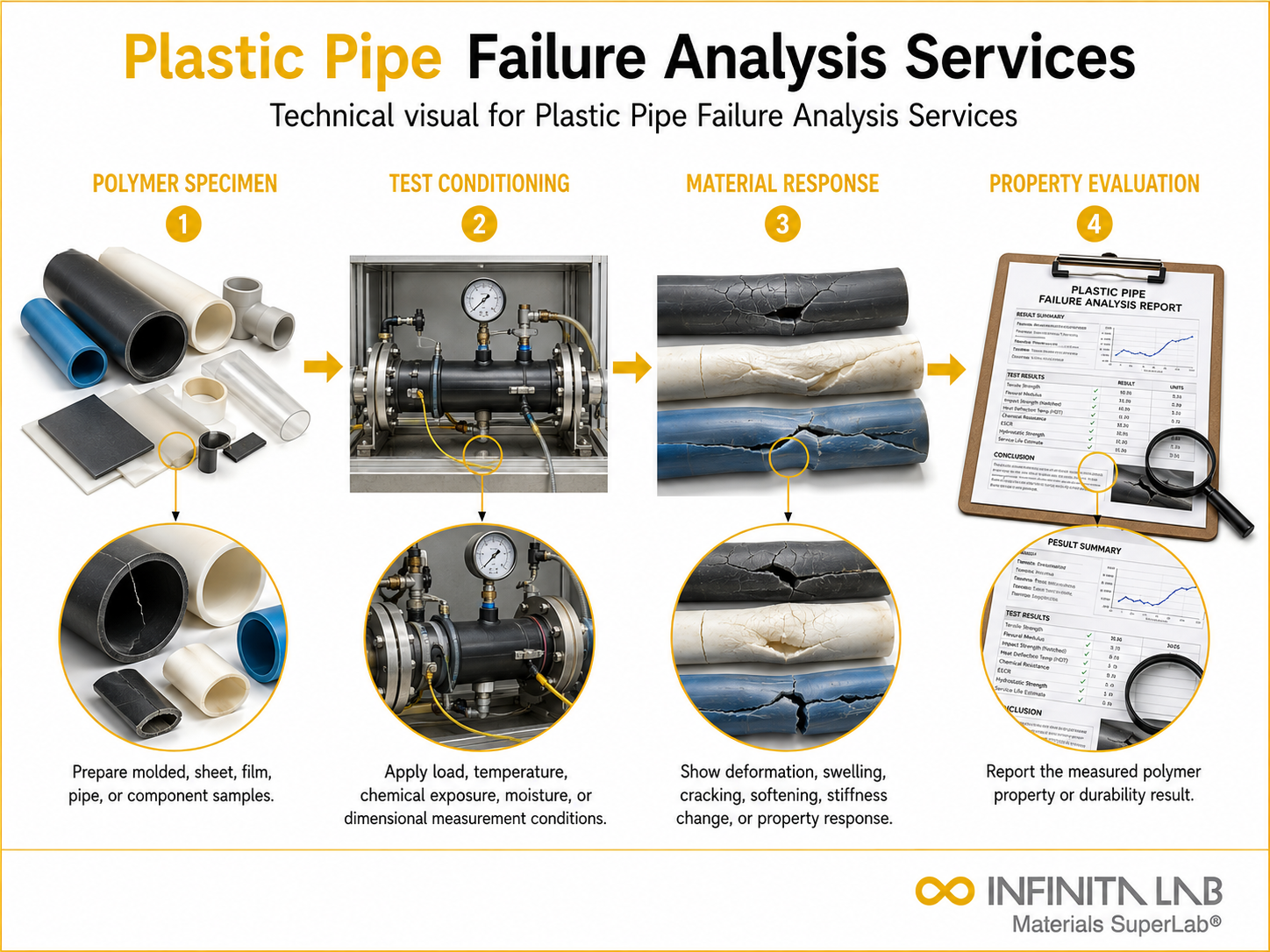
Pipe Failure Analysis investigates the root causes of pipe damage, leaks, or rupture by evaluating material behavior, environmental effects, and operational stresses. It helps identify whether failure resulted from corrosion, mechanical overload, manufacturing defects, or improper installation.
The analysis combines physical examination, material characterization, and performance evaluation to determine failure mechanisms. It supports corrective actions, improves system reliability, and prevents recurrence by providing detailed insights into structural integrity and service conditions affecting pipes across industries.

Scope, Applications, and Benefits
Scope
Pipe Failure Analysis focuses on identifying failure mechanisms and contributing factors in piping systems through systematic examination and testing under controlled conditions.
It includes evaluation of material degradation, stress conditions, environmental exposure, and operational parameters to determine the exact cause of failure and recommend preventive measures.
- Investigation of corrosion, erosion, and chemical degradation
- Analysis of mechanical overload and fatigue failure
- Evaluation of manufacturing defects and material inconsistencies
- Examination of installation and operational issues
- Assessment of environmental and service conditions
- Identification of crack initiation and propagation
- Testing of metallic and non-metallic pipes
- Root cause determination and failure classification
Applications
- Oil and gas pipelines
- Water supply and drainage systems
- Chemical processing plants
- Power generation facilities
- Industrial piping systems
- Infrastructure and construction projects
Benefits
- Identifies root causes of failure accurately
- Prevents recurrence of similar failures
- Improves system reliability and safety
- Supports maintenance and inspection strategies
- Enhances material and design selection
- Reduces operational and repair costs
Pipe Failure Analysis – Process
Sample Collection & Failure Site Documentation
Failed pipe sections are collected and visually documented to preserve evidence and understand failure conditions.
1Visual Inspection & Preliminary Damage Assessment
Surface features, fracture patterns, and deformation are examined to identify initial failure indicators.
2Material Testing & Mechanism Evaluation
Mechanical, chemical, and microstructural tests are conducted to determine degradation and failure mechanisms.
3Root Cause Analysis & Reporting
Findings are analyzed to identify the primary cause and provide recommendations for prevention and improvement.
4Pipe Failure Analysis – Technical Specification
| Parameter | Details |
|---|---|
| Test Method | Failure investigation using mechanical, chemical, and metallurgical analysis |
| Measurement Type | Crack behavior, corrosion rate, and material degradation |
| Sample Type | Metallic and non-metallic pipe sections |
| Loading Type | Evaluation under service-related stress conditions |
| Units | mm crack length, MPa stress, corrosion rate (mm/year) |
| Test Conditions | Ambient and simulated service environments |


Instrumentation Used for Testing
- Optical microscope
- Scanning electron microscope
- Hardness tester
- Chemical analysis instruments
- Ultrasonic testing equipment
- Surface characterization tools
Results and Deliverables
- Identification of failure mechanism
- Root cause analysis report
- Material degradation assessment
- Crack propagation analysis
- Corrosion evaluation results
- Preventive recommendations
Frequently Asked Questions
Failure analysis integrates visual inspection, material testing, and service condition evaluation to correlate evidence, distinguishing primary causes from secondary effects through systematic elimination and validation of possible failure mechanisms.
Fracture surfaces retain microscopic features such as striations, dimples, or brittle patterns that provide direct evidence of failure mode, including fatigue, overload, or corrosion-assisted cracking.
Corrosion gradually reduces wall thickness and weakens structural integrity, increasing susceptibility to rupture under pressure and accelerating crack initiation and propagation.
It ensures understanding of failure causes, enabling corrective actions to prevent recurrence, improve system integrity, and enhance operational safety across critical piping systems.
Crack propagation analysis helps determine the rate, direction, and mechanism of crack growth, providing insights into failure progression and identifying contributing factors such as fatigue, corrosion, or overload.
Why Choose Infinita Lab for Advanced Materials Testing and Characterization?
At the core of this breadth is our network of 2,000+ accredited laboratories across the USA, offering access to over 10,000 testing methods and analytical services. From advanced materials characterization (SEM, TEM, RBS, XPS) to mechanical, chemical, environmental, biological, and standardized ASTM/ISO-compliant testing, we deliver unmatched flexibility, specialization, and scale. You are never limited by geography, facility, or methodology — Infinita Lab connects you to the right expertise and testing solution, every time.

Looking for a Trusted Partner for Accurate and Reliable Testing Services?
Send query us at hello@infinitalab.com or call us at (888) 878-3090 to learn more about our services and how we can support you.



Request a Quote
Submit your material details and receive testing procedures, pricing, and turnaround time within 24 hours.
 Quick Turnaround and Hasslefree process
 Confidentiality Guarantee
 Free, No-obligation Consultation
 100% Customer Satisfaction
