


Weld Failure Analysis Services for Structural & Industrial Welds
Weld failure analysis is a systematic investigation process used to determine the root cause of failure in welded joints by examining defects, material behavior, and service conditions. It involves metallurgical, mechanical, and structural evaluation to identify issues such as fatigue, corrosion, or improper welding, enabling corrective actions and improved reliability.
TRUSTED BY


Precision Testing Solutions for Accurate, Reliable, and Standards-Compliant Results
- Overview
- Scope, Applications, and Benefits
- Test Process
- Specifications
- Instrumentation
- Results and Deliverables
Weld Failure Analysis – Overview
Weld failure analysis is a systematic investigation of failed welded joints to identify root causes such as design flaws, material defects, welding process issues, or service-related degradation. It involves metallurgical, mechanical, and chemical evaluations to understand how and why the weld failed under operational conditions.
This analysis is critical for preventing recurrence, improving weld quality, and ensuring structural integrity. It helps differentiate between fabrication defects and service-induced failures such as fatigue, corrosion, or overload, enabling corrective actions and optimization of welding procedures.

Scope, Applications, and Benefits
Scope
Weld failure analysis evaluates defects, degradation mechanisms, and root causes affecting welded joints under service or testing conditions.
- Identifies weld defects such as cracks, porosity, and inclusions
- Evaluates heat-affected zone (HAZ) and base material behavior
- Assesses mechanical, metallurgical, and environmental factors
- Determines failure mode such as fatigue, corrosion, or overload
- Supports root cause analysis and corrective actions
- Improves welding process control and reliability
Applications
- Structural weld failure investigation
- Pipeline and pressure vessel analysis
- Automotive and aerospace component failure
- Fabrication defect identification
- Quality control and assurance
- Accident and failure investigation
Benefits
- Identifies root cause of weld failure
- Prevents recurrence of similar failures
- Improves welding procedures and quality
- Enhances structural safety and reliability
- Supports compliance and certification
- Reduces operational risks and costs
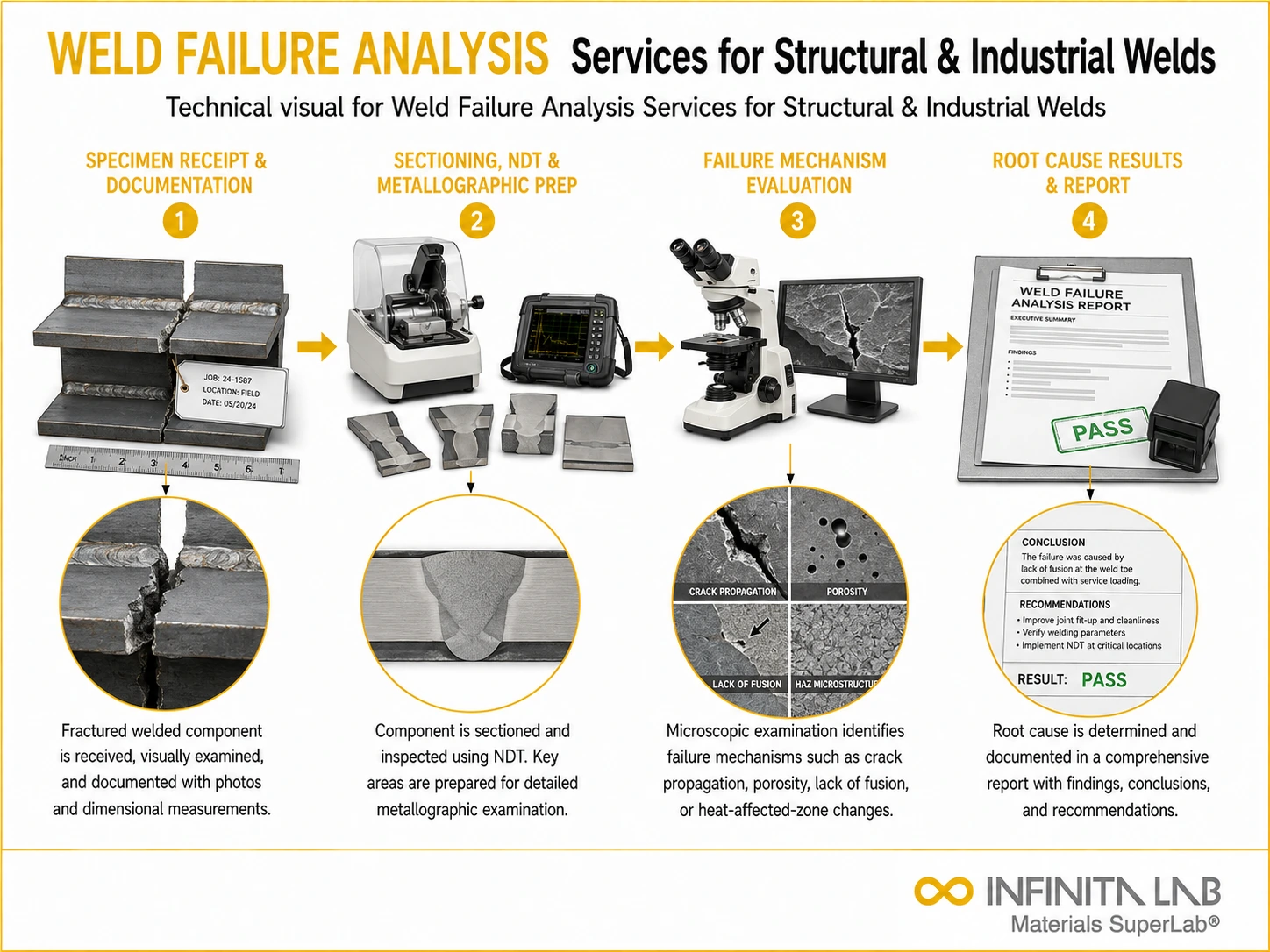
Weld Failure Analysis – Test Process
Visual and Preliminary Examination
The failed weld is inspected visually to identify fracture location, surface defects, and failure patterns.
1Non-Destructive Evaluation (NDT)
Techniques such as ultrasonic or radiographic testing are used to detect internal defects without damaging the sample.
2Metallurgical and Mechanical Analysis
Microstructure, hardness, and mechanical properties are evaluated to understand material behavior and failure mechanisms.
3Root Cause Determination
All findings are correlated to identify the primary cause and contributing factors of failure.
4Weld Failure Analysis – Technical Specifications
| Parameter | Details |
|---|---|
| Measurement Principle | Failure mechanism and root cause evaluation |
| Sample Type | Welded joints and components |
| Analysis Methods | Visual, NDT, metallography, mechanical testing |
| Failure Modes | Fatigue, corrosion, overload, brittle fracture |
| Test Basis | Microstructure, defects, and stress analysis |
| Output Units | Hardness (HV), stress data, defect size |


Instrumentation Used for Testing
- Optical microscope
- Scanning electron microscope (SEM)
- Ultrasonic testing equipment
- Radiography systems
- Hardness tester
- Chemical analysis instruments
Results and Deliverables
- Root cause analysis report
- Failure mode identification
- Microstructure and defect analysis
- Mechanical property evaluation
- Corrective action recommendations
- Technical investigation documentation
Frequently Asked Questions
The most critical step is accurate root cause identification through correlation of metallurgical evidence, defect morphology, and service conditions, as misinterpretation can lead to incorrect corrective actions and repeated failures.
Defects such as porosity, lack of fusion, or inclusions act as stress concentrators, promoting crack initiation under cyclic or static loads, which can propagate and cause premature failure.
The HAZ experiences microstructural changes due to thermal cycles, often resulting in reduced toughness or increased hardness, making it a common site for crack initiation and failure.
Brittle fracture occurs with little deformation and rapid crack propagation, while ductile failure involves significant plastic deformation and energy absorption.
Residual stresses from welding can combine with service loads, increasing the likelihood of crack initiation, distortion, or stress corrosion cracking.
Why Choose Infinita Lab for Advanced Materials Testing and Characterization?
At the core of this breadth is our network of 2,000+ accredited laboratories across the USA, offering access to over 10,000 testing methods and analytical services. From advanced materials characterization (SEM, TEM, RBS, XPS) to mechanical, chemical, environmental, biological, and standardized ASTM/ISO-compliant testing, we deliver unmatched flexibility, specialization, and scale. You are never limited by geography, facility, or methodology — Infinita Lab connects you to the right expertise and testing solution, every time.

Looking for a Trusted Partner for Accurate and Reliable Testing Services?
Send query us at hello@infinitlab.com or call us at (888) 878-3090 to learn more about our services and how we can support you.



Request a Quote
Submit your material details and receive testing procedures, pricing, and turnaround time within 24 hours.
 Quick Turnaround and Hasslefree process
 Confidentiality Guarantee
 Free, No-obligation Consultation
 100% Customer Satisfaction
