


Oil Molecular Weight Determination Testing Services
Determination of molecular weight is important for structural analysis and chemical investigation so that products can be derived from the oil. We will discuss the molecular weight determination of oils by using saponification value. There are many techniques used but as such no standard technique is adopted for finding the molecular weight of oils.
TRUSTED BY


Get compliant results — request your oil molecular weight determination testing quote
- Overview
- Scope, Applications, and Benefits
- Test Process
- Specifications
- Instrumentation
- Results and Deliverables
What Is Oil Molecular Weight Determination?
Molecular weight determination of oils is a critical analytical process used to evaluate the average molecular mass and distribution of compounds present in oils, including triglycerides, fatty acids, and hydrocarbons. This parameter plays a key role in understanding oil properties, including viscosity, stability, volatility, and performance across various applications.
Oils are complex mixtures of compounds with varying molecular sizes, making their characterization essential in industries such as petrochemicals, food processing, lubricants, and cosmetics. Advanced analytical techniques are used to determine both number-average (Mn) and weight-average (Mw) molecular weights, enabling accurate prediction of behavior during processing and end-use performance.

Applications and Benefits of Oil Molecular Weight Determination Testing
Scope
Molecular weight determination evaluates:
- Average molecular weight (Mn, Mw)
- Molecular weight distribution (MWD)
- Degree of polymerization or degradation
- Structural composition of oils
- Correlation with viscosity and stability
Applications
- Edible oils and food-grade products
- Lubricants and industrial oils
- Petrochemical and crude oil fractions
- Bio-oils and renewable fuels
- Cosmetics and specialty chemical oils
Benefits
- Enables prediction of viscosity and flow behavior
- Supports formulation and product development
- Helps assess oil stability and degradation
- Ensures consistency in manufacturing processes
- Provides insight into chemical composition
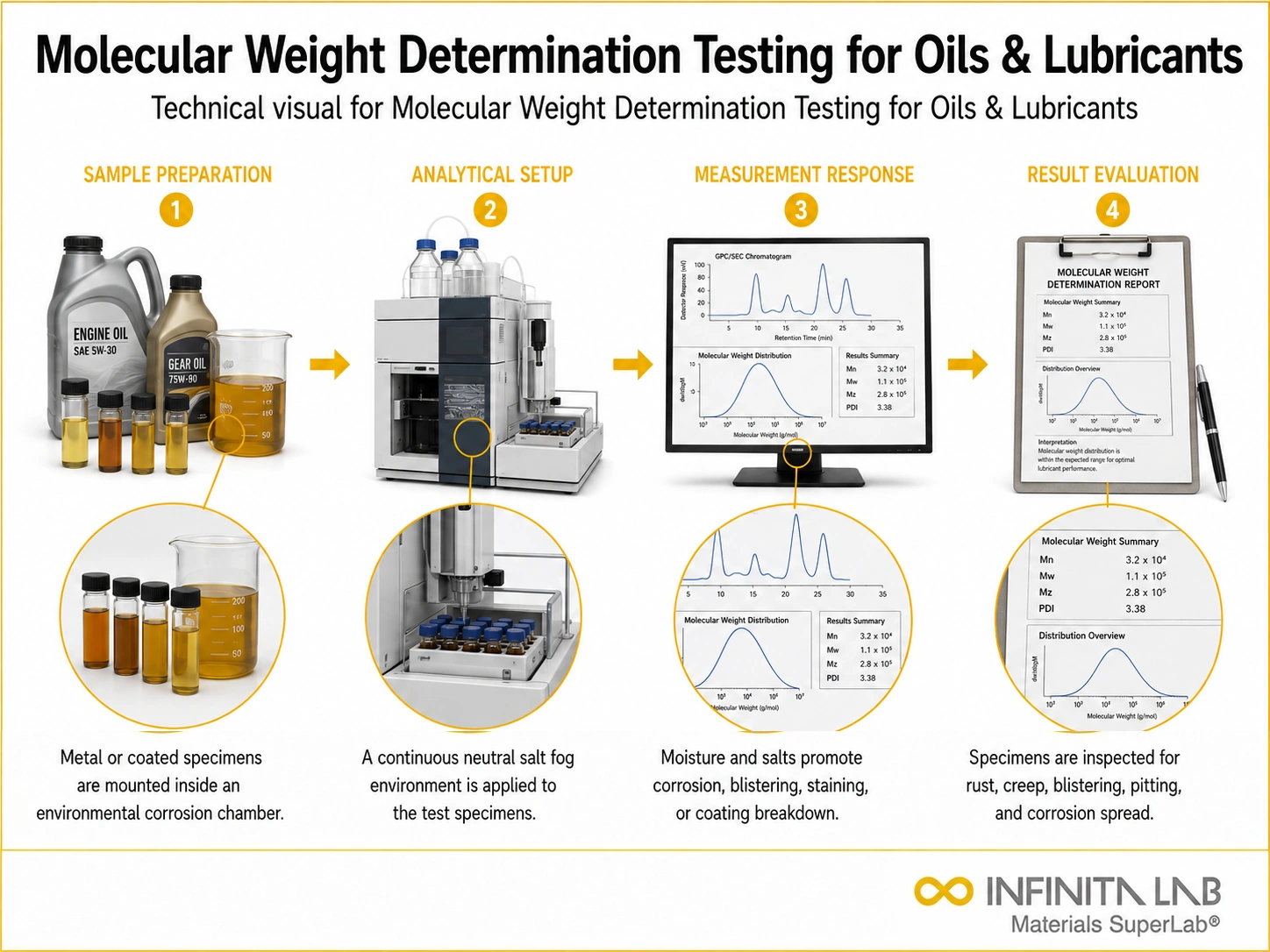
Our Testing Procedure
Sample Preparation
Oil sample is dissolved in a suitable solvent to ensure uniform analysis.
1Separation / Interaction
Techniques such as GPC separate molecules based on size, or chemical reactions (e.g., saponification) are performed.
2Detection / Measurement
Instruments measure molecular size, mass-to-charge ratio, or vapor pressure changes.
3Data Analysis
Average molecular weight and distribution are calculated from analytical data.
4Test parameters and requirements
| Parameter | Details |
|---|---|
| Standards / Methods | ASTM (petroleum analysis), GPC, VPO, Mass Spectrometry |
| Test Principle | Size-based separation or physicochemical interaction measurement |
| Measurement Range | ~100 to >100,000 Da (depending on oil type) |
| Sample Type | Liquid oils, lubricants, bio-oils |
| Outputs | Mn, Mw, molecular weight distribution |


- Gel Permeation Chromatography (GPC) system
- Mass spectrometer (MS)
- Vapor pressure osmometer (VPO)
- Gas chromatography (GC) system
- Analytical balance and solvent systems
- Data acquisition and analysis software
Equipment and Instrumentation Used for Testing
What You Receive: Test Report, Data, and Certification
- Number-average molecular weight (Mn)
- Weight-average molecular weight (Mw)
- Molecular weight distribution (MWD curve)
- Structural composition insights
- Comparative analysis across oil samples
- Test report
Oil Molecular Weight Determination FAQs
It is the process of measuring the average molecular mass and distribution of compounds in oils to understand their chemical composition and performance characteristics.
Common methods include Gel Permeation Chromatography (GPC), Mass Spectrometry (MS), and Vapor Pressure Osmometry (VPO), each providing different levels of detail and accuracy.
Saponification value can be used to estimate average molecular weight, as it relates to the amount of alkali required to react with fatty acids in oils.
Molecular weight affects viscosity, volatility, thermal stability, and overall performance, making it essential for formulation, processing, and quality control.
Industries such as petrochemicals, food processing, cosmetics, lubricants, and biofuels rely on molecular weight determination for product development and quality evaluation.
Why Choose Infinita Lab for Oil Molecular Weight Determination Testing
At the core of this breadth is our network of 2,000+ accredited laboratories across the USA, offering access to over 10,000 testing methods and analytical services. From advanced materials characterization (SEM, TEM, RBS, XPS) to mechanical, chemical, environmental, biological, and standardized ASTM/ISO-compliant testing, we deliver unmatched flexibility, specialization, and scale. You are never limited by geography, facility, or methodology — Infinita Lab connects you to the right expertise and testing solution, every time.

Looking for an Accredited Partner for Oil Molecular Weight Determination Testing?
Send query us at hello@infinitalab.com or call us at (888) 878-3090 to learn more about our services and how we can support you.



Request a Quote
Submit your material details and receive testing procedures, pricing, and turnaround time within 24 hours.
 Quick Turnaround and Hasslefree process
 Confidentiality Guarantee
 Free, No-obligation Consultation
 100% Customer Satisfaction
