


Noise Testing Services
Noise testing is used to determine how well materials can withstand external noise sources. It involves air-borne and structure-borne noise measurements and is tested against various standards including MIL-STD-810, MIL-S-3928, and ASTM C423-66. It provides important insights into the performance and safety of a material, helping to ensure it is suitable for its intended environment.
TRUSTED BY


Get compliant results — request your noise testing quote
- Overview
- Scope, Applications, and Benefits
- Test Process
- Specifications
- Instrumentation
- Results and Deliverables
What Is Noise?
Noise measurement evaluates sound levels generated by equipment, environments, or processes to determine compliance with permissible exposure limits and assess potential impact on human health and system performance. It focuses on quantifying sound pressure levels and frequency characteristics under controlled or real-world conditions.
The test involves capturing sound using calibrated instruments and analyzing parameters such as intensity, frequency distribution, and time variation. Accurate noise measurement supports risk assessment, regulatory compliance, and design improvements by identifying excessive noise sources and enabling effective mitigation strategies.

Applications and Benefits of Noise Testing
Scope
Noise measurement focuses on assessing sound levels and characteristics in various environments to evaluate compliance, safety, and performance under standardized measurement conditions.
- Measurement of sound pressure levels and frequency distribution
- Evaluation of environmental and occupational noise exposure
- Identification of noise sources and patterns
- Assessment of compliance with permissible limits
- Monitoring of noise variations over time
Applications
- Industrial workplace noise assessment
- Environmental noise monitoring
- Machinery and equipment noise evaluation
- Building acoustics analysis
- Transportation and infrastructure noise studies
- Product noise performance testing
Benefits
- Ensures compliance with noise regulations
- Protects human health from excessive noise exposure
- Identifies sources of noise for corrective action
- Improves product and environmental design
- Supports occupational safety programs
- Enhances comfort and productivity
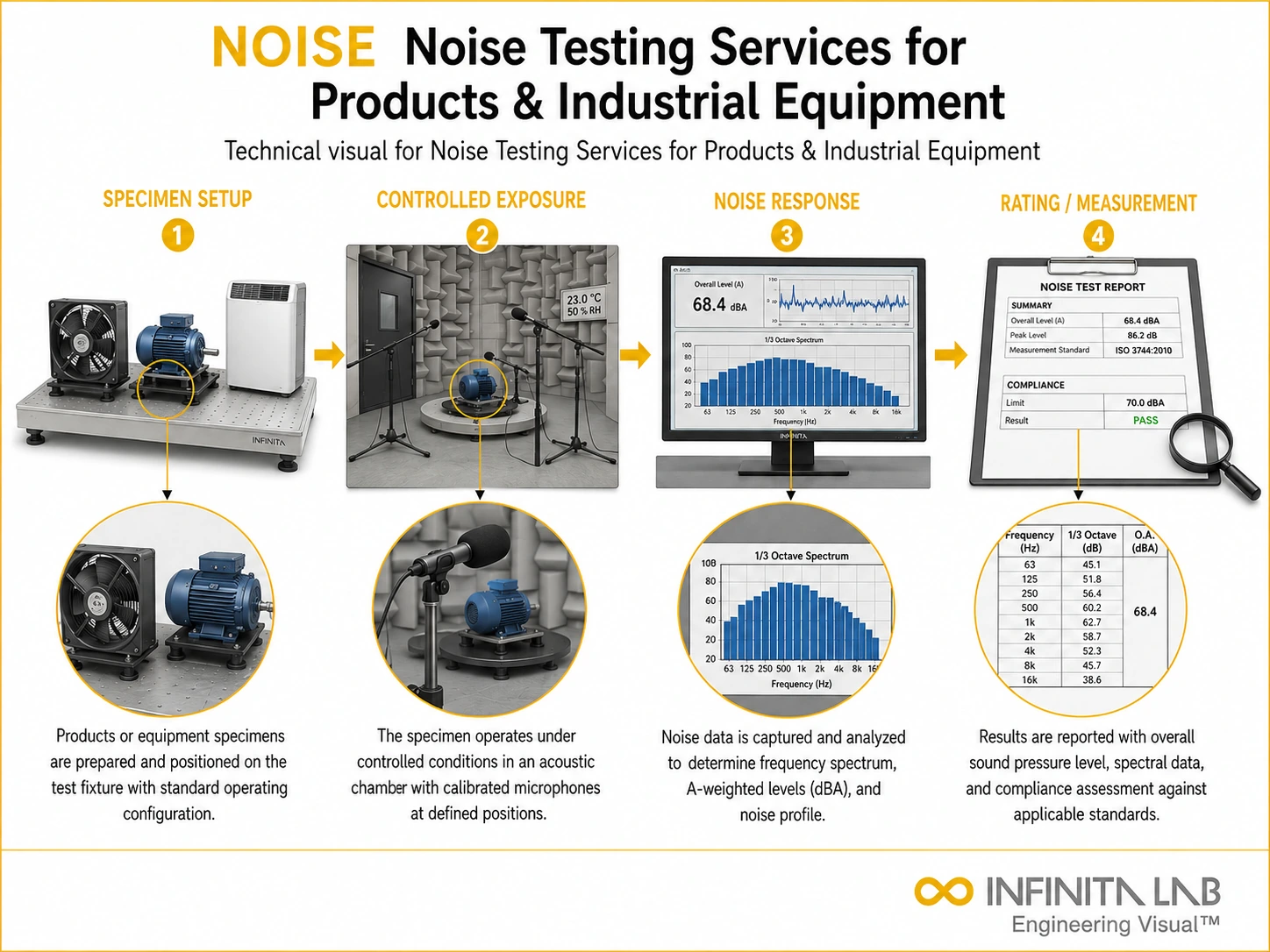
Our Testing Procedure
Instrument Setup & Calibration
Sound level meter is calibrated and configured with appropriate weighting and measurement parameters.
1Measurement Execution
Noise levels are recorded at specified locations and durations under defined environmental conditions.
2Data Logging & Analysis
Recorded data is analyzed for sound pressure levels, frequency content, and time variations.
3Result Evaluation & Reporting
Results are compared with regulatory limits and compiled into a detailed analytical report.
4Test parameters and requirements
| Parameter | Details |
|---|---|
| Measurement Parameter | Sound pressure level (SPL) and frequency spectrum |
| Frequency Range | Typically 20 Hz to 20 kHz depending on application |
| Weighting Scale | A-weighting, C-weighting, or Z-weighting as required |
| Measurement Mode | Continuous, equivalent (Leq), or peak level measurement |
| Instrument Class | Class 1 or Class 2 sound level meter as per standards |
| Time Weighting | Fast, slow, or impulse response settings |
| Environmental Conditions | Controlled or field conditions with minimal interference |


- Sound level meter
- Acoustic calibrator
- Frequency analyzer
- Data logger
- Microphone with windscreen
- Tripod for stable positioning
Equipment and Instrumentation Used for Testing
What You Receive: Test Report, Data, and Certification
- Sound pressure level readings (dB, dB(A), dB(C))
- Equivalent continuous noise level (Leq)
- Frequency analysis results
- Noise exposure assessment report
- Compliance status with regulatory limits
- Recommendations for noise control measures
Noise FAQs
Noise measurement quantifies sound levels to assess exposure risks and compliance with regulations. It is important because excessive noise can cause hearing damage, reduce productivity, and impact environmental quality, making accurate measurement essential for control and mitigation.
dB represents raw sound pressure level, while dB(A) applies frequency weighting to reflect human hearing sensitivity. dB(C) is used for higher sound levels and low-frequency evaluation, providing a more accurate representation of certain noise conditions.
Leq is the equivalent continuous sound level representing fluctuating noise over time as a single value. It provides a practical measure of overall noise exposure for comparison with regulatory limits.
Environmental conditions such as wind, reflections, background noise, and instrument positioning can affect accuracy. Proper setup and controls are essential for reliable measurements.
Time weighting controls how quickly the instrument responds to changes in sound levels. Fast, slow, and impulse settings are used depending on the type of noise being measured.
Why Choose Infinita Lab for Noise Testing
At the core of this breadth is our network of 2,000+ accredited laboratories across the USA, offering access to over 10,000 testing methods and analytical services. From advanced materials characterization (SEM, TEM, RBS, XPS) to mechanical, chemical, environmental, biological, and standardized ASTM/ISO-compliant testing, we deliver unmatched flexibility, specialization, and scale. You are never limited by geography, facility, or methodology — Infinita Lab connects you to the right expertise and testing solution, every time.

Looking for an Accredited Partner for Noise Testing?
Send query us at hello@infinitalab.com or call us at (888) 878-3090 to learn more about our services and how we can support you.



Request a Quote
Submit your material details and receive testing procedures, pricing, and turnaround time within 24 hours.
 Quick Turnaround and Hasslefree process
 Confidentiality Guarantee
 Free, No-obligation Consultation
 100% Customer Satisfaction
