


Liquid Fuel Testing Services
Fuel testing laboratories in the power plant industry provide comprehensive services to ensure the highest quality of indigenous fuels. Testing includes a variety of fuels such as coal, jet, diesel, and #6 fuel, as well as biomass products and other materials. Diesel fuel testing laboratories are certified for use in nuclear power plants and can test for stack emissions and sites affected by petroleum products and oil spills.
TRUSTED BY


Get compliant results — request your liquid fuel testing quote
- Overview
- Scope, Applications, and Benefits
- Test Process
- Specifications
- Instrumentation
- Results and Deliverables
What Is Liquid Fuel?
Liquid fuel testing evaluates the physical, chemical, and performance properties of fuels such as gasoline, diesel, aviation fuel, and biofuels to ensure quality, efficiency, and compliance with standards. It plays a critical role in determining combustion behavior, storage stability, and engine compatibility.
These tests measure parameters like viscosity, density, flash point, sulfur content, and calorific value. Accurate testing helps optimize fuel performance, reduce emissions, and prevent engine damage. Liquid fuel testing is essential for refining processes, quality control, regulatory compliance, and ensuring safe handling and transportation.

Applications and Benefits of Liquid Fuel Testing
Scope
Liquid fuel testing covers comprehensive evaluation of fuel properties to ensure performance, safety, and regulatory compliance across various industrial and energy applications.
- Applicable to gasoline, diesel, aviation fuels, and biofuels
- Evaluates physical properties such as density and viscosity
- Assesses chemical composition including sulfur and contaminants
- Measures combustion characteristics and energy content
- Determines flash point and fire safety parameters
- Supports quality control and refinery operations
- Applicable for storage stability and degradation analysis
- Ensures compliance with international fuel standards
- Used for both raw and refined fuel products
Applications
- Quality control in petroleum refining
- Fuel performance evaluation for engines
- Aviation fuel safety assessment
- Environmental compliance and emission control
- Storage and transportation stability analysis
Benefits
- Ensures fuel quality and consistency
- Improves engine performance and efficiency
- Reduces emissions and environmental impact
- Enhances safety in handling and storage
- Supports compliance with regulatory standards
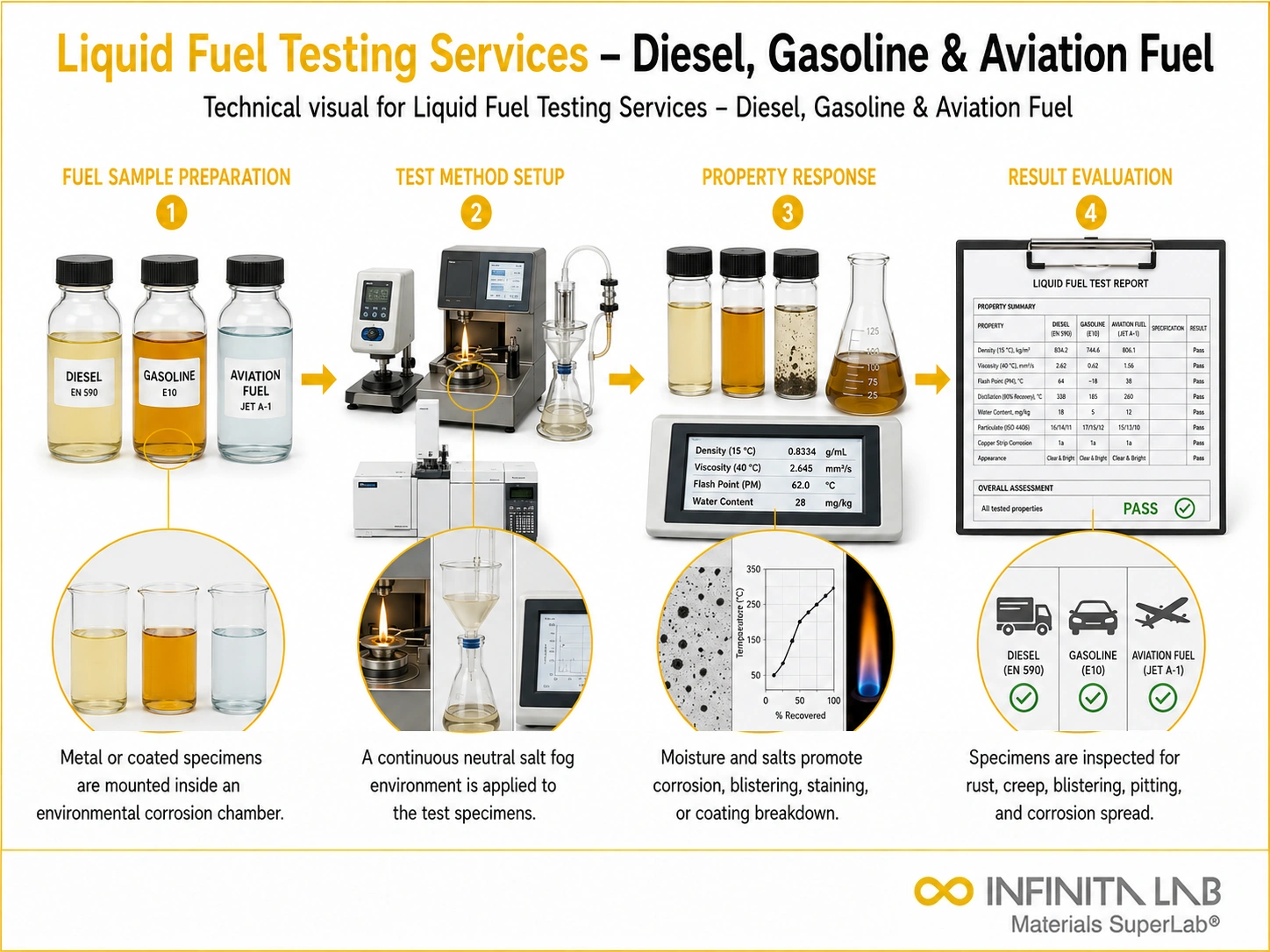
Our Testing Procedure
Sample Collection
Fuel sample is collected under controlled conditions to avoid contamination.
1Property Measurement
Physical and chemical properties are analyzed using standardized methods.
2Combustion Evaluation
Key parameters like calorific value and ignition characteristics are determined.
3Data Analysis
Results are compared with standards to assess quality and compliance.
4Test parameters and requirements
| Parameter | Details |
|---|---|
| Method | Physical, chemical, and combustion property analysis |
| Measurement Type | Density, viscosity, flash point, sulfur content, calorific value |
| Sample Type | Liquid fuels (gasoline, diesel, aviation fuel, biofuels) |
| Loading Type | Thermal, chemical, and analytical testing conditions |
| Units | kg/m³, cSt, °C, wt%, MJ/kg |
| Temperature Range | Ambient to elevated depending on test method |


- Viscometer
- Density meter (hydrometer or digital densitometer)
- Flash point tester
- Bomb calorimeter
- Gas chromatograph (GC)
- Sulfur analyzer
Equipment and Instrumentation Used for Testing
What You Receive: Test Report, Data, and Certification
- Fuel property analysis report
- Density, viscosity, and flash point data
- Sulfur content and composition analysis
- Calorific value and combustion performance
- Compliance and certification report
Liquid Fuel FAQs
Properties like viscosity, volatility, and calorific value directly affect atomization, ignition delay, and burn rate. Optimized values ensure efficient combustion, better energy release, reduced fuel consumption, and lower emissions in engines and combustion systems.
High sulfur levels lead to corrosion, catalyst poisoning, and harmful emissions such as sulfur oxides. Strict limits are enforced to protect engines and reduce environmental impact.
Viscosity controls fuel flow and atomization during injection. High viscosity can cause poor spray patterns, while low viscosity may reduce lubrication, both affecting engine performance.
Reducing sulfur improves emission control system efficiency and reduces SOx emissions. However, it also removes natural lubricants, requiring additives to maintain fuel system protection and performance.
Cold flow properties determine fuel behavior at low temperatures. Poor performance leads to wax crystallization, filter clogging, and restricted fuel flow, affecting engine operation in cold climates.
Why Choose Infinita Lab for Liquid Fuel Testing?
At the core of this breadth is our network of 2,000+ accredited laboratories across the USA, offering access to over 10,000 testing methods and analytical services. From advanced materials characterization (SEM, TEM, RBS, XPS) to mechanical, chemical, environmental, biological, and standardized ASTM/ISO-compliant testing, we deliver unmatched flexibility, specialization, and scale. You are never limited by geography, facility, or methodology — Infinita Lab connects you to the right expertise and testing solution, every time.

Looking for an Accredited Partner for Liquid Fuel Testing?
Send query us at hello@infinitalab.com or call us at (888) 878-3090 to learn more about our services and how we can support you.



Request a Quote
Submit your material details and receive testing procedures, pricing, and turnaround time within 24 hours.
 Quick Turnaround and Hasslefree process
 Confidentiality Guarantee
 Free, No-obligation Consultation
 100% Customer Satisfaction
